Most people who reach this page are Alabama RNs finishing a bachelor's, and the placement you actually need is a community or population health field experience, not another hospital rotation. In Alabama that work happens inside county health departments, community health centers, school and workplace health, home health and hospice, and non-profit programs, with an experienced nurse or a program supervisor signing on as preceptor. We help you find and confirm an approvable site and preceptor, and we tell you plainly when your program already arranges clinicals for you.
Last updated July 2026
Two very different students search for a preceptor in Alabama. Prelicensure BSN students in a traditional or accelerated track usually have hospital clinicals scheduled by their school, so most of them do not need to self-source. The larger group we serve is RN-to-BSN students, already licensed and often working, who have to arrange one community or public health field experience near the end of the program.
If you are in the first group, your school placement office is your first call, and we can still help with the occasional self-source gap. If you are in the second group, this page is built for you.
The community practicum is meant to put you in a population health setting rather than at a bedside. Across Alabama, students commonly complete it in places like these:
The Alabama Department of Public Health runs county health departments in all 67 counties and employs hundreds of public health nurses, which makes a health department one of the more reliable settings to approach for a project.
Alabama concentrates its clinical and public health infrastructure in a handful of metros. Birmingham is the largest medical hub, followed by Montgomery, Mobile on the Gulf coast, Huntsville in the north, and Tuscaloosa. In and around these cities you will find the widest choice of health departments, clinics, and non-profit programs, so a field experience site and a willing preceptor are easier to line up.
Most of Alabama is rural. A majority of the state's 67 counties are classed as rural, including the Black Belt across the center of the state, where health professional shortages are common. If you live in one of these areas, a local county health department, a rural health clinic, a school system, or a home health agency is often the most practical site, and starting early matters because one qualified nurse may be the only preceptor within a reasonable drive.
For a community or population health field experience, your preceptor is generally an experienced registered nurse or an appropriate professional in the setting. That can be a public health nurse, a school nurse, a home health or hospice nurse, an occupational health nurse, or a community program supervisor. The preceptor does not have to be an advanced practice nurse, and this experience is about population health work rather than diagnosis or treatment.
Every program keeps its own rules about a preceptor's degree, license, and years of experience, so confirm the exact criteria with your school before you commit to a site. Our job is to match you with someone who fits both the setting and your program's checklist.
There is no national clinical hour requirement for the BSN. The current national education standards are competency based and set no fixed hour count, so your number comes from your own program. In practice, RN-to-BSN community field experiences tend to fall somewhere in the range of roughly 30 to 120 hours, and the total is decided by your school, not by the state.
Because the figure varies so widely, always confirm your requirement with your program before you build a schedule. Our BSN clinical hours guide explains the ranges, and RN-to-BSN field experience walks through how the practicum usually runs.
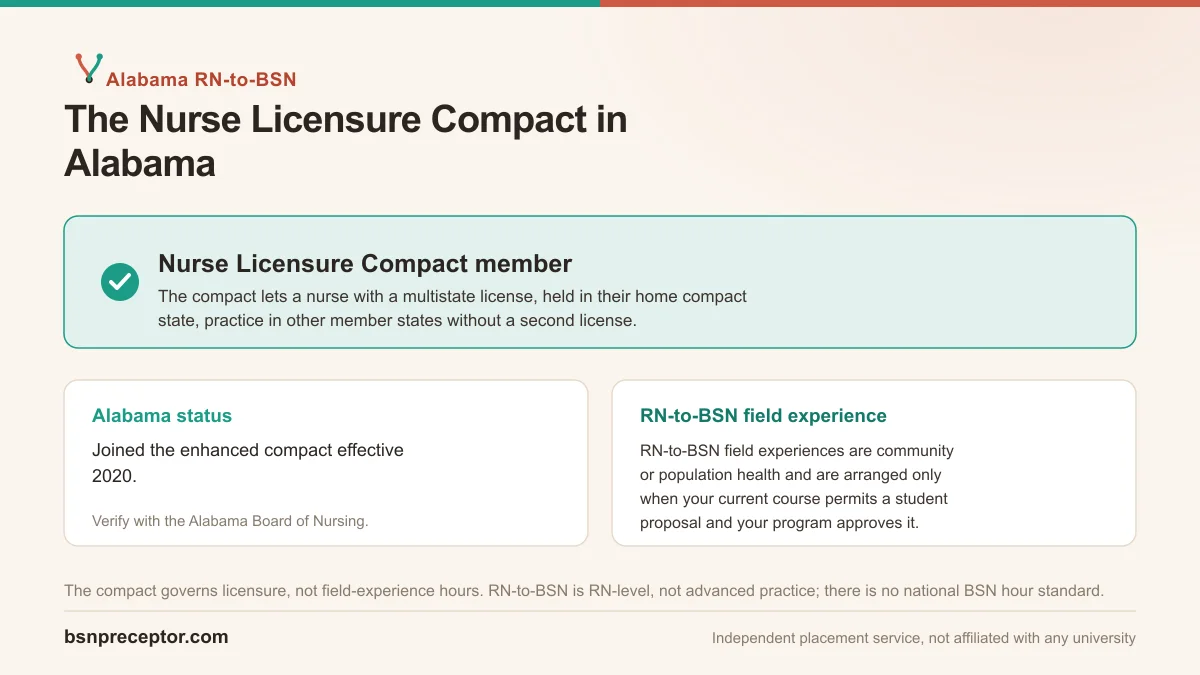
Alabama is a member of the Nurse Licensure Compact. It joined the enhanced compact effective January 1, 2020, which means a nurse who holds a multistate license with Alabama as the home state can practice in other compact states, and nurses from other compact states can practice in Alabama. This matters for RN-to-BSN students because so many are working nurses, and many programs enroll students across state lines.
Registered nurse licensing in the state is handled by the Alabama Board of Nursing, which issues licenses by examination and by endorsement and sets renewal and continuing education rules. If you are licensed elsewhere and doing a field experience in Alabama, check whether your multistate license covers you or whether you need an Alabama license, and confirm current details with the board.
Tell us your city, your program, and your timeline, and we look for a community or public health site with a preceptor who can meet your school's criteria. There is no cost to ask, and nothing is billed until a match is confirmed and your program signs off. See how it works and our cost page, then send your details through the request form or contact us.
It depends on your path. Prelicensure students usually have clinical rotations arranged by their school. RN-to-BSN students normally self-source a community or public health field experience, and that is where we help most. See RN-to-BSN field experience.
There is no statewide or national number. Totals are set by your program and commonly land in the range of about 30 to 120 hours. Confirm your exact requirement with your school and see BSN clinical hours.
Usually yes. A community or population health field experience can be precepted by an experienced registered nurse or an appropriate professional such as a public health nurse or a community program supervisor. It does not have to be an advanced practice nurse. Your program sets the final criteria.
Yes. Alabama joined the enhanced Nurse Licensure Compact effective January 1, 2020. A multistate license held in a compact home state can be used in Alabama and other compact states. Confirm your status with the Alabama Board of Nursing.
No. We are an independent service and we help you find and confirm an approvable site and preceptor, but final approval always rests with your program. We will tell you honestly if your school already arranges your clinicals.
Outside sourcing applies only when the current program explicitly permits or requires a student-proposed preceptor, mentor, or site. An advisor reviews the course instructions before candidate sourcing begins.
We do not guarantee placement. Final approval rests with your program.
