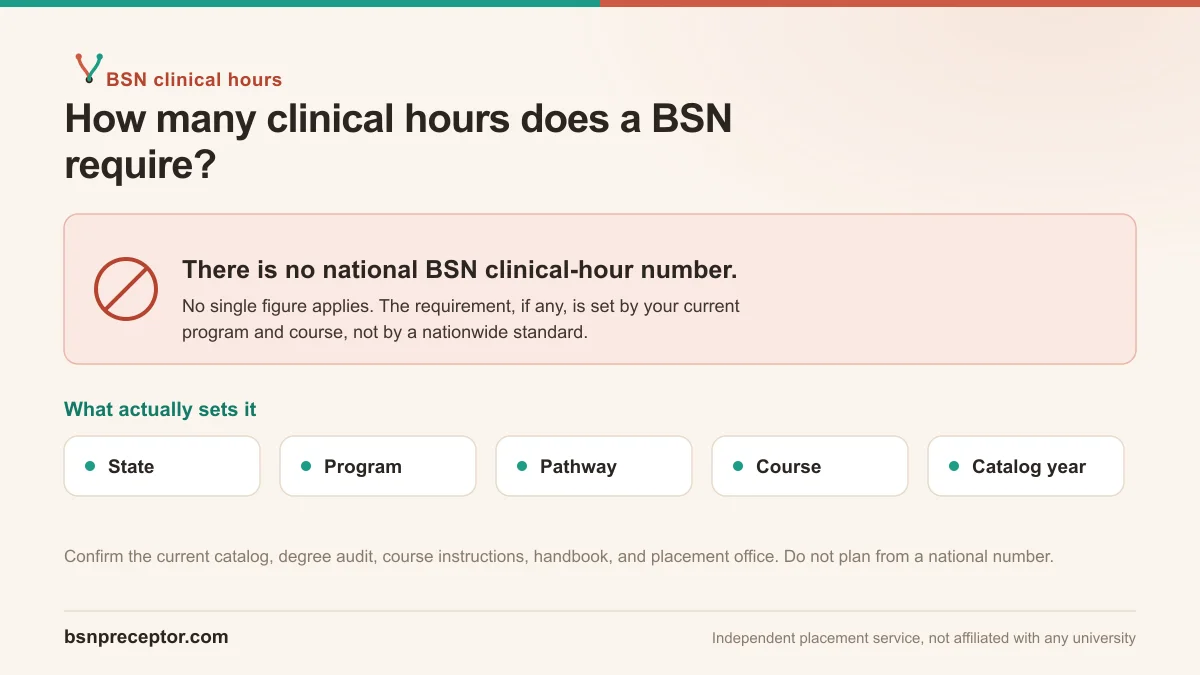
There is no universal BSN clinical or field-experience total. Requirements vary by state, program, pathway, course, and catalog year. Start by confirming the student's current pathway, the course instructions, and whether the nursing program coordinates the experience or explicitly permits a student proposal.
Last updated July 2026
There is no national numeric clinical-hour standard for the BSN. The 2021 AACN Essentials, which frame today's nursing curricula, are competency-based: they describe the practice competencies a graduate must demonstrate rather than prescribing a required hour count for entry-level programs. That is a deliberate shift away from counting hours and toward measuring what a student can actually do.
State requirements and accreditation expectations also shape prelicensure nursing education, but neither supplies one national BSN hour total. The current program and state requirements determine the experiences that apply to a particular student.
The practical takeaway is to confirm the active catalog, degree audit, course instructions, handbook, and placement office. Do not plan from a national number or a figure reported by a student in a different pathway or catalog year.
Traditional and accelerated prelicensure clinical placements are generally coordinated by the nursing program through approved sites, faculty oversight, and affiliation agreements. Students on that path should use the program's placement process. Outside sourcing is appropriate only when current written instructions explicitly allow a student to propose a person or site.
A confirmed post-licensure or RN-to-BSN course may include an applied community, population-health, education, leadership, quality, or care-coordination experience. That possibility does not mean every post-licensure program requires field work or student sourcing. The current course determines the objective, setting, person, hours, and placement ownership.
Accreditation confirms degree-level quality review but does not identify pathway, modality, clinical design, hours, or placement responsibility. Use the accredited BSN school directory for an institution-specific planning page, then verify the active catalog and handbook.
A school name is not enough to establish a requirement. A single institution may have different baccalaureate pathways, curriculum versions, states, courses, and catalog years. Publishing one number as the school's BSN total would collapse those differences and could mislead a student.
Confirm the active degree audit, current catalog, course shell, handbook, and placement office. Ask which requirement applies to this student, whether it is clinical practice or another field experience, how it is documented, and who coordinates the site. Save the controlling instructions before outreach.
The BSN by school directory now lists accredited baccalaureate nursing institutions without assigning unsupported pathways, hours, or placement policies. Each page is a verification checklist rather than an unsourced comparison table.
A clinical or field experience counts only when it meets the current program's pathway, course, objective, setting, supervision, approval, and documentation rules. Accreditation does not disclose those rules for a named institution, and an example from another program is not evidence of eligibility.
When a course explicitly permits a student-proposed community experience, possible settings can include a public-health program, community clinic, school-health service, nonprofit, care-coordination team, quality department, or another setting connected to the objective. These are examples, not claims about any school.
BSNPreceptor can source and document a possible candidate only when the current course explicitly permits or requires a student proposal. The program and site retain approval authority. BSNPreceptor is independent, works independently of any university, and does not guarantee a candidate, placement, approval, or academic outcome.
There is no single national BSN clinical or field-experience total. Requirements vary by state, program, pathway, course, and catalog year. Confirm the active catalog, degree audit, course instructions, handbook, and placement office for the requirement that applies to the student.
Traditional and accelerated prelicensure clinical placements are generally coordinated by the nursing program. Students should use that process. Outside sourcing is appropriate only when current written instructions explicitly permit the student to propose a person or site for the current course.
There is no universal total. Requirements vary by state, program, pathway, course, and catalog year. Confirm the current catalog, degree audit, course instructions, and placement office rather than relying on a school comparison or a number from another student.
A BSN field-experience preceptor may be an experienced RN or a public-health professional, and does not necessarily need to be an APRN. The exact qualification requirement depends on your program, so the preceptor must meet your specific school's stated criteria. This is broader than the APRN requirement common in graduate nursing programs.
Traditional and accelerated prelicensure clinical placements are generally program-coordinated. Use that process unless current written instructions explicitly permit a student proposal. Independent sourcing may help only on that conditional path, and no candidate, placement, or approval is guaranteed.
Outside sourcing applies only when the current program explicitly permits or requires a student-proposed preceptor, mentor, or site. An advisor reviews the course instructions before candidate sourcing begins.
We do not guarantee placement. Final approval rests with your program.
