An RN-to-BSN field experience can be an applied community, population-health, education, leadership, quality, or care-coordination experience when the current program includes one. Student-proposed sourcing applies only when the course explicitly permits or requires it, and the program must approve the person, site, and work before it begins.
Last updated July 2026
It is an applied experience included in some post-licensure baccalaureate courses. Depending on the current objectives, it may involve community health, population health, education, leadership, quality, care coordination, or another approved area rather than an initial-licensure hospital rotation.
The course may ask a student to observe, assess, teach, plan, implement, evaluate, or support work in an approved setting. The current program decides whether a field experience applies, the required hours, the acceptable setting, the candidate role, and the evidence the student must submit.
Do not assume a student-sourcing requirement from the RN-to-BSN label. Some courses may be fully embedded, simulated, project-based, or coordinated in another way. Outside sourcing begins only when current written instructions explicitly permit or require a student-proposed person or site. See BSN clinical hours for the broader framework.
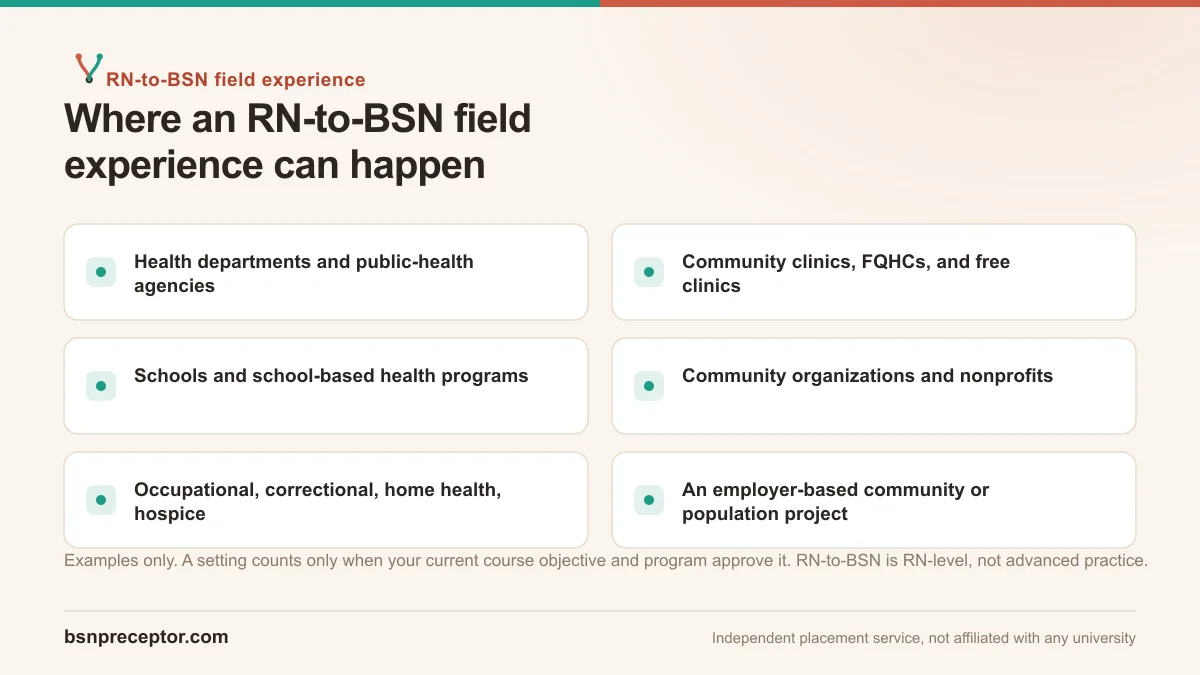
When a current course includes a community or population-health field experience, possible settings can reflect the approved objective. The following examples do not establish what any named program requires or accepts:
Some programs allow you to build a project around your current employer if the work is genuinely community or population focused and a qualified preceptor there can supervise it. Always confirm what your program counts before you commit, because eligible site types vary by school.
A possible field-experience candidate may be an experienced registered nurse, public-health professional, educator, leader, quality professional, or another person whose role fits the current objective. The program decides the required license, education, role, experience, location, and relationship to the student. Do not infer eligibility from a job title alone.
Before outreach, obtain the program's current written criteria and forms. Ask which credentials must be active, whether a minimum experience threshold applies, what conflicts are prohibited, how supervision works, and who completes evaluations or hour verification. Only the program can answer those questions for the course.
First confirm that the current course permits or requires a student proposal. Then organize the candidate's role, credentials, experience, site, availability, relationship to the student, and fit with each course objective. Use the program's current forms rather than a generic template.
The program reviews the proposed person, organization, location, course fit, and paperwork. The site may also require an affiliation agreement, compliance items, authorization checks, or other documents. Student proposal permission does not transfer approval authority to the student or an outside service.
Begin the experience only after the program and site complete their required review. If outside sourcing is permitted, our role is described on how it works. Candidate availability and approval are never guaranteed.
There is no universal BSN clinical or field-experience total. Requirements vary by state, program, pathway, course, and catalog year. Accreditation does not provide a school-specific number, and a figure from another institution or curriculum version should not be used for planning.
Use the current catalog, degree audit, course shell, field-experience handbook, and placement office to confirm the exact requirement. Ask whether the program distinguishes observation, direct participation, project work, or another activity and how the student and candidate must document it.
Our BSN by school directory avoids unsupported hour tables. It provides an institution-specific verification page that keeps pathway, hours, placement ownership, and approval with the current program.
Independent sourcing may help when the current post-licensure course explicitly permits or requires the student to propose a person or site and the student has a complete requirement packet. Without that permission, the student should use the program's own process.
The request should include pathway, course, objectives, confirmed requirement, dates, approved geography, setting, candidate criteria, affiliation steps, compliance items, and forms. We screen possible candidates against those facts and submit information for program review.
BSNPreceptor is independent and works independently of any university. Placement and approval are never guaranteed. See cost or contact for the service terms.
No. It is a supervised community or public-health practicum, not additional bedside rotations. Because you are already a licensed RN, the field experience applies population-health and community content, often through a capstone project at a site such as a health department, clinic, school, or community organization.
There is no universal BSN clinical or field-experience total. Requirements vary by state, program, pathway, course, and catalog year. Confirm the active catalog, degree audit, course instructions, and placement office for the student's exact requirement.
Not necessarily. The acceptable person depends on the current course objective and program criteria. A registered nurse, public-health professional, educator, leader, quality professional, or another role may be possible only if the program explicitly accepts that role. Confirm current credentials and experience rules before outreach.
The current program does. A student should propose a person or site only when current instructions permit it. The program reviews course fit, location, credentials, site eligibility, and paperwork, and the experience should not begin before required approvals are complete.
Only when the current program or course explicitly permits or requires a student-proposed person or site. BSNPreceptor can then source and document a possible candidate for program review. It is independent, works independently of any university, and does not guarantee placement or approval.
Outside sourcing applies only when the current program explicitly permits or requires a student-proposed preceptor, mentor, or site. An advisor reviews the course instructions before candidate sourcing begins.
We do not guarantee placement. Final approval rests with your program.
