If you are an Alaska RN finishing a bachelor's, the placement you need is a community or population health field experience, and in a state this large that means thinking early about distance. Students complete the work inside public health nursing offices, tribal and community health programs, school and workplace health, home health and hospice, and non-profits, with an experienced nurse or a program supervisor as preceptor. We help you find an approvable site and preceptor near you, and we are honest that prelicensure students usually have clinicals arranged by their school.
Last updated July 2026
The right answer for a preceptor search in Alaska depends on your program. Prelicensure BSN students in a campus or accelerated track generally have hospital rotations scheduled by their school, so most do not self-source. RN-to-BSN students, who are already licensed and often working across the state, normally have to arrange a single community or public health field experience, and that is the group we mainly serve.
If your program places you, use its clinical office first. If it asks you to find your own community site, this page is for you.
The field experience is a population health project, not a bedside rotation. In Alaska, students commonly complete it in settings such as these:
The State of Alaska runs public health nursing across the state, including itinerant nurses who travel to communities far from a clinic, and the tribal health system operates a large network of village clinics and regional health centers. Both are natural places to ask about a population health project.
Alaska's health infrastructure clusters in a few places. Anchorage holds the largest share of clinics, agencies, and public health programs, with Fairbanks in the interior and Juneau in the southeast as the other main hubs. In and around these cities, a field experience site and a willing preceptor are the easiest to arrange.
Much of Alaska is remote and off the road system, reached mainly by plane or boat, with care delivered through village clinics, community health aides, and regional hospitals. If you live in a rural or off-road community, plan early: a local public health nurse, a tribal health program, a school, or a home health agency may be your most realistic site, and the nearest qualified preceptor can be a long way off. A telehealth or hybrid arrangement is worth asking your program about.
For a community or population health field experience, your preceptor is generally an experienced registered nurse or an appropriate professional in the setting, such as a public health nurse, a tribal or community health program supervisor, a school nurse, or a home health nurse. The preceptor does not have to be an advanced practice nurse, because this experience centers on population health rather than diagnosis or treatment.
Programs set their own rules on a preceptor's license, degree, and experience, so confirm the criteria with your school before you commit. We work to match you with someone who fits both the setting and those requirements.
There is no national clinical hour count for the BSN. The current national education standards are competency based and name no fixed number, so your requirement comes from your own program. RN-to-BSN community field experiences generally fall in the range of roughly 30 to 120 hours, set by the school rather than the state.
Confirm your exact figure with your program before you schedule anything. Our BSN clinical hours page lays out the ranges, and RN-to-BSN field experience explains how the practicum tends to run.
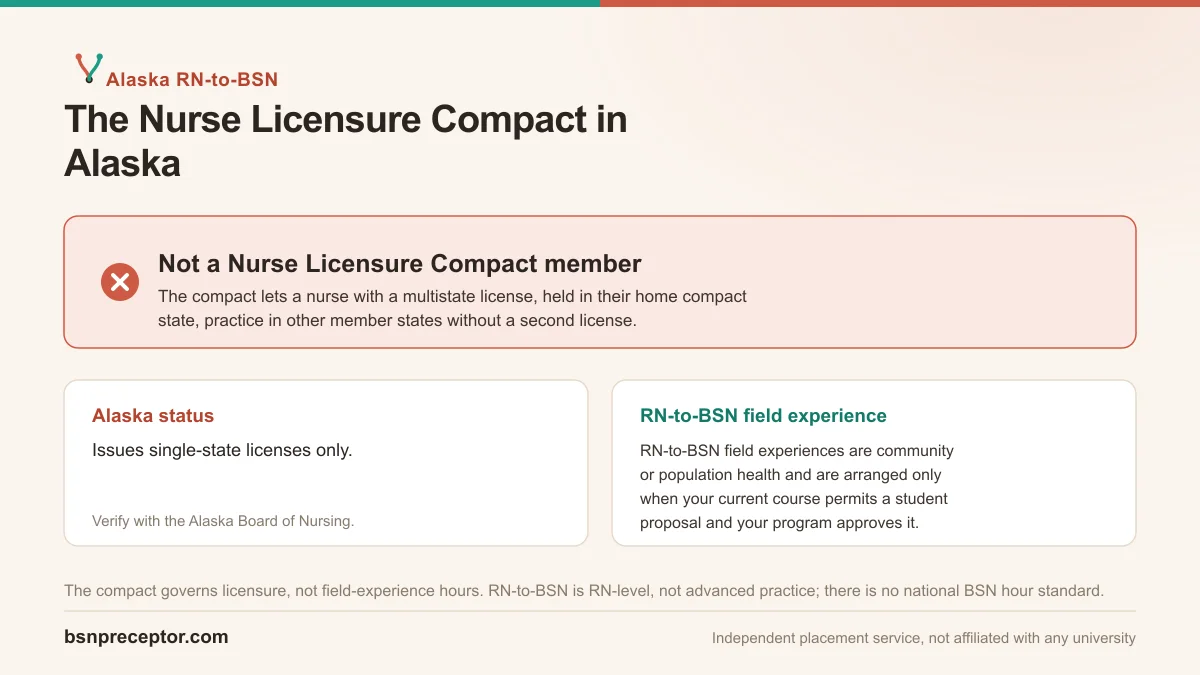
Alaska is not a member of the Nurse Licensure Compact. That means a multistate license from a compact state does not by itself let you practice in Alaska: you need an Alaska registered nurse license to practice here, whether you are working or completing a field experience. Legislation to join the compact has been introduced more than once, but as of 2026 the state has not adopted it, so confirm the current status before you rely on it.
Licensing is handled by the Alaska Board of Nursing, part of the state Division of Corporations, Business and Professional Licensing, which issues licenses by examination and endorsement. If you are an out of state student placing in Alaska, or an Alaska nurse enrolled in an online program elsewhere, check the board's current rules early, because processing can take weeks.
Send us your community or region, your program, and your timeline, and we look for a public health, tribal, school, or home health site with a preceptor who can meet your school's rules. Asking costs nothing, and nothing is billed until a match is confirmed and your program approves it. See how it works, then use the request form or contact us.
No. Alaska is not a compact member as of 2026, so a multistate license from another state does not by itself authorize practice here. You need an Alaska registered nurse license. Confirm the current status with the Alaska Board of Nursing.
Usually yes. RN-to-BSN students normally self-source a community or public health field experience, which is where we help most. Prelicensure students generally have clinicals arranged by their school. See RN-to-BSN field experience.
Plan early. A local public health nurse, a tribal health program, a school, or a home health agency is often the most realistic site, and the nearest qualified preceptor may be far away. Ask your program whether a telehealth or hybrid project is allowed.
There is no national or statewide number. Programs set the total, commonly in the range of about 30 to 120 hours. Confirm your requirement with your school and see BSN clinical hours.
Usually yes. A community or population health experience can be precepted by an experienced registered nurse or an appropriate professional such as a public health or tribal health supervisor. It does not have to be an advanced practice nurse. Your program sets the criteria.
Outside sourcing applies only when the current program explicitly permits or requires a student-proposed preceptor, mentor, or site. An advisor reviews the course instructions before candidate sourcing begins.
We do not guarantee placement. Final approval rests with your program.
