For Arizona RNs finishing a bachelor's, the placement that matters is a community or population health field experience, not another hospital rotation. Students complete it inside county health departments, community health centers, school and workplace health, home health and hospice, tribal and border health programs, and non-profits, precepted by an experienced nurse or a program supervisor. We help you find and confirm an approvable site and preceptor, and we are candid that prelicensure students usually have clinicals arranged by their school.
Last updated July 2026
A preceptor search in Arizona splits along one line. Prelicensure BSN students in campus and accelerated tracks usually have clinical rotations set up by their school, so most do not self-source. RN-to-BSN students, already licensed and frequently working, generally arrange one community or public health field experience on their own, and they are the group we mainly help.
If your school places you, start with its clinical office. If it hands you the search, read on.
The community practicum is a population health project rather than bedside care. In Arizona, students commonly complete it in settings like these:
Arizona runs public health through the state health services department and county health departments in all fifteen counties. The Maricopa County agency, which covers the state's largest metro, is one of the biggest local health jurisdictions in the country, so metro students have a wide field of possible sites.
Arizona's health infrastructure is concentrated in the Sun Corridor. The Valley, meaning the greater metro around the state capital in Maricopa County, holds the deepest bench of clinics, agencies, and programs, with Tucson in Pima County as the second hub and nearby Mesa, Chandler, and Scottsdale adding more. In these areas a field experience site and a willing preceptor are the easiest to line up.
Outside the metros the picture changes. Northern counties such as Coconino, Navajo, and Apache are large and rural and include substantial tribal lands, while the southern border counties of Santa Cruz, Yuma, and Cochise carry their own community health needs. Both Maricopa and Pima county health departments have added tribal liaison roles. If you live in a rural, tribal, or border community, a county health unit, a tribal health program, a community health center, a school, or a home health agency is often the most practical site, and early outreach helps because qualified preceptors are spread thin.
For a community or population health field experience, your preceptor is generally an experienced registered nurse or an appropriate professional in the setting, such as a public health nurse, a school nurse, a home health nurse, an occupational health nurse, or a community program supervisor. The preceptor does not have to be an advanced practice nurse, since the experience is about population health rather than diagnosis or treatment.
Each program sets its own standards for a preceptor's license, degree, and experience, so confirm those with your school before you commit to a site. We aim to match you with someone who fits both the setting and your program's list.
The BSN has no national clinical hour count. Current national education standards are competency based and set no fixed number, so your total comes from your program. RN-to-BSN community field experiences usually fall in the range of roughly 30 to 120 hours, decided by the school rather than the state.
Confirm your figure with your program before you build a schedule. See BSN clinical hours for the ranges and RN-to-BSN field experience for how the practicum usually works.
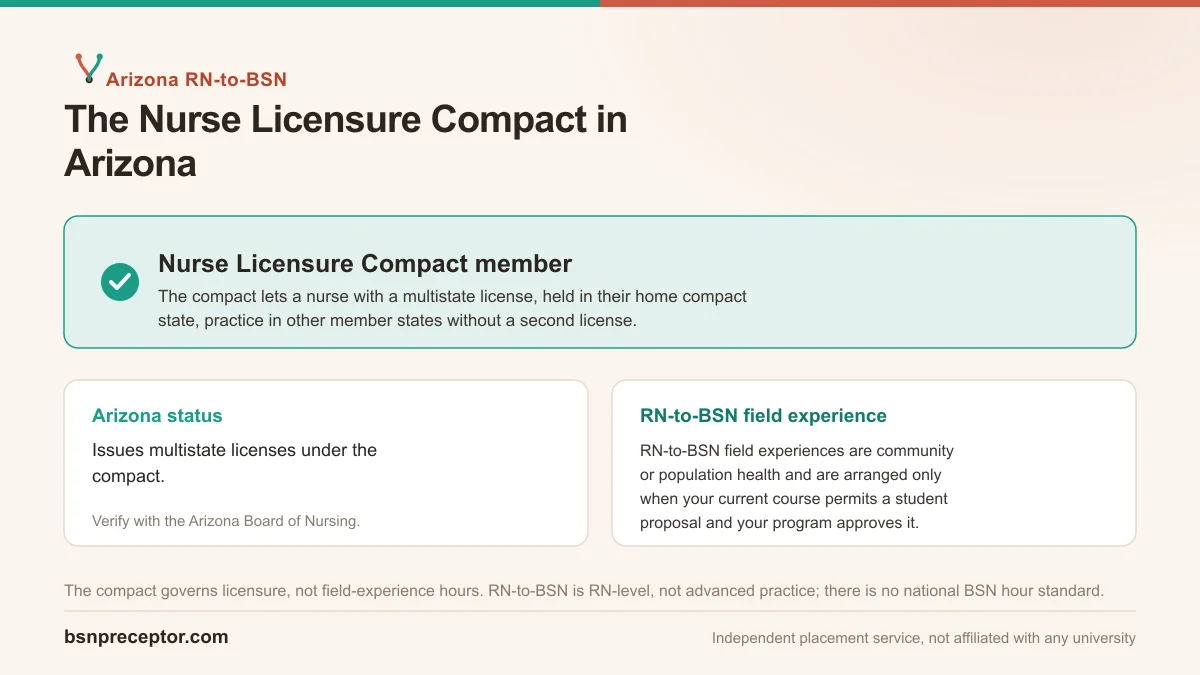
Arizona is a member of the Nurse Licensure Compact. A nurse who holds a multistate license with Arizona as the home state can practice in other compact states, and nurses from other compact states can practice in Arizona under their multistate license. That flexibility helps the many RN-to-BSN students who work while they study or who enroll in an online program based in another state.
Registered nurse licensing is handled by the Arizona State Board of Nursing, which issues licenses by examination and endorsement and sets renewal rules. If you hold a license elsewhere and are placing in Arizona, check whether your multistate license covers you, and confirm current details with the board.
Give us your city, your program, and your timeline, and we look for a community or public health site with a preceptor who can satisfy your school's rules. There is no cost to ask, and nothing is billed until a match is confirmed and your program signs off. See how it works and our cost page, then send your details through the request form.
Yes. Arizona is a compact member, so a multistate license held with Arizona as the home state can be used in other compact states, and compact nurses from elsewhere can practice in Arizona. Confirm your status with the Arizona State Board of Nursing.
It depends on your path. Prelicensure students usually have clinicals arranged by their school. RN-to-BSN students typically self-source a community or public health field experience, which is where we help most. See RN-to-BSN field experience.
A county health unit, a tribal health program, a community health center, a school, or a home health agency is often the most workable site outside the metros. Start early, because qualified preceptors are spread thin in the rural north and along the border.
There is no national or statewide number. Your program sets the total, commonly in the range of about 30 to 120 hours. Confirm your requirement with your school and see BSN clinical hours.
No. A community or population health field experience can be precepted by an experienced registered nurse or an appropriate professional such as a public health nurse or a community program supervisor. It does not have to be an advanced practice nurse. Your program sets the final criteria.
Outside sourcing applies only when the current program explicitly permits or requires a student-proposed preceptor, mentor, or site. An advisor reviews the course instructions before candidate sourcing begins.
We do not guarantee placement. Final approval rests with your program.
