For California RNs finishing a bachelor's, the placement you need is a community or population health field experience, not another hospital rotation. Students complete it inside county public health departments, community clinics and health centers, school and workplace health, home health and hospice, and non-profits, precepted by an experienced nurse or a program supervisor. We help you find and confirm an approvable site and preceptor, and we are honest that prelicensure students usually have clinicals arranged by their school.
Last updated July 2026
A preceptor search in California depends on your track. Prelicensure BSN students in campus and accelerated programs generally have their clinical rotations scheduled by the school, so most do not self-source. RN-to-BSN students, already licensed and often working, usually arrange one community or public health field experience themselves, and they are the group we mainly serve.
If your program places you, begin with its clinical office. If it asks you to find your own community site, this page is for you.
The community practicum is a population health project rather than bedside care. Across California, students commonly complete it in settings such as these:
California runs public health through the state department and 61 local health jurisdictions, which are its 58 counties plus the cities of Berkeley, Long Beach, and Pasadena. The Los Angeles county agency is the largest local health department in the country, so students in that region have a wide field of possible sites.
California's health infrastructure is deep but uneven. The big metros of Los Angeles, San Diego, the San Francisco Bay Area, and Sacramento hold the widest choice of health departments, clinics, and non-profit programs, so a field experience site and a willing preceptor are easiest to arrange there.
The Central Valley is different. Cities like Fresno, Bakersfield, Modesto, and Stockton anchor large agricultural regions served heavily by community health centers, including some of the country's largest networks of migrant and farmworker clinics, which can be strong population health sites. The far north and the mountain and desert counties are rural and thinly served, so if you live there a county public health department, a community health center, a school, or a home health agency is often the most practical site, and early outreach helps because preceptors are spread thin.
For a community or population health field experience, your preceptor is generally an experienced registered nurse or an appropriate professional in the setting, such as a public health nurse, a school nurse, a home health nurse, an occupational health nurse, or a community program supervisor. The preceptor does not have to be an advanced practice nurse, since the experience is about population health rather than diagnosis or treatment.
Each program sets its own rules for a preceptor's license, degree, and experience, so confirm the criteria with your school before you commit to a site. We aim to match you with someone who fits both the setting and your program's requirements.
The BSN has no national clinical hour count. The current national education standards are competency based and set no fixed number, so your total comes from your own program. RN-to-BSN community field experiences usually fall in the range of roughly 30 to 120 hours, decided by the school rather than the state.
Confirm your figure with your program before you build a schedule. See BSN clinical hours for the ranges and RN-to-BSN field experience for how the practicum usually works.
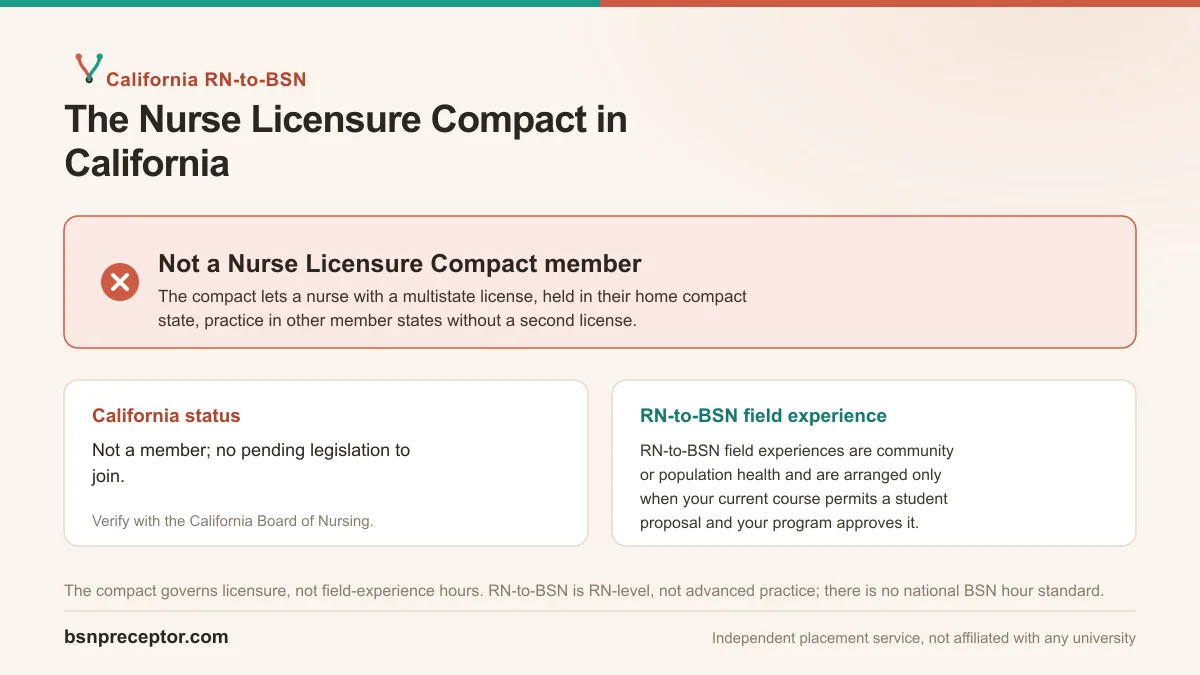
California is not a member of the Nurse Licensure Compact. A multistate license from a compact state does not authorize practice in California, and there is no pending legislation to join. To practice here, including for a field experience that counts as nursing practice, you need a California registered nurse license, obtained by examination or by endorsement if you are licensed in another state.
Registered nurse licensing is handled by the California Board of Registered Nursing. Endorsement can take time, so if you are licensed elsewhere and plan to place in California, start the process early and confirm current requirements with the board before you rely on any timeline.
Send us your city, your program, and your timeline, and we look for a community or public health site with a preceptor who can satisfy your school's rules. There is no cost to ask, and nothing is billed until a match is confirmed and your program signs off. See how it works and our cost page, then use the request form.
No. California is not a compact member, and there is no pending legislation to join. A multistate license from another state does not authorize practice here, so you need a California registered nurse license. Confirm current rules with the California Board of Registered Nursing.
Usually yes. RN-to-BSN students normally self-source a community or public health field experience, which is where we help most. Prelicensure students generally have clinicals arranged by their school. See RN-to-BSN field experience.
Community health centers, including migrant and farmworker clinics, are strong sites in the Central Valley, while a county public health department, a school, or a home health agency often works in rural areas. Start early, because preceptors are spread thin outside the metros.
There is no national or statewide number. Your program sets the total, commonly in the range of about 30 to 120 hours. Confirm your requirement with your school and see BSN clinical hours.
No. A community or population health field experience can be precepted by an experienced registered nurse or an appropriate professional such as a public health nurse or a community program supervisor. It does not have to be an advanced practice nurse. Your program sets the final criteria.
Outside sourcing applies only when the current program explicitly permits or requires a student-proposed preceptor, mentor, or site. An advisor reviews the course instructions before candidate sourcing begins.
We do not guarantee placement. Final approval rests with your program.
