Yes, we help BSN students in Colorado line up the community or population-health field experience their program asks them to self-source, along with a preceptor who can sign the hours. Most of the people we place are RN-to-BSN students, already licensed and often working, who need a local public-health site rather than a hospital rotation. This page maps where those placements happen across Colorado and who can serve as your preceptor.
Last updated July 2026
The word preceptor means something specific for a BSN, and it helps to be honest about who needs one. If you are in a prelicensure program, your school almost always arranges your clinical rotations, so you probably do not need us. Our work is with the other group.
If you are not sure which path is yours, tell us your program and we will say plainly whether you even need a placement. There is more on our RN-to-BSN field experience page.
A BSN community field experience is built around population health, not bedside acute care, so the sites look different from a hospital clinical. Across Colorado these placements sit inside the public-health and community-nursing world.
Colorado's community health centers alone reach more than 850,000 patients across hundreds of clinic sites, which gives an RN-to-BSN student a wide field of realistic settings to work within.
Where you live in Colorado shapes how quickly a site comes together, because the state's population and its public-health infrastructure are not spread evenly.
We will tell you honestly if your area is short on a given setting and look at a neighboring county before it costs you a term.
This is where a BSN differs most from a graduate placement. Your preceptor does not have to be a physician or a graduate-level specialist. For a community or population-health experience the right person is usually an experienced nurse or an appropriate professional in the setting.
Your program sets the final rule on who qualifies and how the hours are logged, so we confirm the fit against your school's checklist before anyone commits.
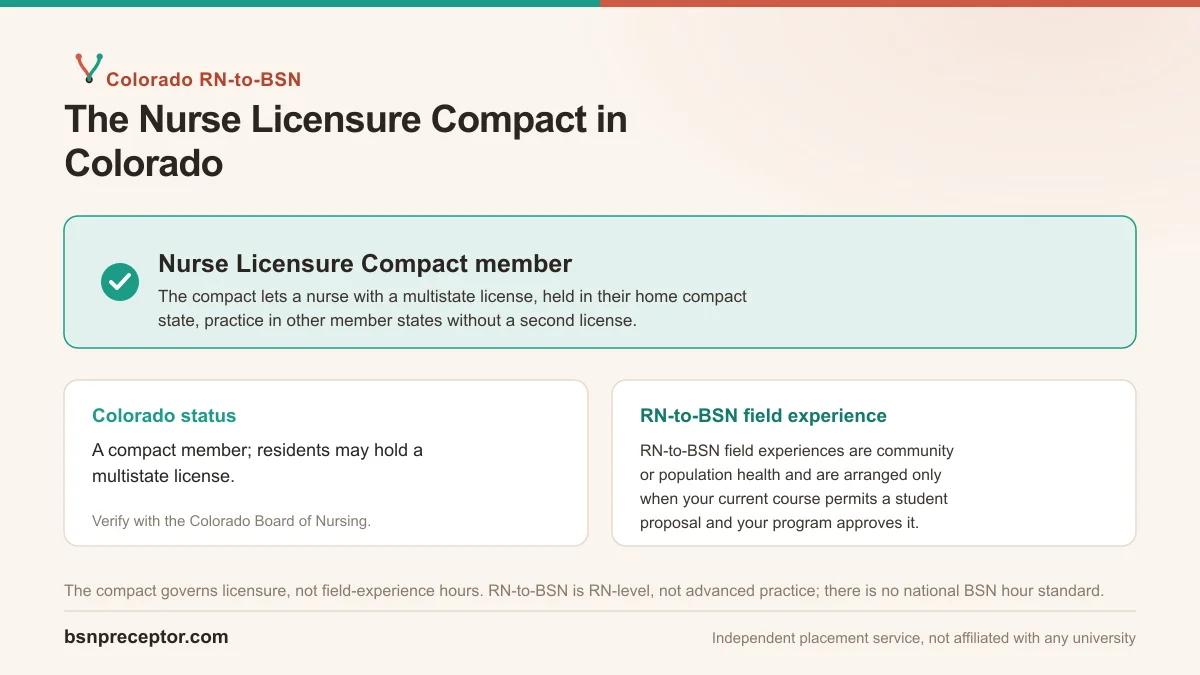
Because most RN-to-BSN students are already working nurses, licensure matters more than any placement detail. Colorado is a member of the Nurse Licensure Compact, which lets a nurse whose primary residence is another compact state work in Colorado on a multistate license, and lets Colorado residents do the same across compact lines.
Licensure and compact rules change, so confirm your own status with the Colorado State Board of Nursing, which sits inside the state's Division of Professions and Occupations.
There is no national required clinical-hour number for the BSN. The 2021 education standards are competency-based, and each program sets its own community field-experience total, commonly somewhere in the rough range of 30 to 120 hours. Confirm your exact figure with your program, and see our BSN clinical hours guide for how the pieces fit.
When you are ready, request a preceptor at the match form and we reply within one business day. We assist with sourcing and coordination, and we never guarantee placement or your program's approval.
It depends on your path. Prelicensure programs almost always arrange clinical rotations for you. RN-to-BSN programs usually ask you to self-source a community or population-health field experience and a preceptor to sign the hours. Tell us your program and we will say honestly whether you need a placement at all.
There is no national BSN hour standard, and the number is set by your program, commonly in the rough range of 30 to 120 hours. Colorado does not add a separate state figure. Confirm your exact requirement with your program and see our BSN clinical hours page.
For a community or population-health experience it is generally an experienced registered nurse or an appropriate professional in the setting, such as a public-health nurse or a community-program supervisor. It does not have to be a physician or a graduate-trained specialist. Your program makes the final call on who qualifies.
Yes. We are independent and not tied to any school, so we regularly place students whose programs are based elsewhere but who complete the field experience in Colorado. We match to your program's rules, then hand your school a packet to approve.
Not the field experience itself, but it can simplify licensure. Colorado is a compact state, so a multistate license from your primary compact state generally lets you work here. Confirm your status with the Colorado State Board of Nursing before you start.
Outside sourcing applies only when the current program explicitly permits or requires a student-proposed preceptor, mentor, or site. An advisor reviews the course instructions before candidate sourcing begins.
We do not guarantee placement. Final approval rests with your program.
