Yes, we help BSN students in Connecticut arrange the community or population-health field experience their program asks them to self-source, and we find a preceptor who can sign the hours. Nearly all of the students we place are RN-to-BSN nurses finishing the bachelor's while they work. This page lays out where those placements happen in Connecticut, who can precept, and how the state's recent move into the Nurse Licensure Compact fits in.
Last updated July 2026
The most useful thing we can tell a Connecticut student is which path they are on, because it decides whether you need us at all. Prelicensure programs generally arrange their own clinical rotations. RN-to-BSN programs generally do not.
We mostly serve that first group. Share your program and we will tell you whether a placement is even required. You can see the shape of it on our RN-to-BSN field experience page.
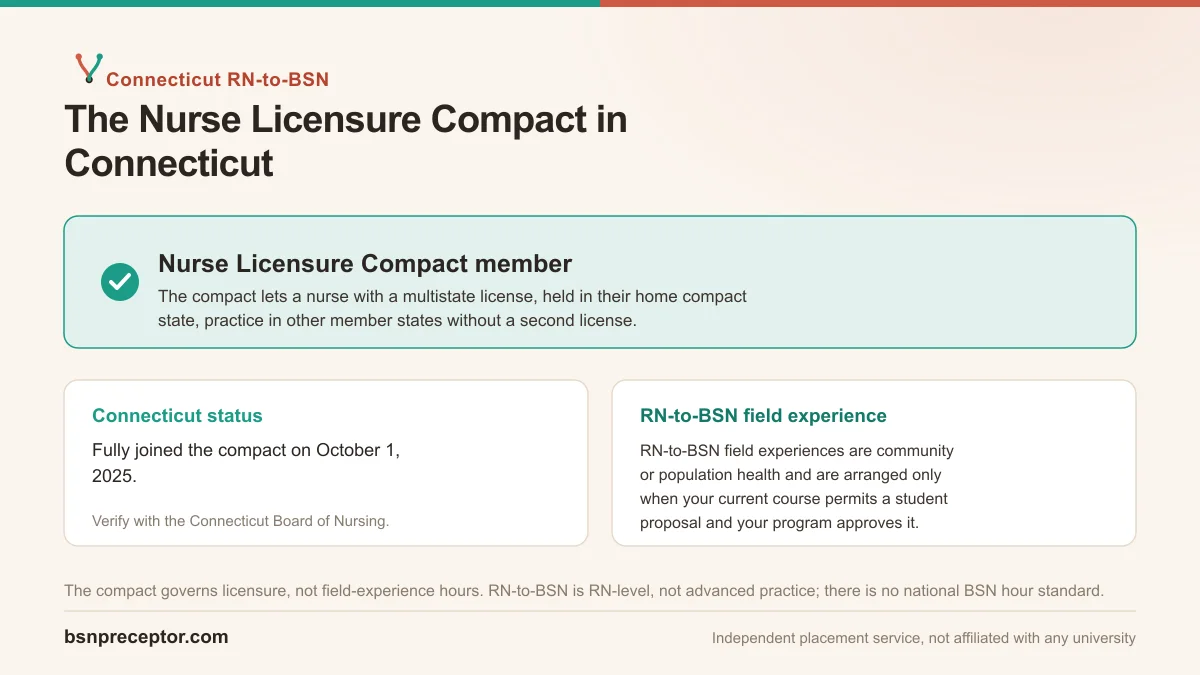
Most RN-to-BSN students are working nurses, so licensure comes first. Connecticut fully joined the Nurse Licensure Compact on October 1, 2025, which was a meaningful change for a state that ran single-state licensure for years.
Because Connecticut's compact status is recent, confirm your own conversion and status with the Connecticut Board of Examiners for Nursing, which is housed in the state Department of Public Health.
A BSN community field experience centers on population health rather than acute bedside care, so the settings are public-health and community organizations rather than hospital units.
With fifty-nine local health agencies covering most of the state's towns, there is a genuine spread of community sites once you know where to look.
The state is small, but the density of sites still varies, and knowing that early saves weeks of searching.
If your town is short on a particular setting, we look to a neighboring district rather than let the calendar slip.
Your Connecticut preceptor does not have to be a physician or a graduate-level specialist. For a community or population-health experience the right fit is usually an experienced nurse or an appropriate professional in the setting.
Your program has the final say on who qualifies and how hours are recorded, so we match the fit to your school's rules before anyone signs on.
There is no national required clinical-hour number for the BSN. The 2021 education standards are competency-based, and each program sets its own community field-experience total, commonly in the rough range of 30 to 120 hours. Confirm your figure with your program and see our BSN clinical hours guide.
Ready when you are: request a preceptor at the match form and we reply within one business day. We help with sourcing and coordination, and we never guarantee placement or your program's approval.
Yes. Connecticut fully implemented the Nurse Licensure Compact on October 1, 2025. If Connecticut is your primary residence you can apply to convert to a multistate license, and nurses from other compact states can work here on theirs. Confirm your status with the Connecticut Board of Examiners for Nursing.
Usually not. Prelicensure programs generally arrange clinical rotations for their students. We mainly help RN-to-BSN students, who self-source a community or population-health field experience, and the minority of hybrid prelicensure tracks that ask students to find a local site.
There is no national BSN hour standard. Your program sets the number, commonly in the rough range of 30 to 120 hours, and Connecticut does not add a separate figure. Always confirm the exact requirement with your program.
In public-health and community settings: town and city health departments, regional health districts, community health centers, school and occupational health, and home health or hospice agencies. The cities carry the most sites, but the regional districts spread them statewide.
Yes. We are independent and work with students at any university, including online programs based in other states. We match to your program's rules, then hand your school a packet to approve.
Outside sourcing applies only when the current program explicitly permits or requires a student-proposed preceptor, mentor, or site. An advisor reviews the course instructions before candidate sourcing begins.
We do not guarantee placement. Final approval rests with your program.
