Yes, we help BSN students in Delaware set up the community or population-health field experience their program asks them to self-source, along with a preceptor who can sign the hours. Most people we place are RN-to-BSN students, already licensed and often working, who need a public-health or community site rather than a hospital rotation. This page shows where those placements sit across Delaware's three counties and who can precept.
Last updated July 2026
Before anything else, it helps to sort out whether you need a preceptor at all. Prelicensure programs almost always arrange clinical rotations for their students. RN-to-BSN programs almost always ask you to find your own community field experience.
We work mainly with the first group. Tell us your program and we will say whether a placement is even required. You can read how it runs on our RN-to-BSN field experience page.
Delaware is compact enough that the whole state is within reach, but the character of each county still shapes where sites sit.
Because distances are short, a student in one county can often reach a strong site in the next, which we use to our advantage when a setting is scarce nearby.
A BSN community field experience is about population health rather than acute bedside care, so the sites are public-health and community organizations.
Delaware's Smart Start home-visiting program for pregnant mothers and young families is one example of the maternal and child work an RN-to-BSN student can build a community experience around.
Your Delaware preceptor does not have to be a physician or a graduate-level specialist. For a community or population-health experience the right person is usually an experienced nurse or an appropriate professional in the setting.
Your program sets the final rule on who qualifies and how hours are logged, so we confirm the fit against your school's checklist first.
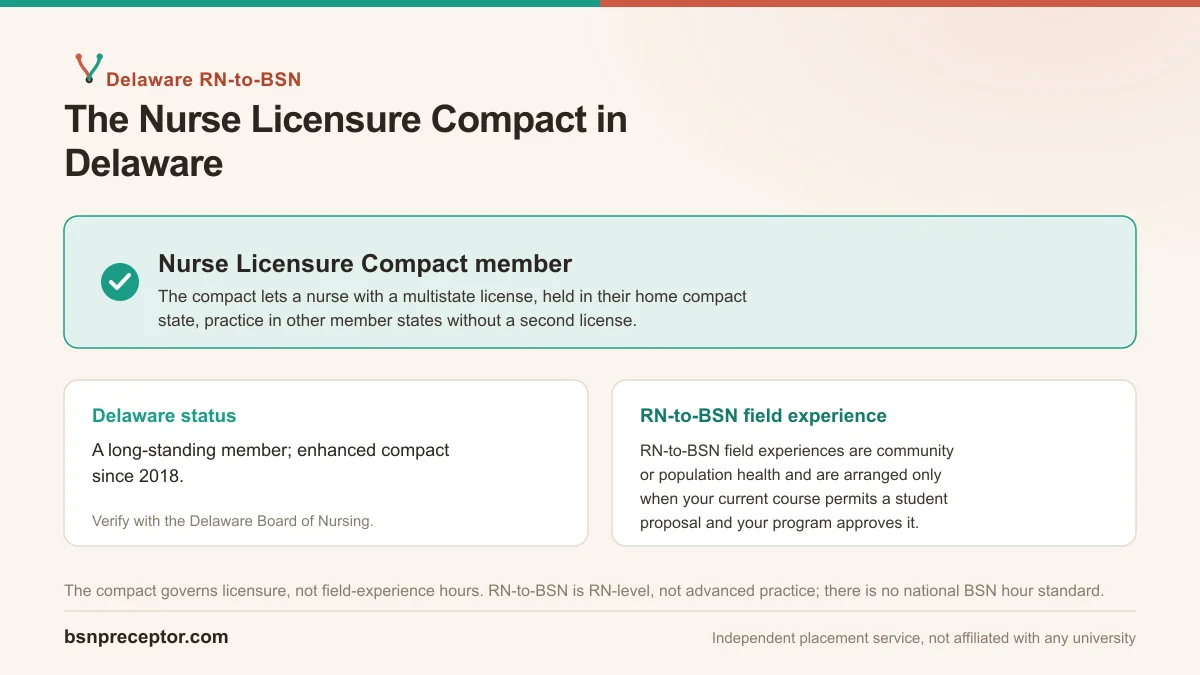
Most RN-to-BSN students are already licensed and working, so licensure is the first thing to settle. Delaware is a long-standing member of the Nurse Licensure Compact, having joined the enhanced compact in early 2018.
Compact and licensure rules change, so confirm your own status with the Delaware Board of Nursing, part of the state Division of Professional Regulation.
There is no national required clinical-hour number for the BSN. The 2021 education standards are competency-based, and each program sets its own community field-experience total, commonly in the rough range of 30 to 120 hours. Confirm your figure with your program, and see our BSN clinical hours guide.
When you are ready, request a preceptor at the match form and we reply within one business day. We assist with sourcing and coordination, and we never guarantee placement or your program's approval.
Yes. Delaware joined the enhanced Nurse Licensure Compact in early 2018. A Delaware multistate license lets you work across compact states, and a multistate license from another compact state generally lets you work here. Confirm your status with the Delaware Board of Nursing.
In public-health and community settings across New Castle, Kent, and Sussex counties: the Division of Public Health's nursing clinics, community health centers, school and occupational health, and home health or hospice agencies. Sussex County's growing older-adult population keeps community and home-based sites especially active.
It depends on your path. Prelicensure programs usually arrange clinical rotations. RN-to-BSN programs usually ask you to self-source a community field experience and a preceptor to sign the hours. Tell us your program and we will say honestly whether you need a placement.
There is no national BSN hour standard. Your program sets the number, commonly in the rough range of 30 to 120 hours, and Delaware does not add a separate figure. Confirm the exact requirement with your program.
Yes. We are independent and work with students at any university, including online programs based elsewhere. We match to your program's rules, then hand your school a packet to approve.
Outside sourcing applies only when the current program explicitly permits or requires a student-proposed preceptor, mentor, or site. An advisor reviews the course instructions before candidate sourcing begins.
We do not guarantee placement. Final approval rests with your program.
