Most of the BSN placements we handle in Hawaii are for RN-to-BSN students finishing a community or population health field experience, plus the smaller group of prelicensure students who have to find their own site. Hawaii runs public health through the state Department of Health and its island district offices rather than the mainland pattern of independent county agencies, so where you place depends a great deal on which island you live on. We help you find an approvable site and preceptor and get the paperwork your program needs into order.
Last updated July 2026
The honest picture of the BSN in Hawaii is two very different paths, and only one of them usually needs us. Prelicensure students in a traditional or accelerated program are almost always placed into their clinical rotations by the school, which holds the affiliation agreements with the hospitals. RN-to-BSN students, who are already licensed and often working, are the ones asked to go find their own community or public health field experience and a preceptor to sign off. That self-source group is our core work.
If you are not sure which path you are on, our page on RN-to-BSN field experience walks through it, and BSN by school shows how programs differ.
Roughly seven in ten residents live on Oahu, so Honolulu holds the deepest supply of sites and preceptors, from the state Department of Health offices to a wide network of community health centers. The neighbor islands are more rural and the options thinner, which is exactly why starting early matters. Hilo and Kailua-Kona anchor Hawaii Island, Kahului and Wailuku anchor Maui County along with Molokai and Lanai, and Lihue anchors Kauai.
Because Hawaii centralizes public health, much of what a mainland student would find at a county department sits inside the Department of Health district health offices on each island, which run public health nursing, family health, and communicable disease work. A distinctive Hawaii option is the Native Hawaiian Health Care Systems, coordinated statewide through Papa Ola Lokahi, with a system serving each major island and a strong community and prevention focus.
For a community or population health field experience, your preceptor is generally an experienced registered nurse or an appropriate professional in the setting, such as a public health nurse, a community program supervisor, or a nurse working in a population health role. It does not have to be an advanced practice nurse or a prescriber. The person needs a current Hawaii license where the role requires one, relevant experience, and the willingness to supervise and evaluate you.
Your program sets the final rules on who qualifies, and it holds approval over the site and the preceptor. We match you to someone who fits those rules, but the school makes the call.
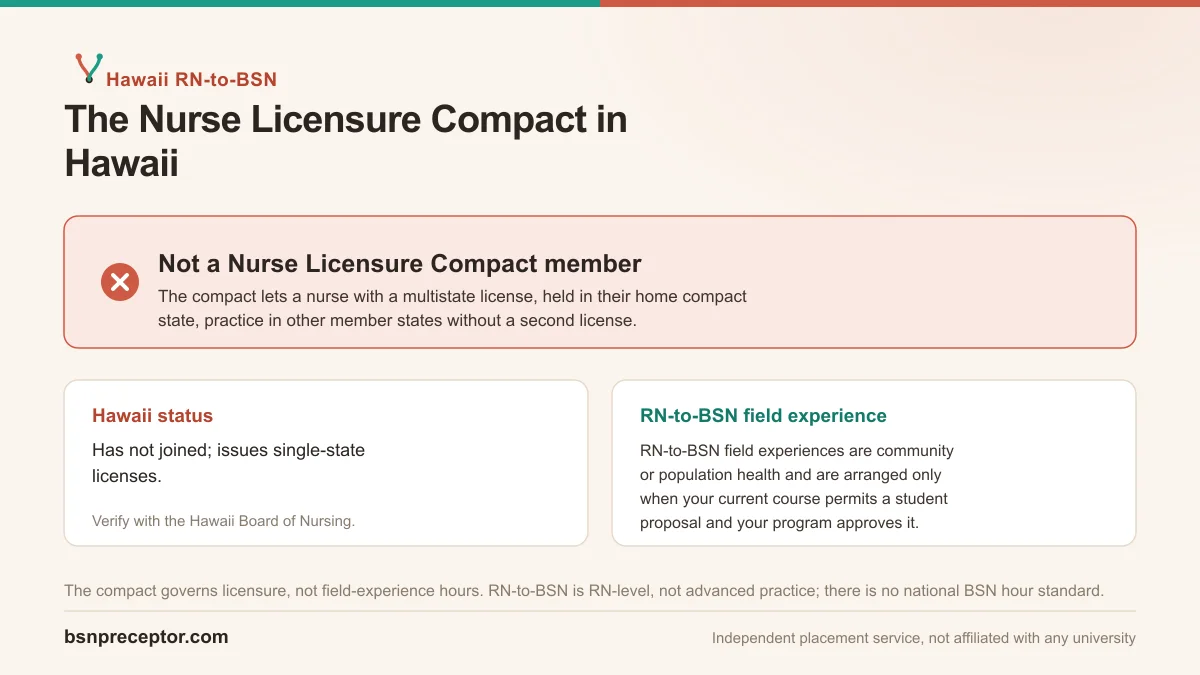
Hawaii has not joined the Nurse Licensure Compact, so it issues single-state licenses and does not recognize a multistate license for practice in the islands. If you are a working RN in Hawaii, you hold a Hawaii license through the Hawaii Board of Nursing, which sits under the Department of Commerce and Consumer Affairs. If you moved from a compact state and are enrolled in an online program based elsewhere, confirm which state's license covers your field experience hours.
Licensure and compact status can change, so treat the board as the authority. Confirm your standing and any renewal or verification steps with the Hawaii Board of Nursing before your term begins.
There is no national clinical hour number for the BSN. The community or population health hours for an RN-to-BSN program are set by each school and vary widely, commonly landing somewhere in the range of roughly 30 to 120 hours, often tied to a capstone course. Prelicensure clinical totals are a separate matter and are arranged by your program.
Because the number is program specific, the only reliable figure is the one in your own handbook. Our overview of BSN clinical hours explains why the totals differ so much, and you should still confirm yours with your program.
Island logistics reward lead time. Three to four months ahead of your term is reasonable on Oahu, and more helps on the neighbor islands, where a single willing preceptor can decide whether a site works. If you can travel or complete part of the experience near family on another island, tell us early so we can widen the search.
We are independent, we work with BSN students at any university, and we handle the outreach, the matching, and the affiliation paperwork so you are not cold calling agencies between shifts. We never guarantee placement or your program's approval of a preceptor or site, because that decision belongs to your school. To start, use the form at #match or reach us through contact, see how it works for the steps, and our cost page is upfront.
No. Hawaii has not joined the Nurse Licensure Compact, so it issues single-state licenses and does not recognize a multistate license for practice in the islands. If you moved from a compact state or study online, confirm your licensure with the Hawaii Board of Nursing.
Common sites include Department of Health district health offices, community health centers, the Native Hawaiian Health Care Systems, school and college health, occupational health, and home health or hospice agencies. Availability is deepest on Oahu and thinner on the neighbor islands.
Often yes. Hawaii Island, Maui County, and Kauai all have health department offices, community health centers, and home health agencies, though the supply of sites and preceptors is smaller than on Oahu. Starting early is the difference maker.
Generally an experienced registered nurse or an appropriate professional in the setting, such as a public health nurse or a community program supervisor. It does not have to be an advanced practice nurse, and your program sets the final eligibility rules.
There is no national BSN hour standard. Community field experience hours are set by your program and commonly fall in the range of roughly 30 to 120 hours. Confirm the exact figure in your own program handbook.
Outside sourcing applies only when the current program explicitly permits or requires a student-proposed preceptor, mentor, or site. An advisor reviews the course instructions before candidate sourcing begins.
We do not guarantee placement. Final approval rests with your program.
