In Illinois we mainly help RN-to-BSN students find the community or population health field experience their program asks them to self-source, plus the minority of prelicensure students told to locate their own site. Illinois has one of the deeper local public health networks in the country, from the Chicago and Cook County departments to close to a hundred certified local health departments downstate, which gives students real options once you know where to look. We help you find an approvable site and preceptor and get the paperwork your school needs in order.
Last updated July 2026
Not every BSN student needs a placement service, and it is worth being honest about that. Prelicensure students in a traditional or accelerated program are usually assigned to clinical rotations by the school, which holds the hospital agreements. RN-to-BSN students already hold a license, often work while they study, and are the ones asked to go find a community or public health field experience and a preceptor to sign off. That self-source group is our main work.
See RN-to-BSN field experience for how the model works and BSN by school for how requirements differ.
Illinois splits sharply between a dense northeast and a rural remainder, and that divide decides how easy a site is to find. Chicago is served by its own city health department, while suburban Cook County runs a large county department of its own, and the collar counties of DuPage, Lake, Will, Kane, and McHenry each add more. Together the Chicago area holds the deepest supply of community and population health sites in the state.
Downstate the picture is more spread out. Rockford anchors the north, Peoria and Bloomington and Normal sit in the center, Springfield is the capital, Champaign and Urbana hold a university community, the Metro East counties near St. Louis form a distinct market, and Carbondale anchors the far south. Rural central and southern Illinois lean on their county health departments and community health centers, where a single preceptor can make or break a placement, so lead time matters more there.
Illinois offers most of the settings an RN-to-BSN capstone looks for, and the state also has deep roots in faith community nursing, the congregational model that began in the Chicago suburbs in the 1980s and remains a recognized community setting here.
For a community or population health field experience, the preceptor is generally an experienced registered nurse or an appropriate professional in the setting, such as a public health nurse, a community program supervisor, a school nurse, or a nurse in a population health role. It does not have to be an advanced practice nurse or a prescriber. The preceptor needs a current Illinois license where the role requires one, relevant experience, and the willingness to supervise and evaluate you.
Your program sets the final rules on who qualifies and keeps approval over both the site and the preceptor. We match you to someone who fits, and your school makes the decision.
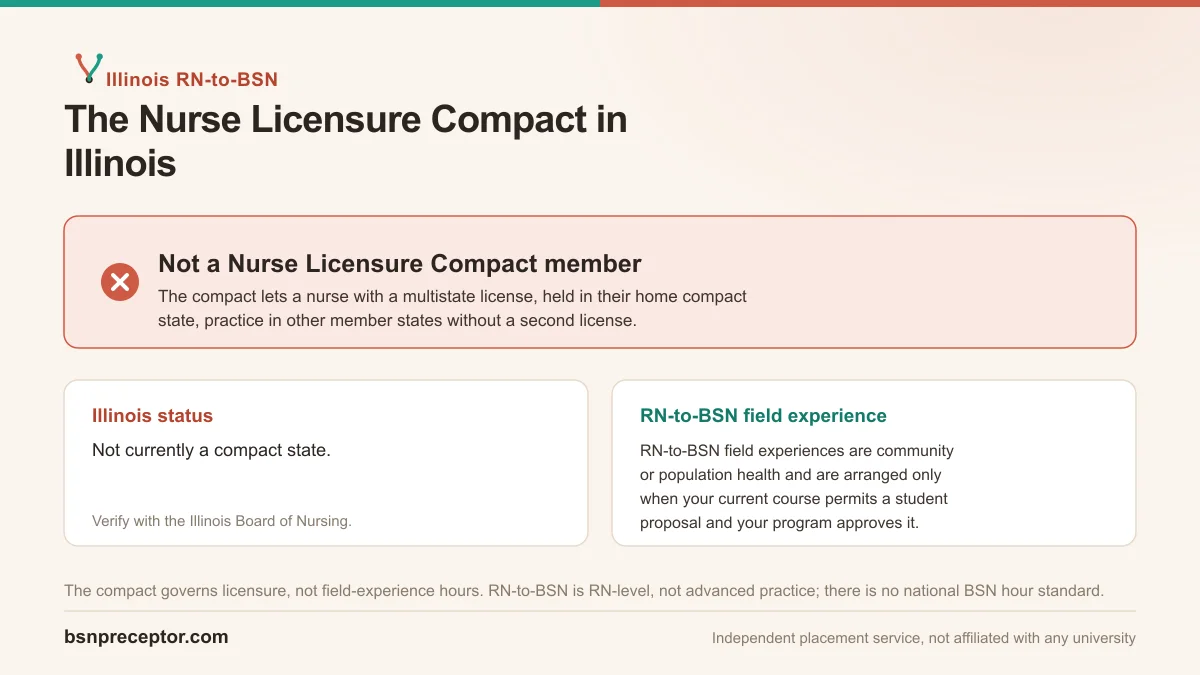
Illinois is not currently a Nurse Licensure Compact state. Even though joining has been debated in the legislature more than once, the state has not put a multistate license into effect, so Illinois issues single-state licenses and does not recognize a multistate license from another state for practice here. Nursing licensure is handled by the Illinois Department of Financial and Professional Regulation.
If you are a working RN in Illinois you hold an Illinois license, and if you study online across state lines you should confirm which state's license covers your field experience. Compact status can change, so treat the state agency as the authority and verify your standing before your term begins.
There is no national clinical hour requirement for the BSN. The community or population health hours in an RN-to-BSN program are set by each school and vary widely, commonly landing in the range of roughly 30 to 120 hours and often tied to a capstone course. Prelicensure clinical totals are a separate matter arranged by your program.
Because the number is program specific, your handbook is the only figure you can rely on. Our overview of BSN clinical hours explains the variation, and you should still confirm yours with your program.
In the Chicago area the best sites fill quickly, and downstate the challenge is fewer options per county, so either way lead time helps. Three to four months before your term is reasonable, and more helps in rural counties or when you need a specific kind of population health setting. If you can travel for part of the experience, tell us early so we can widen the search.
We are independent, we work with BSN students at any university, and we handle the outreach, the matching, and the affiliation paperwork so you are not calling agencies between shifts. We never guarantee placement or your program's approval of a preceptor or site, because that decision belongs to your school. To start, use the form at #match or reach us through contact, and our preceptor FAQ answers the common questions.
No. Illinois is not currently a Nurse Licensure Compact state and has not put a multistate license into effect, so it issues single-state licenses. If you study online across state lines, confirm which license covers your hours with the Illinois Department of Financial and Professional Regulation.
Common sites include local health departments in Chicago, Cook County, the collar counties and downstate, community health centers, school and college health, occupational health, home health and hospice, and faith community programs. The Chicago area has the most options.
Yes. Springfield, Peoria, Rockford, Champaign and Urbana, the Metro East, and the southern counties all have county health departments and community health centers. Options per county are fewer than in the metro, so starting early is the difference maker.
Generally an experienced registered nurse or an appropriate professional such as a public health nurse, a school nurse, or a community program supervisor. It does not have to be an advanced practice nurse, and your program sets the final eligibility rules.
There is no national BSN hour standard. Community field experience hours are set by your program and commonly fall in the range of roughly 30 to 120 hours. Confirm the exact figure in your own program handbook.
Outside sourcing applies only when the current program explicitly permits or requires a student-proposed preceptor, mentor, or site. An advisor reviews the course instructions before candidate sourcing begins.
We do not guarantee placement. Final approval rests with your program.
