In Iowa we mainly help RN-to-BSN students find the community or population health field experience their program asks them to self-source, plus the minority of prelicensure students told to locate their own site. Iowa organizes local public health through a board of health in each of its 99 counties, which contract with agencies to deliver services, so where you place depends on which agency covers your county. We help you find an approvable site and preceptor and get the paperwork your school needs in order.
Last updated July 2026
Being honest about who needs a placement service saves everyone time. Prelicensure students in a campus or accelerated program are usually assigned to clinical rotations by the school, which holds the hospital agreements, so most do not come to us. RN-to-BSN students already hold a license, often work while they study, and are the ones asked to find a community or public health field experience and a preceptor to sign off. That self-source group is our main work.
See RN-to-BSN field experience for how the model works and BSN by school for how requirements differ between programs.
Iowa delivers public health county by county. A local board of health in each of the 99 counties contracts with an agency to provide services, and that agency might be a standalone county public health department, a hospital, or a visiting nurse service. Public health nursing services at the county level are a common and welcoming home for a population health field experience.
The state, now organized under Iowa Health and Human Services, is moving toward a shared responsibility model with lead entities meant to spread strong local collaboration across all 99 counties. For a student, the practical point is simple: your county agency, whatever its form, is usually the first door to knock on for a community placement.
Des Moines is the largest metro and holds the deepest supply of sites. Cedar Rapids sits nearby, Iowa City anchors an academic medical center and a college of public health, the Quad Cities and Davenport sit on the eastern border, and Waterloo, Cedar Falls, Sioux City, Council Bluffs, Dubuque, and Ames round out the larger markets. Most of Iowa is rural and agricultural, which makes agricultural and occupational health a real part of the community landscape, from food processing plants to farm communities.
For a community or population health field experience, the preceptor is generally an experienced registered nurse or an appropriate professional in the setting, such as a public health nurse, a visiting nurse, a community program supervisor, or a nurse in a population health role. It does not have to be an advanced practice nurse or a prescriber. The preceptor needs a current Iowa license where the role requires one, relevant experience, and the willingness to supervise and evaluate you.
Your program sets the final rules on who qualifies and keeps approval over both the site and the preceptor. We match you to someone who fits, and your school makes the decision.
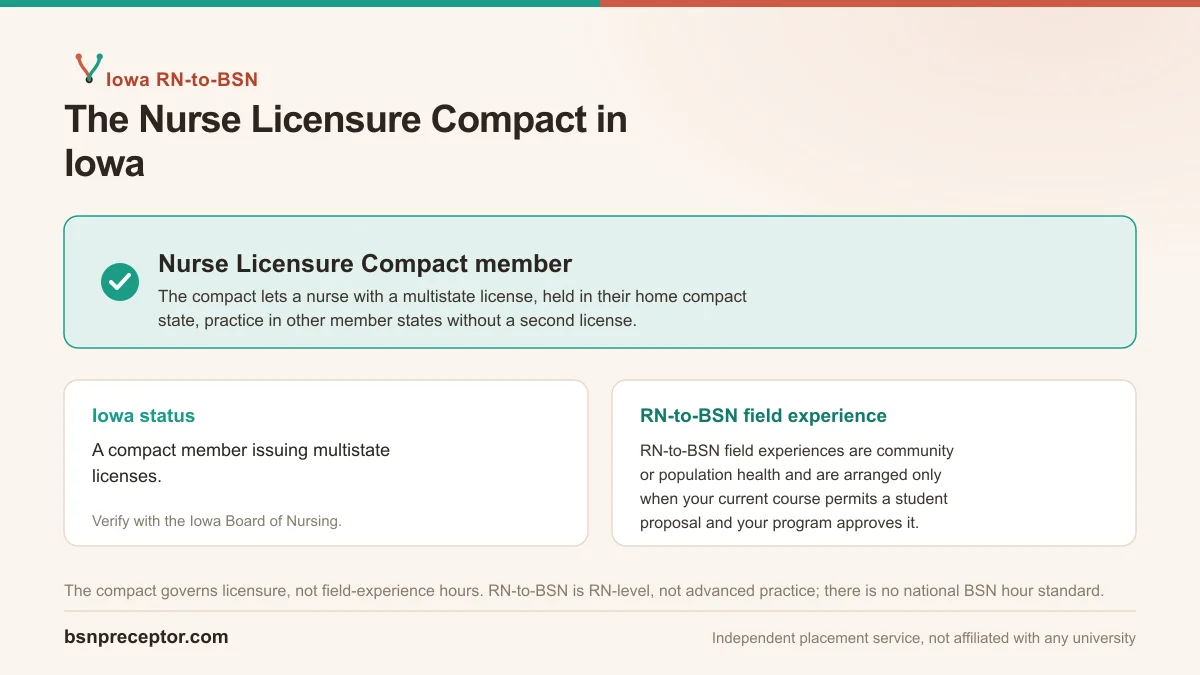
Iowa is a member of the Nurse Licensure Compact. If Iowa is your primary state of residence, your Iowa registered nurse license can carry a multistate privilege, which is convenient for working RNs enrolled in online programs that reach across state lines. Iowa licenses nurses through the Iowa Board of Nursing, now part of the Department of Inspections, Appeals, and Licensing.
Compact and licensure rules can change, so verify your status with the board rather than assuming. Confirm your primary state of residence and any renewal or verification details with the Iowa Board of Nursing before your field experience begins.
There is no national clinical hour requirement for the BSN. The community or population health hours in an RN-to-BSN program are set by each school and vary widely, commonly landing in the range of roughly 30 to 120 hours and often tied to a capstone course. Any prelicensure clinical totals are separate and are arranged by your program.
Because the number is program specific, your handbook is the only figure you can rely on. Our overview of BSN clinical hours explains the variation, and you should still confirm yours with your program.
Sites in Des Moines and the larger cities fill as terms approach, and rural counties have fewer agencies to begin with, so lead time helps either way. Three to four months before your term is reasonable, and more helps in the rural counties or when you need a specific population health setting. If you can travel for part of the experience or place near family in another county, tell us early so we can widen the search.
We are independent, we work with BSN students at any university, and we handle the outreach, the matching, and the affiliation paperwork so you are not calling agencies between shifts. We never guarantee placement or your program's approval of a preceptor or site, because that decision belongs to your school. To start, use the form at #match or reach us through contact, and how it works walks through the steps.
Yes. Iowa belongs to the Nurse Licensure Compact. If Iowa is your primary residence, your registered nurse license can carry a multistate privilege, which helps working RNs in online programs. Confirm details with the Iowa Board of Nursing.
Common sites include county public health and visiting nurse agencies, community health centers, school and college health, occupational health in agriculture and industry, home health and hospice, and non-profit or faith community programs. Des Moines and the larger cities have the most options.
Each of Iowa's 99 counties has a board of health that contracts with an agency, often a county public health department or a visiting nurse service, to deliver services. That county agency is usually the first place to look for a population health placement.
Generally an experienced registered nurse or an appropriate professional such as a public health nurse, a visiting nurse, or a community program supervisor. It does not have to be an advanced practice nurse, and your program sets the final eligibility rules.
There is no national BSN hour standard. Community field experience hours are set by your program and commonly fall in the range of roughly 30 to 120 hours. Confirm the exact figure in your own program handbook.
Outside sourcing applies only when the current program explicitly permits or requires a student-proposed preceptor, mentor, or site. An advisor reviews the course instructions before candidate sourcing begins.
We do not guarantee placement. Final approval rests with your program.
