Most students who ask us for a BSN preceptor in Kansas are RN-to-BSN students: already-licensed registered nurses finishing the bachelor's, whose final requirement is a community or population-health field experience they arrange themselves. A smaller group are prelicensure students in tracks that ask them to find their own site. There is no national BSN clinical-hour count, so what you need is set by your own program, and our job is to help you secure an approvable Kansas site and preceptor.
Last updated July 2026
It helps to be honest about who this page is for. For most prelicensure BSN students, the school arranges hospital clinical rotations, and you do not go looking for a preceptor at all. The students who self-source are mainly two groups: RN-to-BSN students completing a community or public-health capstone, and the minority of prelicensure or hybrid students whose program asks them to line up a local placement.
If you are an RN-to-BSN student in Kansas, your field experience is rarely bedside hospital work. It is a project inside a community or population-health setting, supervised by an experienced nurse or an appropriate professional there. That is a very different search from a hospital rotation, and it opens up settings across the whole state.
Kansas runs its public health through the Kansas Department of Health and Environment and roughly 100 local health departments that cover all 105 counties, most of them county-run, a few multi-county or city-county. Those health departments are among the most common homes for an RN-to-BSN field experience, and they are only the start.
Any of these can host a population-health project, and the preceptor is the experienced person already working there.
Where you live changes how quickly a site comes together. The Kansas City metro on the Wyandotte and Johnson county side, Wichita and Sedgwick County, Topeka, Lawrence, and Manhattan hold the densest mix of health departments, community centers, and health-system population-health teams, so options are broad but so is student competition.
Head west and the map thins out. Salina, Hutchinson, Hays, Great Bend, Dodge City, Garden City, Liberal, and Colby anchor large frontier counties where a single health department or community center may be the main option for miles. Sites there are often glad to host a local student, and the trade is distance: the field experience may sit a fair drive from home. Kansas groups its local departments into preparedness regions, which is a useful way to think about where the nearest realistic options sit.
For a community or population-health experience, the preceptor is generally an experienced BSN-prepared registered nurse or an appropriate professional in the setting: a public-health nurse, a school nurse, a community-program supervisor, a home-health nurse, or a nurse in a care-coordination role. It does not have to be an advanced-practice nurse, because you are learning population-level work rather than diagnosis and treatment.
Your program has the final say on who qualifies and what documentation it needs, so read your practicum handbook before you approach anyone. We match you to a preceptor whose role and setting fit those rules, but your school approves the arrangement.
There is no national required clinical-hour number for the BSN. The 2021 education standards are competency-based and set no fixed count, so your total comes from your own program. In practice, RN-to-BSN community field experiences commonly land somewhere in the range of roughly 30 to 120 hours, and the exact figure varies widely from school to school.
Because the number is yours to confirm, check your syllabus and ask your faculty before you count on anything. Our page on BSN clinical hours explains the range in more detail, and RN-to-BSN field experience walks through what the capstone usually involves.
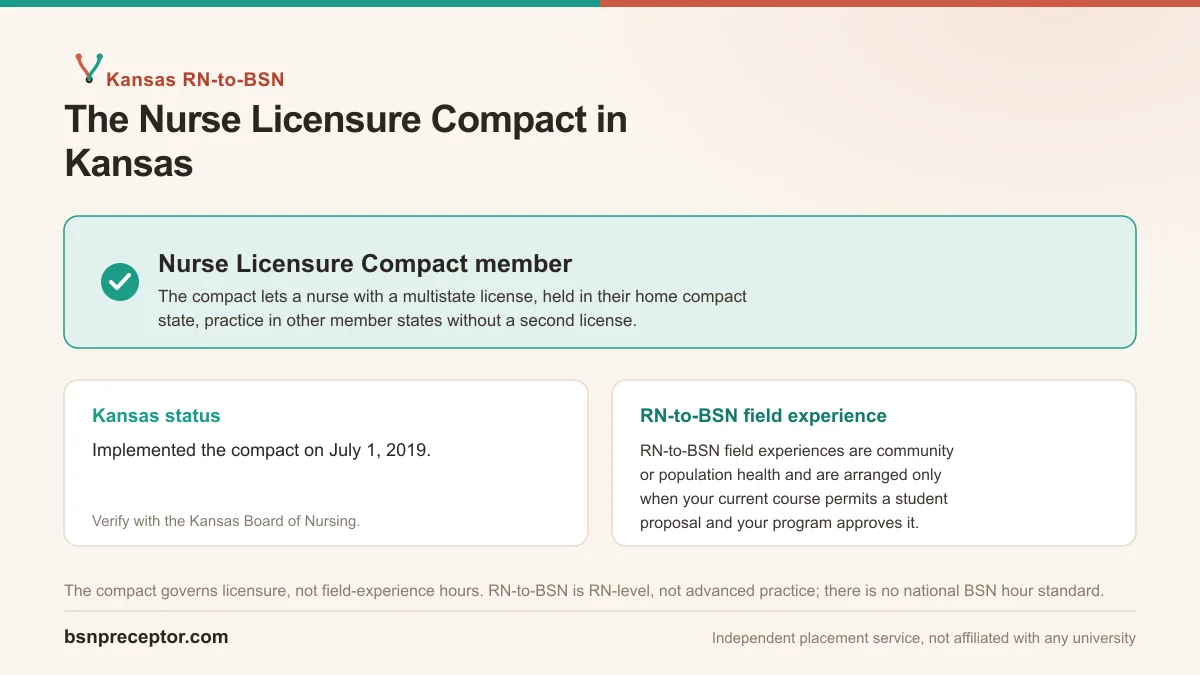
Because RN-to-BSN students are usually working nurses, and many programs enroll students across state lines, licensure matters. Kansas is a member of the Nurse Licensure Compact and has issued multistate licenses since it implemented the compact on July 1, 2019. A multistate license held by a Kansas resident allows practice in Kansas and other compact states, which helps if you work or precept near a border or study online.
Registered-nurse licensure in Kansas is handled by the Kansas State Board of Nursing in Topeka. Compact rules and your own license type can change, so confirm your status directly with the board rather than assuming.
If you have already asked your employer, your own nurse contacts, and your local health department and still have no site, that is where we come in. We are an independent placement service, separate from any university, and we help BSN students from any Kansas program. We match on your city, the population or setting you want, and your term dates, then help with the paperwork your school requires.
We never guarantee placement, and your program makes the final call on any preceptor or site. Send your program, your town, and your start window through the match form on this page or through contact, and see how it works and cost for the mechanics.
Yes. Most prelicensure BSN students have their hospital rotations arranged by the school. We focus on RN-to-BSN students who must self-source a community or population-health field experience, and on the minority of prelicensure students whose program asks them to find a local site.
Common settings include county and city-county health departments, community health centers, school and college health, occupational health, home health and hospice, and population-health roles inside health systems. The Kansas Department of Health and Environment and roughly 100 local health departments give options in nearly every county.
Generally an experienced registered nurse or an appropriate professional in the setting, such as a public-health nurse, school nurse, or community-program supervisor. It does not have to be an advanced-practice nurse. Your program sets the final rules, so confirm them first.
There is no national BSN hour standard. Totals are set by each program and commonly fall in the range of roughly 30 to 120 hours. Confirm your exact requirement with your own school before you plan around a number.
Yes. Kansas implemented the Nurse Licensure Compact on July 1, 2019, so a resident with a multistate license can practice in Kansas and other compact states. Confirm your own license type with the Kansas State Board of Nursing.
Outside sourcing applies only when the current program explicitly permits or requires a student-proposed preceptor, mentor, or site. An advisor reviews the course instructions before candidate sourcing begins.
We do not guarantee placement. Final approval rests with your program.
