In Kentucky, the BSN students who need a preceptor are mostly RN-to-BSN students: working registered nurses finishing the bachelor's, whose capstone is a self-arranged community or population-health field experience. Prelicensure students are usually placed in clinicals by their school, though a few hybrid tracks ask students to source a local site. No national rule sets your hours, so your program decides, and we help you find an approvable Kentucky site and preceptor.
Last updated July 2026
Kentucky runs a decentralized public health system through the Department for Public Health, part of the Cabinet for Health and Family Services. Every one of the state's 120 counties is served, some by an independent county health department and many by a multi-county district health department. That structure matters to you, because those health departments are among the most reliable hosts for an RN-to-BSN community or population-health field experience.
District departments cover much of rural Kentucky. The Kentucky River and Lake Cumberland districts, for example, each serve a cluster of counties in the south and east. In the metros, single-county departments in Louisville and Lexington run large program teams. Either kind can support a student project in immunization, maternal and child health, or communicable disease work.
A community field experience is not bedside hospital nursing, so the settings look different from a prelicensure rotation. Across Kentucky, RN-to-BSN students commonly place in:
The preceptor is the experienced nurse or professional already doing that work, and the project is built around their setting.
Kentucky's population and its health infrastructure sit unevenly. The Louisville and Lexington metros, Northern Kentucky across from Cincinnati, and the smaller hubs of Bowling Green, Owensboro, and Paducah hold the most sites and the most competing students. If you live in one of these, the challenge is less about whether a setting exists and more about getting in before others do.
Eastern and Appalachian Kentucky are a different story. Health needs there are high, and the district health departments and federally qualified health centers that serve counties like Perry, Letcher, and Pike are often central to the whole community. They can be excellent field-experience hosts, and they frequently welcome a local student. The honest trade is travel: in the mountains, the nearest approvable site may be a real drive from home.
For a population-health field experience, your preceptor is generally an experienced BSN-prepared registered nurse or an appropriate professional in the setting, such as a public-health nurse, a school nurse, or a community-program director. An advanced-practice nurse is not required, because the work is community and population focused rather than diagnosis and treatment.
Every Kentucky program sets its own preceptor criteria and paperwork, so check your practicum handbook first. We line up a preceptor whose role fits those rules, and your school gives the final approval.
The BSN has no national clinical-hour requirement. The 2021 education standards are competency-based and name no fixed number, so your hours come from your own program. RN-to-BSN community field experiences commonly run somewhere in the range of roughly 30 to 120 hours, and the figure differs from school to school.
Confirm your own total before planning around it. See BSN clinical hours for the range and RN-to-BSN field experience for what the capstone usually asks of you.
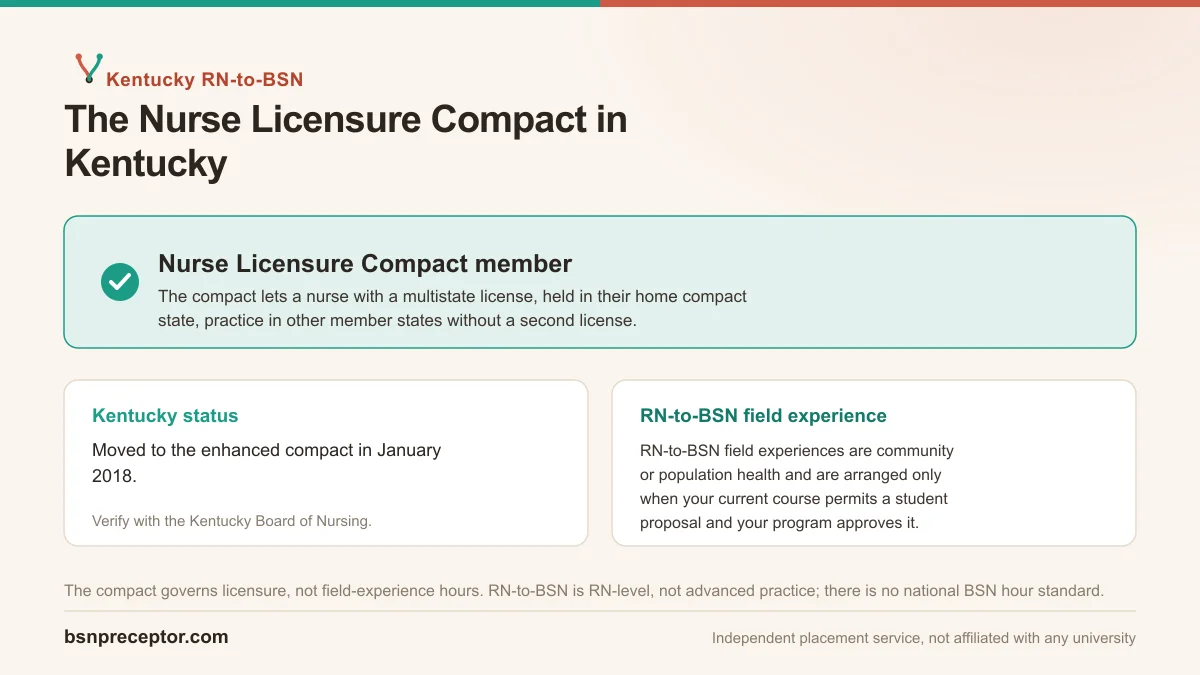
Most RN-to-BSN students are already licensed and working, so compact status is worth knowing. Kentucky was part of the original Nurse Licensure Compact and moved to the enhanced version, which it implemented on January 19, 2018. A Kentucky resident holding a multistate license can practice in Kentucky and in other compact states, which is useful near the Ohio, Indiana, or Tennessee lines and for online programs.
Registered-nurse licensure in Kentucky is overseen by the Kentucky Board of Nursing. License types and compact rules change over time, so verify your own standing with the board rather than relying on a summary.
If you have worked your contacts, your employer, and your county health department and still have nothing firm, that is our job. We are independent of any university, and we help BSN students from every Kentucky program. We match on your location, the population or setting you need, and your term dates, and we help assemble the documents your school wants.
We do not guarantee placement, and your program approves the final site and preceptor. Send your program, your town, and your start date through the match form here or by contact, and read how it works and cost for the details.
Mostly RN-to-BSN students. Prelicensure programs usually arrange hospital clinicals for their students. We focus on RN-to-BSN students self-sourcing a community or population-health field experience, plus the few prelicensure or hybrid students asked to find their own local site.
Common hosts include county and district health departments, community health centers, school and college health, occupational health, home health and hospice, non-profits, and population-health teams in health systems. Kentucky's district health departments reach nearly every rural county.
No. For a community or population-health experience the preceptor is generally an experienced registered nurse or an appropriate professional, such as a public-health nurse or program supervisor. Your program sets the criteria, so confirm what it accepts.
There is no national standard. Each program sets the total, commonly in the range of roughly 30 to 120 hours. Check your own syllabus and confirm with faculty before counting on a specific number.
Yes. Kentucky is a compact state and implemented the enhanced Nurse Licensure Compact on January 19, 2018. A resident with a multistate license can practice in other compact states. Confirm your license type with the Kentucky Board of Nursing.
Outside sourcing applies only when the current program explicitly permits or requires a student-proposed preceptor, mentor, or site. An advisor reviews the course instructions before candidate sourcing begins.
We do not guarantee placement. Final approval rests with your program.
