In Maryland, the BSN students who need a preceptor are mostly RN-to-BSN students: working registered nurses finishing the bachelor's, whose capstone is a self-arranged community or population-health field experience. Prelicensure students are generally placed in clinicals by their school, though a minority of hybrid tracks ask students to self-source. No national rule sets your hours, so your program decides, and we help you find an approvable Maryland site and preceptor, from the city to the shore.
Last updated July 2026
Most prelicensure BSN students in Maryland have their hospital clinicals arranged by the school and never look for a preceptor. The students who self-source are mainly RN-to-BSN students, already-licensed nurses finishing the bachelor's, plus a minority of prelicensure or hybrid students whose program asks them to find a local site.
For an RN-to-BSN student, the capstone is a community or population-health project rather than bedside care. You spend your hours in a public-health or community setting under an experienced professional, working on the health of a group instead of one patient at a time.
Maryland has an unusually clean public-health map: one local health department in each of its 23 counties and one in Baltimore City, twenty-four in all, overseen by the Community Health Administration of the Maryland Department of Health. Those health departments are among the most dependable hosts for an RN-to-BSN community field experience, running programs in immunization, maternal and child health, and communicable disease.
Around them sits a wider network: community health centers and federally qualified health centers, and regional Area Health Education Centers serving Western Maryland, the Eastern Shore, and the central part of the state. Any of these can anchor a population-health project.
Because the work is population focused, the settings are broad. Maryland RN-to-BSN students commonly place in:
In each setting the preceptor is the experienced professional already running that work.
Maryland packs a lot of variety into a small state. The Baltimore metro and the Washington suburbs in Montgomery and Prince George's counties, along with Howard, Anne Arundel, and Frederick, hold the deepest concentration of health departments, community centers, and health-system population-health teams. If you live in the corridor, sites exist in number, and the task is getting in ahead of other students.
Beyond the corridor the picture changes. The Eastern Shore, centered on Salisbury and dotted with rural and agricultural communities, and Western Maryland around Hagerstown and Cumberland, are served by county health departments and community centers that may be the main option for a wide area. Southern Maryland sits somewhere in between. These sites often welcome a local student, and the trade is drive time across the Bay Bridge or into the mountains.
For a community or population-health field experience, your preceptor is generally an experienced BSN-prepared registered nurse or an appropriate professional in the setting: a public-health nurse, a school nurse, a home-health nurse, or a community-program supervisor. An advanced-practice nurse is not required, because the work is population health rather than diagnosis and treatment.
On hours, there is no national BSN requirement. The 2021 education standards are competency-based and name no fixed count, so your total comes from your program, commonly in the range of roughly 30 to 120 hours. Confirm your own number, and see BSN clinical hours and RN-to-BSN field experience.
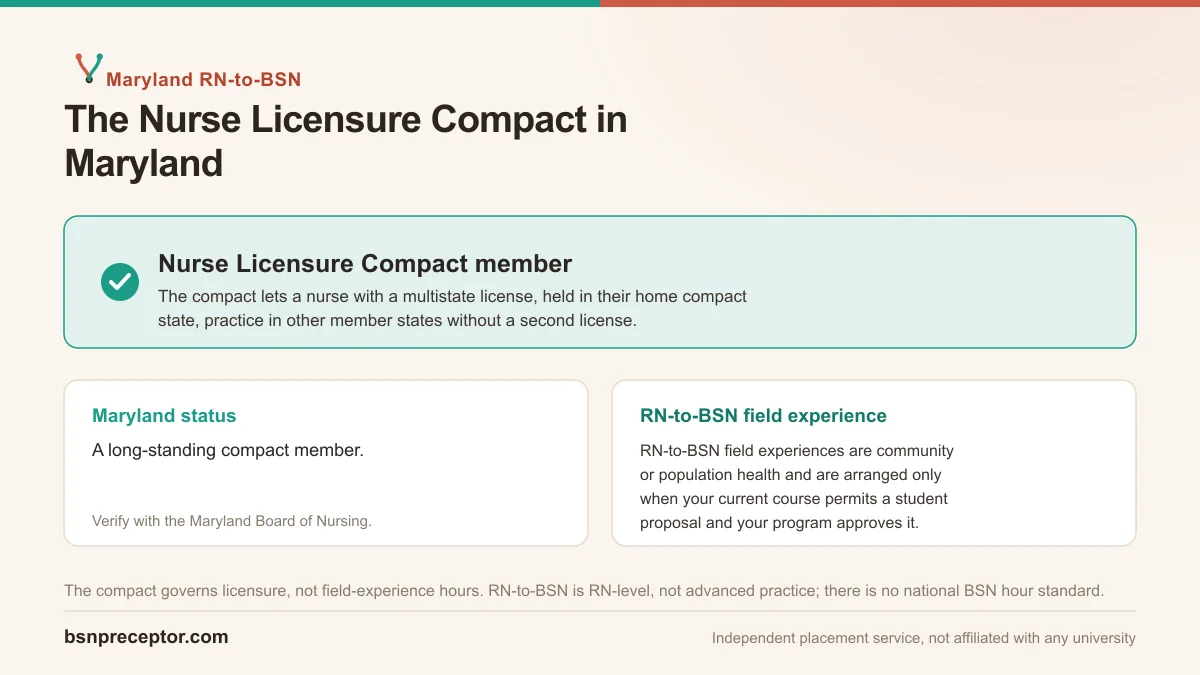
Since RN-to-BSN students are usually working nurses, licensure is worth knowing. Maryland is a longstanding member of the Nurse Licensure Compact, so a Maryland resident holding a multistate license can practice in Maryland and in other compact states, which helps in the busy Washington and Baltimore job markets and in online programs that cross state lines.
Registered-nurse licensure in Maryland is handled by the Maryland Board of Nursing in Baltimore. Compact rules and license types can change, so confirm your own status directly with the board rather than relying on a summary.
If you have already asked your employer, your own nurse contacts, and your county health department and still have no firm site, that is where we help. We are an independent placement service, separate from any university, and we work with BSN students from every Maryland program. We match on your county, the population or setting you want, and your term dates, then help with the paperwork your school requires.
We never guarantee placement, and your program makes the final call on any preceptor or site. Send your program, your county, and your start window through the match form on this page or through contact, and see how it works and cost.
Yes. Prelicensure programs generally arrange hospital clinicals for their students. We focus on RN-to-BSN students self-sourcing a community or population-health field experience, and on the minority of prelicensure or hybrid students asked to find a local site.
Common settings include county and Baltimore City health departments, community health centers, school and college health, occupational health, home health and hospice, non-profits, and population-health roles in health systems. Maryland has one local health department in each county plus Baltimore City.
Generally an experienced registered nurse or an appropriate professional in the setting, such as a public-health nurse or a community-program supervisor. It does not have to be an advanced-practice nurse. Your program sets the final rules, so confirm them first.
There is no national BSN hour standard. Each program sets the total, commonly in the range of roughly 30 to 120 hours. Confirm your exact requirement with your own school before planning around a number.
Yes. Maryland is a compact member, so a resident holding a multistate license can practice in Maryland and other compact states. Confirm your own license type with the Maryland Board of Nursing.
Outside sourcing applies only when the current program explicitly permits or requires a student-proposed preceptor, mentor, or site. An advisor reviews the course instructions before candidate sourcing begins.
We do not guarantee placement. Final approval rests with your program.
