Most people who reach us in Massachusetts are already licensed RNs finishing an RN-to-BSN, and the one piece they have to arrange on their own is a community or population health field experience with a qualified preceptor. Massachusetts runs one of the most locally governed public health systems in the country, and that shapes where those hours are easy or hard to find. Below is a plain look at the settings that count, who can precept, and how registered-nurse licensure works in the state.
Last updated July 2026
We mainly help two groups. The larger group is RN-to-BSN students, working nurses whose bachelor's completion ends in a community or public-health practicum they must source themselves. The smaller group is prelicensure students in accelerated or hybrid tracks whose school asks them to find a local site. Most traditional prelicensure clinical rotations are still arranged by the school, so if your program places you, you may not need us at all, and we will tell you so.
If you are self-sourcing, the goal is simple. You need an approvable site and an approvable preceptor that your program will sign off on, close enough to where you live to be practical. That is the whole job, and it is what we do across the state. See RN-to-BSN field experience for the full picture.
Massachusetts gives a community or population-health practicum plenty of homes. The most common settings are:
A single project, like a falls-prevention push at a senior center or an immunization drive, often satisfies the field experience. Your program decides which of these settings qualifies, so check its practicum guide before you commit.
Massachusetts has more local health departments than any other state, because each of its 351 cities and towns runs its own board of health under home rule, supported by the Department of Public Health's Office of Local and Regional Health. For a student, that means the front door to a public-health placement is often your own town hall rather than a county office.
Sites cluster where people do. Greater Boston, plus Worcester in the center and the gateway cities of Lowell, Lawrence, New Bedford, Fall River, and Springfield in the Pioneer Valley, hold the densest mix of health departments, community health centers, and hospital population-health teams. Cape Cod and the islands run smaller and more seasonal, and the Berkshires and Franklin County in the west are genuinely rural, where sites and preceptors are fewer and worth lining up early.
For a community or population-health field experience, the preceptor is generally an experienced registered nurse, often BSN-prepared, or another suitable professional in the setting, such as a public-health nurse, a school nurse, a community-program manager, or a nurse working in care coordination. It does not have to be an advanced-practice nurse. What matters is that the person and the site meet your program's written criteria and that your program approves them in advance.
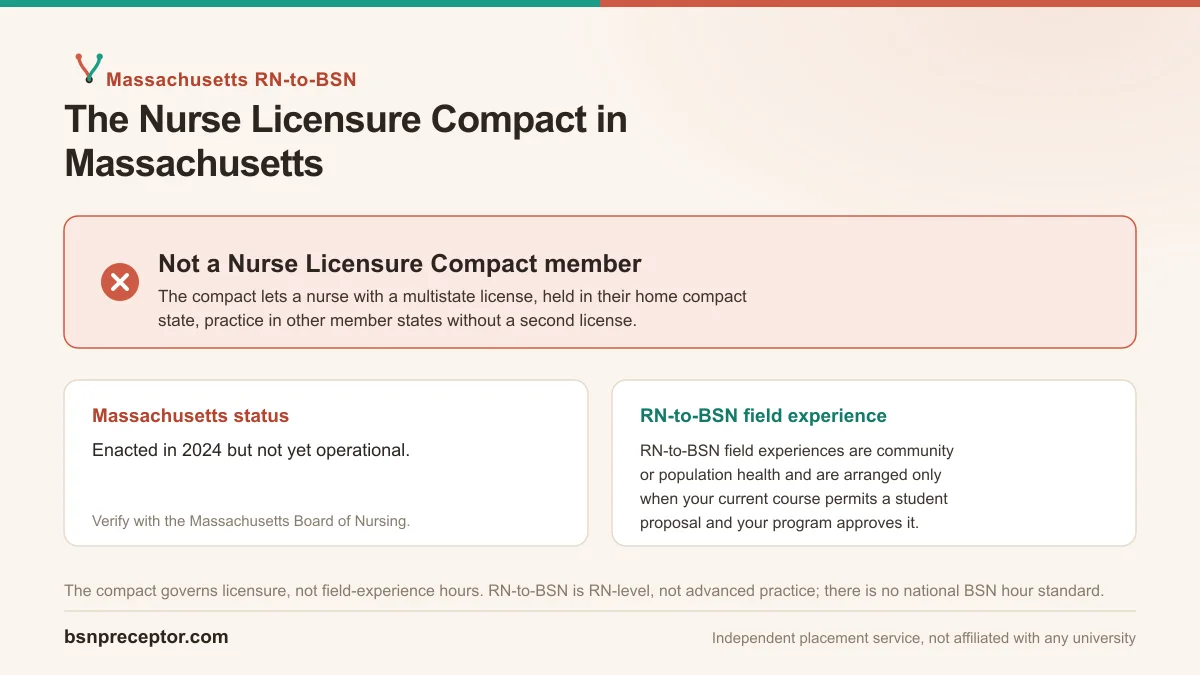
Practice in Massachusetts runs on a registered-nurse license from the Massachusetts Board of Registration in Nursing. Today the state issues a single-state license. Massachusetts enacted the Nurse Licensure Compact in 2024, but the Board has not yet brought it into operation, so a multistate privilege is not being issued and the timeline is still moving. Confirm the current status with the Board rather than assuming.
This matters because many RN-to-BSN programs run online across state lines. Wherever you physically complete your field experience, you do it under that state's license rules, so a working RN who lives here should hold, or be endorsing into, a Massachusetts license. When in doubt, ask your program and the Board together.
There is no national required clinical-hour number for the BSN. The 2021 competency-based standards set no hour count for entry-level education, and RN-to-BSN field-experience hours are set by each program, commonly in the range of roughly 30 to 120 hours. Confirm your own program's figure before you plan, and see BSN clinical hours for the detail.
If you want a hand lining up an approvable site and preceptor in Massachusetts, tell us your program and your city and we will start sourcing. There is no cost to ask, and nothing is billed until a match is confirmed and your school signs off. Look at how it works, check the cost, or request a preceptor and we will reply within one business day.
If you are in an RN-to-BSN program, usually yes; the community or public-health field experience is normally self-sourced. Most prelicensure rotations are arranged by the school. We help with the self-source path and will tell you honestly if your program already places you.
Common sites include a town or city board of health, a community health center, a school health office, a home health or hospice agency, or a hospital population-health team. Greater Boston and the gateway cities have the most options, while western Massachusetts is thinner.
Not in practice yet. Massachusetts passed the Nurse Licensure Compact in 2024, but the Board of Registration in Nursing has not brought it into operation, so licenses are single-state for now. Confirm the current status with the Board.
There is no national BSN standard. Programs set their own totals, commonly in the range of roughly 30 to 120 hours. Check your program's practicum guide, and see our BSN clinical hours page.
No. For a community or population-health experience it is generally an experienced registered nurse or an appropriate professional in the setting, such as a public-health or school nurse, subject to your program's rules.
Outside sourcing applies only when the current program explicitly permits or requires a student-proposed preceptor, mentor, or site. An advisor reviews the course instructions before candidate sourcing begins.
We do not guarantee placement. Final approval rests with your program.
