In Michigan, the students who need us most are working RNs finishing an RN-to-BSN, where the bachelor's ends in a community or public-health field experience you arrange yourself. Michigan spreads its public-health work across county and district health departments that stretch from the Detroit metro to the Upper Peninsula, and that geography drives where a site and preceptor are simple to find. Here is how the settings, the preceptor, and licensure fit together.
Last updated July 2026
Two kinds of students come to this page. Most are RN-to-BSN students, already licensed and working, whose degree finishes with a self-sourced community or population-health experience. A smaller number are prelicensure students in accelerated or hybrid programs asked to find their own local placement. Traditional prelicensure clinicals are usually arranged by the school, so if yours does that, you may be set already.
For the self-source path, the task is narrow and concrete. Find a site and a preceptor your program will approve, near enough to home to be workable. That is what we source across Michigan. Start with RN-to-BSN field experience if you are new to this.
A Michigan community or population-health practicum can sit in many places. The settings students use most are:
One focused project usually meets the requirement, whether that is a community health assessment, a vaccine clinic, or a chronic-disease education effort. Confirm which settings your program accepts before you sign anything.
Michigan organizes local public health under the Department of Health and Human Services, with 45 local health departments covering all 83 counties. Some serve a single county, while others are multi-county districts, a pattern common in the north where population is thin.
The southeast, anchored by Detroit across Wayne, Oakland, and Macomb counties, holds the deepest pool of sites, followed by Grand Rapids and Kalamazoo in the west and the Lansing, Ann Arbor, Flint, and Saginaw corridor in the middle. The Upper Peninsula and the northern lower peninsula are rural, where district health departments, home health, and hospice cover long distances and early planning pays off.
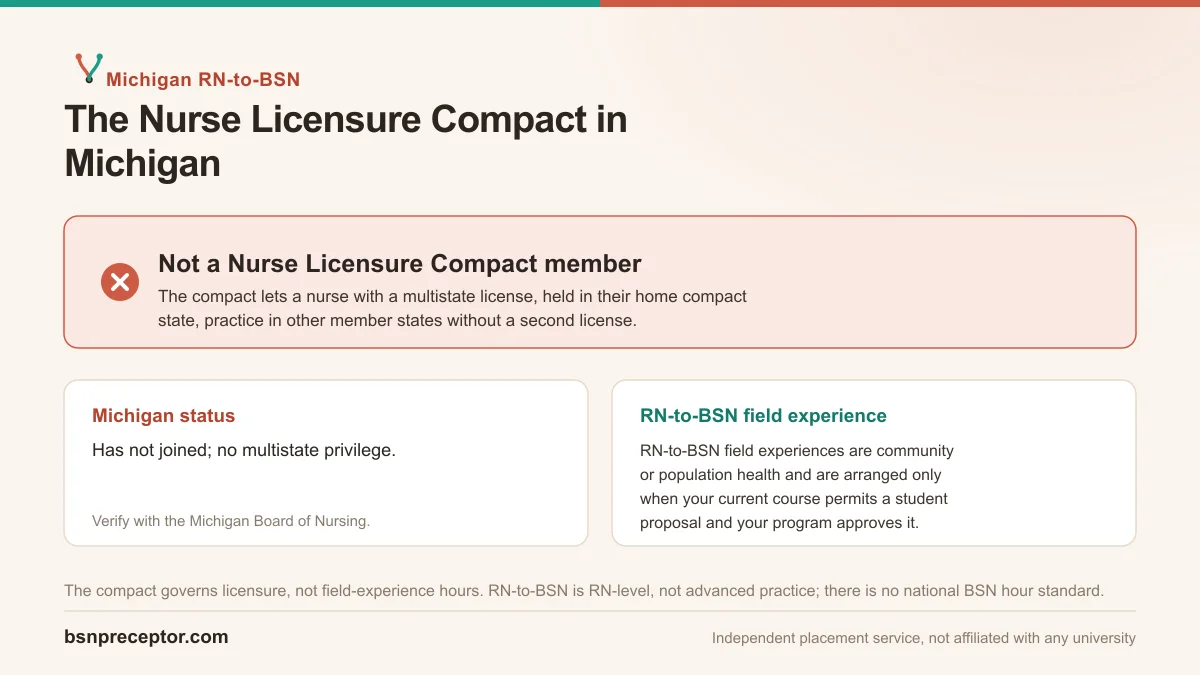
Practice in Michigan runs on a registered-nurse license from the Michigan Board of Nursing, part of the Department of Licensing and Regulatory Affairs. Michigan issues a single-state license. Legislation to join the Nurse Licensure Compact moved through the state House in 2025, but at the time of writing Michigan has not joined, so a Michigan license carries no multistate privilege and nurses from other states apply for licensure by endorsement.
Because many RN-to-BSN programs are online and cross state lines, your field experience follows the license rules of the state where you actually do the work. If you live and practice in Michigan, that means a Michigan license. Confirm the latest compact position with the Board, since this is the kind of thing that changes.
The preceptor for a community or population-health field experience is usually an experienced registered nurse, often BSN-prepared, or another appropriate professional in the setting, such as a public-health nurse, a school nurse, an occupational-health nurse, or a supervisor of a community program. It does not need to be an advanced-practice nurse. Your program sets the exact standard and must approve both the preceptor and the site ahead of time, so we aim for a match your school will accept.
There is no national clinical-hour requirement for the BSN. The 2021 competency-based standards name no hour count for entry-level education, and RN-to-BSN field-experience hours are set program by program, commonly in the range of roughly 30 to 120 hours. Verify your own number, and use BSN clinical hours for context.
If you would like help finding an approvable Michigan site and preceptor, send us your program and city and we will get to work. Asking costs nothing, and nothing is billed until a match is confirmed and your school approves it. See how it works or request a preceptor, and we will respond within one business day.
Not currently. A bill to adopt the Nurse Licensure Compact passed the Michigan House in 2025, but Michigan has not joined, so RN licenses here are single-state. Confirm today's status with the Michigan Board of Nursing.
In RN-to-BSN programs the community or public-health field experience is normally self-sourced, while most prelicensure rotations are arranged by the school. We help self-sourcing students find an approvable site and preceptor.
In rural Michigan, county and district health departments, home health and hospice agencies, school health offices, and community health centers are the usual sites. In the Upper Peninsula, plan early because options are spread out.
Often yes. For a community or population-health experience the preceptor is generally an experienced registered nurse or a suitable professional in the setting, not necessarily an advanced-practice nurse. Your program sets the criteria and must approve the person.
There is no national BSN hour standard; programs set their own, commonly roughly 30 to 120 hours. Check your program and see BSN clinical hours.
Outside sourcing applies only when the current program explicitly permits or requires a student-proposed preceptor, mentor, or site. An advisor reviews the course instructions before candidate sourcing begins.
We do not guarantee placement. Final approval rests with your program.
