If you are finishing an RN-to-BSN in Minnesota, the part you likely have to arrange yourself is a community or population-health field experience with an approved preceptor. Minnesota has a deep public-health tradition and a formal partnership between the state and local community health boards, which gives students a wide choice of settings. This page lays out where students place, who can precept, and how registered-nurse licensure sits.
Last updated July 2026
A Minnesota community or population-health practicum has many possible homes. Students most often complete theirs in:
A single defined project, such as an immunization outreach or a maternal-child home-visiting effort, commonly satisfies the experience. Because programs differ on what counts, read your practicum guide before you commit to a site.
Minnesota runs local public health through a state and local partnership set in the Local Public Health Act. The community health board is the legal governing body for local public health, and it may be a single county, several counties together, or in a few cases a city. In some places public health stands alone, in others it sits inside a human-services agency, and in a few a hospital delivers the services under contract.
Sites concentrate in the Twin Cities of Minneapolis and Saint Paul, with strong secondary hubs in Rochester in the southeast, Duluth on Lake Superior, and the regional centers of Saint Cloud, Mankato, and Moorhead. Greater Minnesota runs rural and, in the north and northwest, frontier, where public-health nurses cover large areas. Eleven tribal nations run their own health programs, and the metro's large immigrant and refugee communities shape a lot of public-health nursing work.
We help two groups. The larger one is RN-to-BSN students, working nurses whose degree ends in a self-sourced community field experience. The smaller one is prelicensure students in accelerated or hybrid tracks who must find their own site. Most prelicensure clinical rotations are arranged by the school, so if your program places you, you may not need help, and we will say so plainly.
For self-sourcing students the job is clear: an approvable site and an approvable preceptor within reach of home. That is what we source. See RN-to-BSN field experience for how the process runs.
For a community or population-health field experience, your preceptor is generally an experienced registered nurse, often BSN-prepared, or another appropriate professional in the setting. Minnesota even defines the public-health nurse role in statute, and a public-health nurse, school nurse, or community-program supervisor is a natural fit. It does not have to be an advanced-practice nurse. Your program sets the criteria and must approve the preceptor and site in advance.
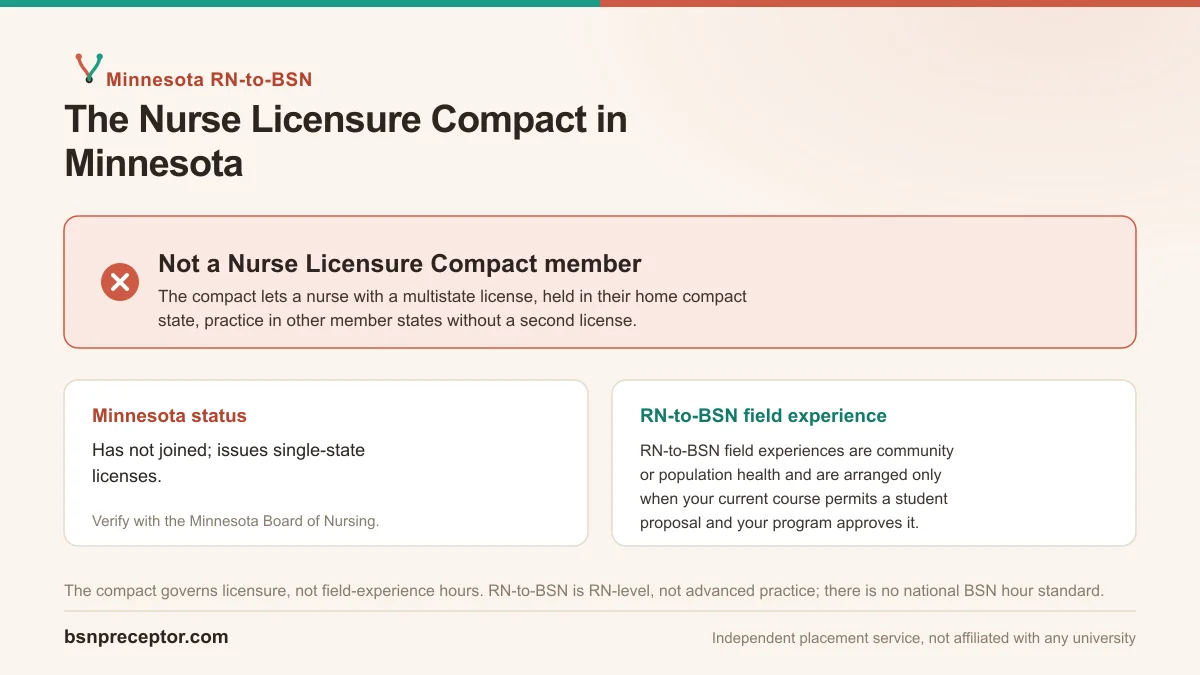
Practice in Minnesota depends on a registered-nurse license from the Minnesota Board of Nursing, and the state issues a single-state license. Bills to adopt the Nurse Licensure Compact have appeared in recent sessions, but Minnesota has not joined, so a Minnesota license carries no multistate privilege and nurses moving here apply for licensure by endorsement.
Since many RN-to-BSN programs run online across state lines, your field experience follows the rules of the state where you complete it. A working RN living in Minnesota should hold, or be endorsing into, a Minnesota license. Check the Board for the latest on the compact, which can shift from session to session.
There is no national required clinical-hour number for the BSN. The 2021 competency-based standards set no hour count for entry-level education, and RN-to-BSN field-experience hours vary by program, commonly in the range of roughly 30 to 120 hours. Confirm your own program's figure, and see BSN clinical hours for more.
If you want help finding an approvable Minnesota site and preceptor, tell us your program and your city and we will begin sourcing. There is no cost to ask, and nothing is billed until a match is confirmed and your school signs off. Read how it works, see the cost, or request a preceptor.
No. Minnesota has considered Nurse Licensure Compact bills but has not joined, so RN licenses are single-state and out-of-state nurses apply by endorsement. Confirm the current status with the Minnesota Board of Nursing.
In an RN-to-BSN program, usually yes; the community field experience is self-sourced. Most prelicensure rotations are arranged by the school. We help the self-source path and will tell you if your program already places you.
Outside the Twin Cities, common sites are county and multi-county community health boards, community health centers, home health and hospice, school health, and tribal health programs. In the rural north, plan early because distances are large.
Generally an experienced registered nurse or an appropriate professional in the setting, such as a public-health or school nurse. It does not need to be an advanced-practice nurse. Your program sets the rules and must approve the preceptor.
There is no national BSN standard; programs set totals themselves, commonly roughly 30 to 120 hours. Confirm with your program and see BSN clinical hours.
Outside sourcing applies only when the current program explicitly permits or requires a student-proposed preceptor, mentor, or site. An advisor reviews the course instructions before candidate sourcing begins.
We do not guarantee placement. Final approval rests with your program.
