For most students who reach us in Mississippi, the missing piece of an RN-to-BSN is a community or population-health field experience with a qualified preceptor, arranged on their own. Mississippi runs a state-operated network of county health departments and leans heavily on community health centers, especially across its rural stretches, which shapes where placements are easy to build. Below is a clear look at the settings, the preceptor, and how licensure works.
Last updated July 2026
We help two groups of Mississippi students. The larger group is RN-to-BSN students, working nurses whose bachelor's ends in a self-sourced community or public-health practicum. The smaller group is prelicensure students in accelerated or hybrid programs asked to find a local site of their own. Most traditional prelicensure rotations are arranged by the school, so if yours places you, you may already be covered.
When you do have to self-source, the goal is straightforward: an approvable site and an approvable preceptor close enough to home to be practical, that your program will sign off on. That is exactly what we do here. See RN-to-BSN field experience for the walkthrough.
Mississippi is unusual in how centralized its public health is. The Mississippi State Department of Health operates county health departments in every county, grouped into nine public health districts, with regional offices that include a central region in Jackson and a southern region in Hattiesburg. For a student, that means a large, consistent set of public-health sites reachable through one state system.
The state is mostly rural. Jackson anchors the center, the Gulf Coast runs along Gulfport and Biloxi, Hattiesburg holds the Pine Belt, Tupelo sits in the northeast, and Meridian lies to the east. The Delta in the northwest is notably rural and underserved, which is one reason community health centers matter so much there, while DeSoto County in the north edges the Memphis metro. Rural placement is doable, but lining up a site and preceptor early makes it far smoother.
A community or population-health field experience in Mississippi can sit in a range of settings. The most common are:
Often a single project, such as a hypertension screening series or an immunization push, meets the requirement. Your program decides which settings qualify, so check its practicum guide first.
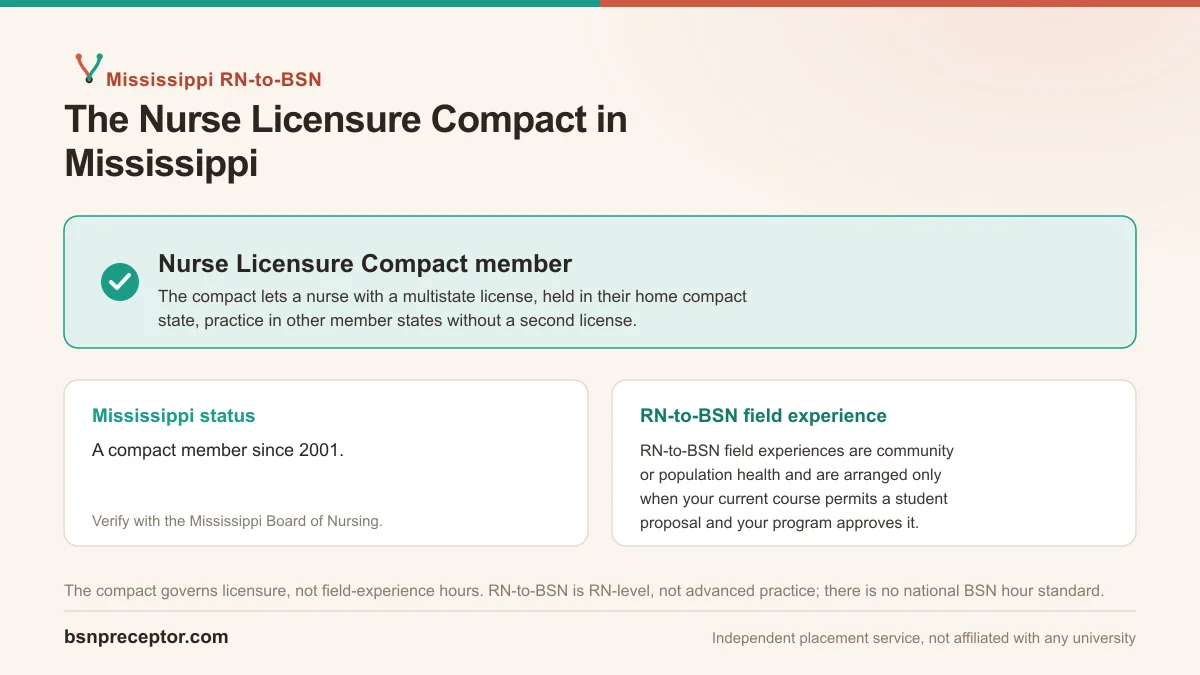
Practice in Mississippi runs on a registered-nurse license from the Mississippi Board of Nursing. Mississippi is a longstanding Nurse Licensure Compact member and has been since 2001. If Mississippi is your primary state of residence, your license can be issued as multistate, letting you practice in other compact states without a second license.
That portability helps RN-to-BSN students, because many programs run online across state lines. Even so, your field experience follows the rules of the state where you complete it, so confirm the specifics with the Board. If you moved here on a compact license from another state, you can generally keep practicing while your endorsement is reviewed, but verify your own case.
For a community or population-health field experience, the preceptor is generally an experienced registered nurse, often BSN-prepared, or another appropriate professional in the setting, such as a public-health nurse, a school nurse, or a community-program supervisor. It does not have to be an advanced-practice nurse. Your program sets the exact criteria and must approve both the preceptor and the site before you begin, so we match you to someone your school can accept.
There is no national clinical-hour requirement for the BSN. The 2021 competency-based standards set no hour count for entry-level education, and RN-to-BSN field-experience hours are set by each program, commonly in the range of roughly 30 to 120 hours. Confirm your own program's number and see BSN clinical hours.
If you want help finding an approvable Mississippi site and preceptor, send us your program and city and we will start sourcing. There is no cost to ask, and nothing is billed until a match is confirmed and your school signs off. Look over how it works, browse the preceptor FAQ, or request a preceptor.
Yes. Mississippi has been a Nurse Licensure Compact member since 2001, so if it is your primary residence your RN license can be multistate. Confirm your own status with the Mississippi Board of Nursing.
In RN-to-BSN programs, usually yes; the community field experience is self-sourced. Most prelicensure rotations are arranged by the school. We help self-sourcing students and will tell you if your program already places you.
State-run county health departments, community health centers, rural health clinics, home health and hospice, and school health offices are the usual sites. Because the Delta is rural, it helps to line up a preceptor early.
Often yes. For a community or population-health experience the preceptor is generally an experienced registered nurse or a suitable professional in the setting, not necessarily an advanced-practice nurse. Your program sets the criteria and must approve the person.
There is no national BSN standard; each program sets its own, commonly roughly 30 to 120 hours. Confirm with your program and see BSN clinical hours.
Outside sourcing applies only when the current program explicitly permits or requires a student-proposed preceptor, mentor, or site. An advisor reviews the course instructions before candidate sourcing begins.
We do not guarantee placement. Final approval rests with your program.
