Most students who come to us in Missouri are working RNs finishing an RN-to-BSN, where the degree ends in a community or population-health field experience you set up yourself. Missouri delivers local public health through about 115 city and county agencies, and its two big metros sit at opposite ends of the state, which affects where a site and preceptor are simple to find. This page explains the settings, the preceptor, and how licensure works.
Last updated July 2026
Two groups reach this page. The larger is RN-to-BSN students, already licensed and working, whose bachelor's finishes with a self-sourced community or public-health experience. The smaller is prelicensure students in accelerated or hybrid tracks who must find their own site. Most prelicensure clinical rotations are still arranged by the school, so if your program places you, you may be set and we will tell you honestly.
For the self-source path, the work is simple to state: an approvable site and an approvable preceptor within reach of home that your program will approve. That is what we source across Missouri. If this is new, start with RN-to-BSN field experience.
A Missouri community or population-health practicum can live in many settings. Students most often use:
A single project often meets the requirement, such as a community health assessment or a vaccination clinic. Your program decides what qualifies, so read its practicum guide before committing to a site.
Missouri delivers local public health through roughly 115 local public health agencies, a mix of city, county, and combined offices that work with the Department of Health and Senior Services under contract while staying locally governed. That gives students a broad, dependable set of public-health sites statewide.
The two largest pools of sites sit at opposite ends: Saint Louis in the east and Kansas City in the west. Springfield anchors the Ozarks in the southwest, Columbia sits in the center as a medical and university town, and Jefferson City is the capital. The Bootheel in the far southeast is rural, agricultural, and underserved, and long rural stretches run through the Ozarks, so in those areas it pays to arrange a site and preceptor early.
For a community or population-health field experience, your preceptor is generally an experienced registered nurse, often BSN-prepared, or another appropriate professional in the setting, such as a public-health nurse, a school nurse, or a community-program supervisor. It does not need to be an advanced-practice nurse. Your program sets the criteria and must approve the preceptor and the site in advance, so we work toward a match your school will accept.
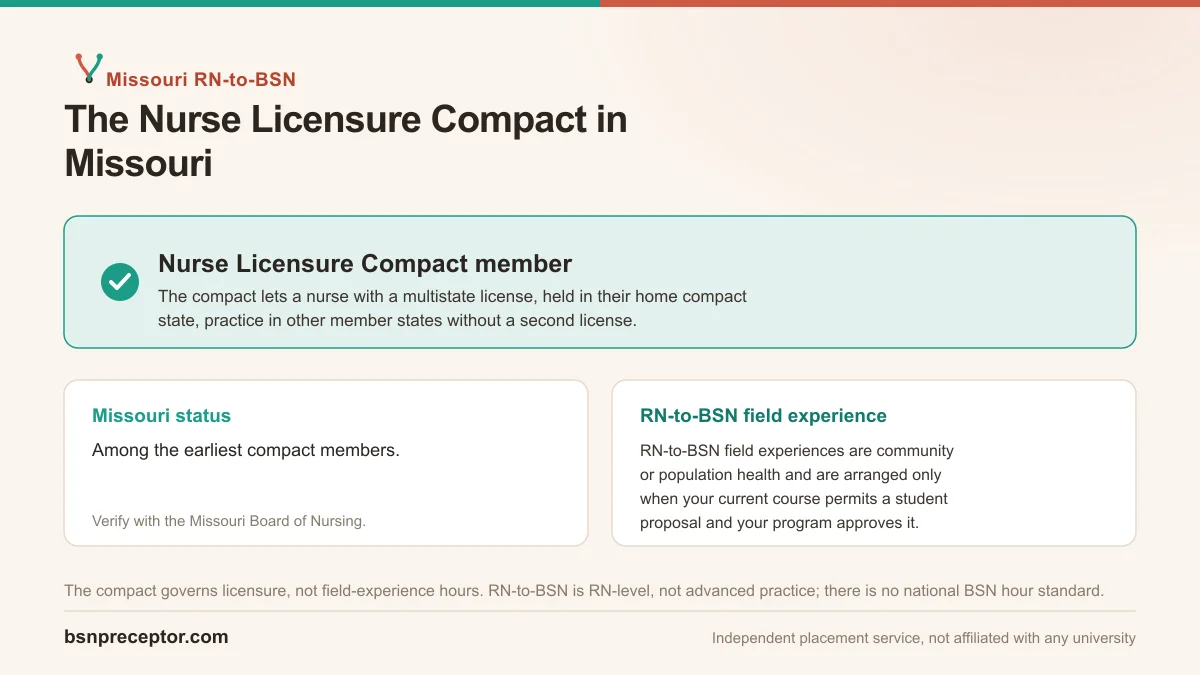
Practice in Missouri runs on a registered-nurse license from the Missouri State Board of Nursing, part of the Division of Professional Registration. Missouri is a Nurse Licensure Compact member and was one of the earliest to join. With Missouri as your primary state of residence, your license can be multistate, so you may practice in other compact states without applying separately in each.
For working RNs finishing a bachelor's online, that reach is handy, though your community field experience still follows the rules of the state where you complete it. Keep your primary residence and license details current with the Board, and confirm anything you are unsure about before you count on it.
There is no national required clinical-hour number for the BSN. The 2021 competency-based standards name no hour count for entry-level education, and RN-to-BSN field-experience hours are set by each program, commonly in the range of roughly 30 to 120 hours. Confirm your own program's figure and see BSN clinical hours.
If you want help lining up an approvable Missouri site and preceptor, tell us your program and your city and we will start sourcing. There is no cost to ask, and nothing is billed until a match is confirmed and your school signs off. See how it works, check the cost, or request a preceptor, and we will reply within one business day.
Yes. Missouri is a Nurse Licensure Compact member and was one of the first to join, so if it is your primary residence your RN license can be multistate. Confirm your own status with the Missouri State Board of Nursing.
In RN-to-BSN programs the community or public-health field experience is normally self-sourced, while most prelicensure rotations are arranged by the school. We help self-sourcing students find an approvable site and preceptor.
City and county public health agencies, community health centers, home health and hospice, and school health offices are common sites. In the Bootheel and the Ozarks, plan early because sites are more spread out.
No. For a community or population-health experience it is generally an experienced registered nurse or a suitable professional in the setting, such as a public-health or school nurse, subject to your program's rules.
There is no national BSN hour standard; programs set their own totals, commonly roughly 30 to 120 hours. Check your program and see BSN clinical hours.
Outside sourcing applies only when the current program explicitly permits or requires a student-proposed preceptor, mentor, or site. An advisor reviews the course instructions before candidate sourcing begins.
We do not guarantee placement. Final approval rests with your program.
