In Nebraska, the students we help are mostly RN-to-BSN nurses who have to self-source a community or population health field experience, since prelicensure programs generally arrange their own clinical rotations. The BSN has no national clinical-hour number; most programs place this experience in a range of about 30 to 120 hours, and your school sets yours. We help you find an approvable site and preceptor from Omaha and Lincoln to the Panhandle.
Last updated July 2026
Nebraska organizes public health through the Department of Health and Human Services Division of Public Health and a statewide network of local health departments, several of which cover multiple rural counties. Those departments, community health centers, and school health programs are where RN-to-BSN students most often build a population health project. Big metro departments like the Douglas County Health Department in Omaha and the Lincoln-Lancaster County Health Department carry the heaviest program load, while the State Office of Rural Health helps knit together services across the sparsely populated west.
The two BSN routes carry very different clinical expectations. Prelicensure students generally have rotations arranged by their school and rarely need outside help. RN-to-BSN students, already licensed as RNs, are usually told to find their own community or public health experience and a preceptor to sign off, and that is the group we serve, along with the few accelerated or hybrid students asked to self-source.
The largest concentration of sites and preceptors sits in the east, in Omaha in Douglas County and in Lincoln in Lancaster County, where big local health departments and hospital systems run population-health programs. Central and western Nebraska, including Grand Island, Kearney, Columbus, Norfolk, and Scottsbluff in the Panhandle, lean on multi-county health departments and the State Office of Rural Health, so a rural placement rewards an early start.
A community or population health preceptor is generally an experienced registered nurse or a suitable professional in the setting, not a prescriber. Public health nurses, community-program supervisors, and nurses in population-health roles routinely qualify, but your program decides on credentials and hours.
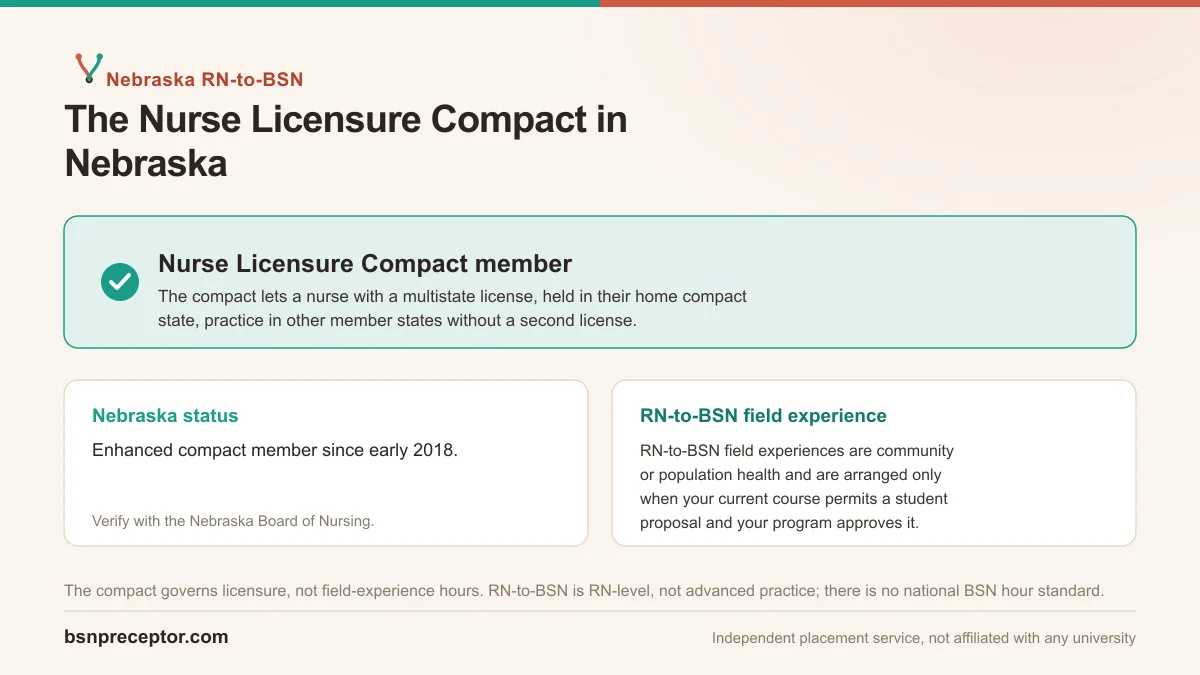
Nebraska is a Nurse Licensure Compact member and has issued multistate licenses under the enhanced compact since early 2018. Because many RN-to-BSN students are working nurses and many programs run online across state lines, this matters: if Nebraska is your primary residence you may hold a multistate license, and a multistate license from another compact state generally reaches Nebraska practice. Nebraska nurses are licensed by the Department of Health and Human Services, and details should be confirmed with its licensure unit.
Give us your school, your town, and the population you want to serve, and we search for an approvable community or public health site and a preceptor near you. We are independent, we work with students at any university, and we assist rather than promise, since your program always signs off. Asking costs nothing, and you can see how it works and our cost up front.
There is no national or state BSN hour standard. Your community or population health hours are set by your program, commonly in the range of about 30 to 120 hours, so confirm the exact number with your school.
Usually not, because prelicensure programs arrange their own clinical rotations. We focus on RN-to-BSN students and the smaller group of accelerated or hybrid students who are told to self-source a site.
Yes. Local and multi-county health departments are among the most common Nebraska settings, along with community health centers, school health, and home health, subject to your program's approval.
Nebraska is a Nurse Licensure Compact member, so a multistate license from your home compact state generally lets you practice here. Confirm your own case with the Nebraska Board of Nursing.
Your nursing program. We help you find community sites and preceptors likely to meet its rules, but the school makes the final decision and we never guarantee a placement.
Outside sourcing applies only when the current program explicitly permits or requires a student-proposed preceptor, mentor, or site. An advisor reviews the course instructions before candidate sourcing begins.
We do not guarantee placement. Final approval rests with your program.
