Most BSN placement help in New Mexico is for RN-to-BSN students, already-licensed nurses finishing the bachelor's, whose capstone is a self-arranged community or population health field experience with a preceptor. We also help the smaller group of accelerated and online prelicensure students who must find their own site, since traditional prelicensure programs arrange clinical rotations themselves. This page maps where those experiences happen from Albuquerque to the rural counties, and how licensure fits in.
Last updated July 2026
A BSN is a bachelor's degree, not an advanced-practice program, so the RN-to-BSN experience is built around community and population health rather than hospital specialty shifts. For nurses finishing the bachelor's, the requirement is a set number of hours with a public health or community-nursing team, usually tied to a capstone. Prelicensure students, by contrast, generally have their rotations arranged by the school.
New Mexico runs a wide public health network that makes good field-experience ground. The state health department keeps public health offices in most counties and works alongside two dozen Tribes, Nations, and Pueblos on prevention and direct care. Around those sit a large web of community health centers, most of them in rural areas, plus home health, hospice, and school programs.
New Mexico is largely rural and frontier, so where you live changes the search. Albuquerque and neighboring Rio Rancho hold the deepest bench of clinics, agencies, and hospital population-health teams, and Santa Fe, the capital, adds state agencies and non-profits. Las Cruces anchors the south near the border, where community and migrant health work is steady, while Roswell, Farmington, and Gallup have real offices and centers but fewer of them.
For a community or population health field experience the preceptor is generally an experienced registered nurse or another qualified professional in the setting, not an advanced-practice nurse. Public health nurses, school nurses, community-program supervisors, and nurses in population-health roles routinely qualify. Your program sets the credential and hour rules and gives the final approval, so we match you to someone it can sign off on.
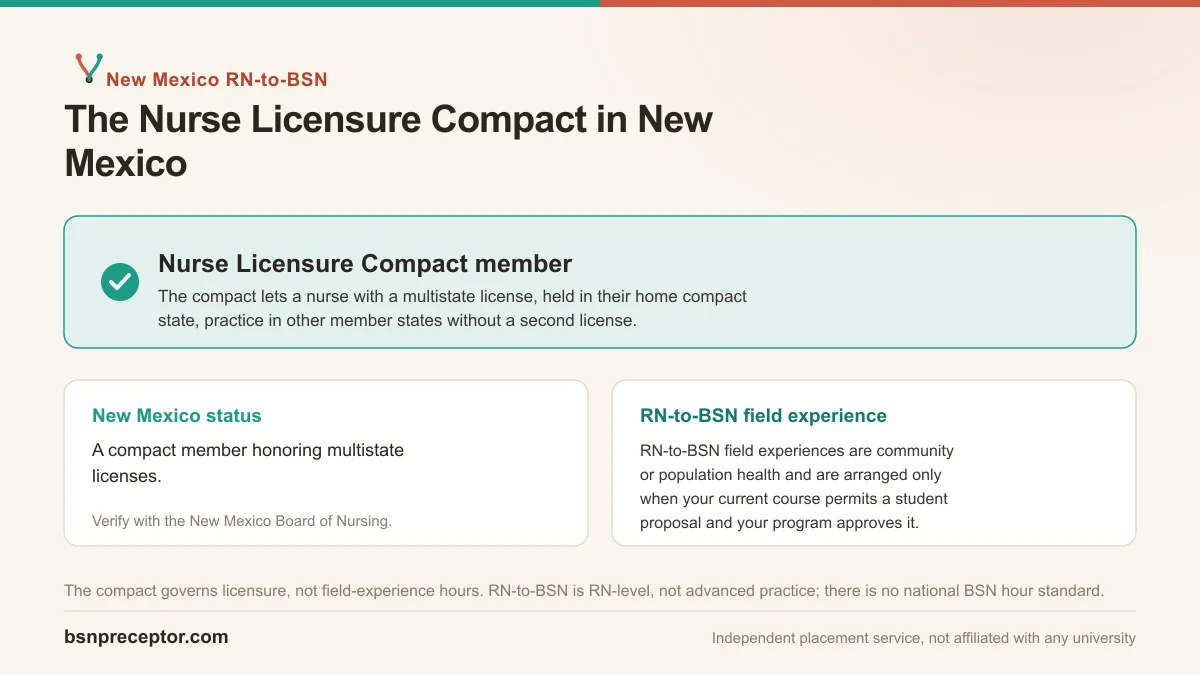
Because RN-to-BSN students are usually working nurses, licensure comes first. New Mexico is a member of the Nurse Licensure Compact, so a nurse who holds a multistate license as a resident of another compact state can generally practice here without a second license. If you make New Mexico your primary residence, you apply for New Mexico licensure through the state board. Compact rules change over time, so confirm your own status with the board.
We keep the promise small and honest. If your program already arranges your clinicals, we will tell you, and you will not need us. If you are RN-to-BSN or a self-source prelicensure student, we look for an approvable community or public health site and preceptor near you, make the introduction, and hand your program clean paperwork. We are independent, we work with students at any university, and final approval always rests with your school.
There is no national or state BSN hour standard. Your program sets the community or population health hours, commonly in the range of about 30 to 120 hours, so confirm the exact number with your school and see our BSN clinical hours page.
Usually not, because prelicensure programs arrange their own clinical rotations. We focus on RN-to-BSN students and the smaller group of accelerated or hybrid students told to self-source a community site.
Yes. New Mexico participates in the Nurse Licensure Compact, so a multistate license from another compact state generally covers practice here. If you move your primary residence to New Mexico you apply through the New Mexico Board of Nursing. Confirm current rules with the board.
Yes, in most programs. A community or population health experience is typically precepted by an experienced registered nurse or a qualified public health professional. It does not need a nurse practitioner. Your program approves the final choice.
Often, yes. County public health offices, community health centers, tribal or Indian Health Service programs, school health, and home health agencies exist across rural New Mexico. Rural searches can take longer, so reach out early with your city and program.
Outside sourcing applies only when the current program explicitly permits or requires a student-proposed preceptor, mentor, or site. An advisor reviews the course instructions before candidate sourcing begins.
We do not guarantee placement. Final approval rests with your program.
