In New York, most BSN placement help goes to RN-to-BSN students, working nurses finishing the bachelor's, who need a community or population health field experience arranged with their own preceptor. A smaller group of accelerated and online prelicensure students also has to self-source a site, though most prelicensure clinicals are still set up by the school. This page shows where those experiences happen from New York City to the rural North Country, and why the state's licensure rules deserve a close read.
Last updated July 2026
A BSN is a bachelor's degree, not an advanced-practice program, so the RN-to-BSN experience is built around community and population health rather than hospital specialty shifts. New York gives students a deep bench of settings, anchored by a state health department and 58 local health departments, the 57 county health departments plus the New York City Department of Health and Mental Hygiene. Read the RN-to-BSN field experience for the shape of a typical capstone.
The state splits sharply between the New York City metro and everything north and west of it. In the five boroughs, Yonkers, and the lower Hudson Valley, community health centers, hospital population-health departments, and community non-profits are dense, so the task is choosing among sites and getting approval quickly. Buffalo, Rochester, Syracuse, and the capital, Albany, offer the same range on a smaller scale.
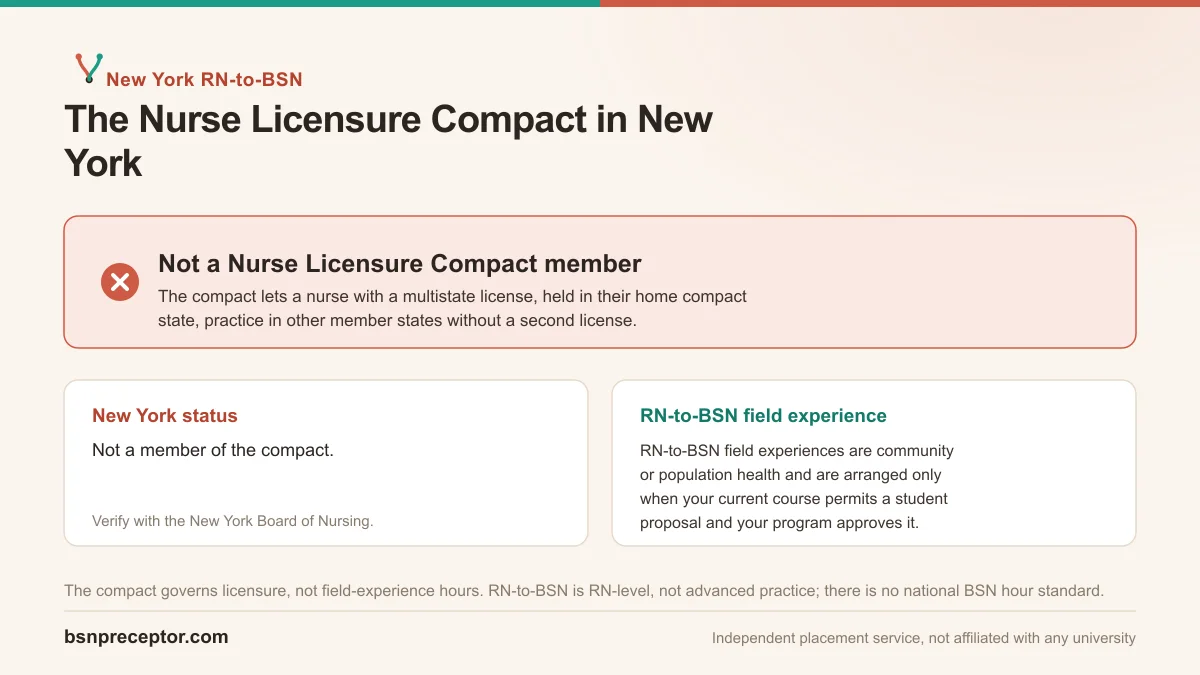
This is the detail out-of-state students miss most. New York is not a member of the Nurse Licensure Compact. A multistate license issued by a compact state does not by itself authorize practice in New York, and to work as a nurse in New York you hold a New York RN license. Licensure runs through the New York State Board for Nursing, part of the State Education Department's Office of the Professions, rather than a standalone board of nursing.
For a community or population health experience the preceptor is usually an experienced registered nurse or another qualified professional at the site. Public health nurses, school nurses, care managers, and community-program supervisors routinely qualify. A bachelor's field experience does not require a nurse practitioner, and your program sets the final rules on credentials and paperwork.
There is no New York or national rule that fixes how many field-experience hours a BSN must complete. Totals are set program by program and commonly land somewhere between about 30 and 120 hours for the RN-to-BSN community experience. Check the exact number against your syllabus before you plan a placement.
If your program already arranges your placements, we will say so and send you on your way. If you are RN-to-BSN or a self-source prelicensure student, we look for an approvable community or public health site and preceptor near you, make the introduction, and give your program clean documentation. We are independent, we work with students at any university, and we assist rather than promise, because your school holds final approval.
No. New York does not belong to the Nurse Licensure Compact. A multistate license from a compact state does not cover practice in New York, so you need a New York RN license to practice here. Confirm your status with the New York State Board for Nursing at the Office of the Professions.
Mostly your school does. Traditional prelicensure BSN programs arrange hospital rotations for their students. We concentrate on RN-to-BSN community field experiences and the smaller number of accelerated or online prelicensure students told to find a local site.
There is no statewide or national BSN figure. Programs set their own totals, often in the range of about 30 to 120 hours. Confirm the exact number with your program and see our BSN clinical hours page.
Yes. County health departments, home health and hospice agencies, school health, and migrant or farmworker health programs operate across upstate New York. Rural areas have fewer sites, so start early and share your county and program when you reach out.
Your nursing program. We help you find community sites and preceptors likely to meet its rules, but the school makes the final decision and we never guarantee a placement.
Outside sourcing applies only when the current program explicitly permits or requires a student-proposed preceptor, mentor, or site. An advisor reviews the course instructions before candidate sourcing begins.
We do not guarantee placement. Final approval rests with your program.
