Most BSN placement help in North Carolina is for RN-to-BSN students, already-licensed nurses completing the bachelor's, whose capstone is a self-arranged community or population health field experience with a preceptor. We also help the smaller group of accelerated and online prelicensure students who must find their own site, since traditional prelicensure programs arrange clinical rotations themselves. Here is how field experience takes shape from the Piedmont cities to the coastal plain and the mountains.
Last updated July 2026
A BSN is a bachelor's degree rather than an advanced-practice credential, so the RN-to-BSN experience is grounded in community and population health. If you are in a traditional prelicensure program, your school most likely coordinates your hospital rotations and you may not need us at all. Our work is the self-source path: matching an approvable community site and preceptor when the program leaves that to you.
North Carolina has a strong local public health structure. The state Division of Public Health works with dozens of local public health agencies that together serve all 100 counties, and around them sit community health centers, home health and hospice agencies, and school health programs. That mix gives RN-to-BSN students a wide choice of population-health settings.
Where you live shapes the search. The Piedmont crescent, Charlotte, Raleigh, Durham, Greensboro, and Winston-Salem, holds the most clinics, agencies, and hospital population-health teams, so students there usually have the widest choice. Fayetteville and Wilmington add coastal and military-adjacent options, while the rural east and the Appalachian west around Asheville are more spread out.
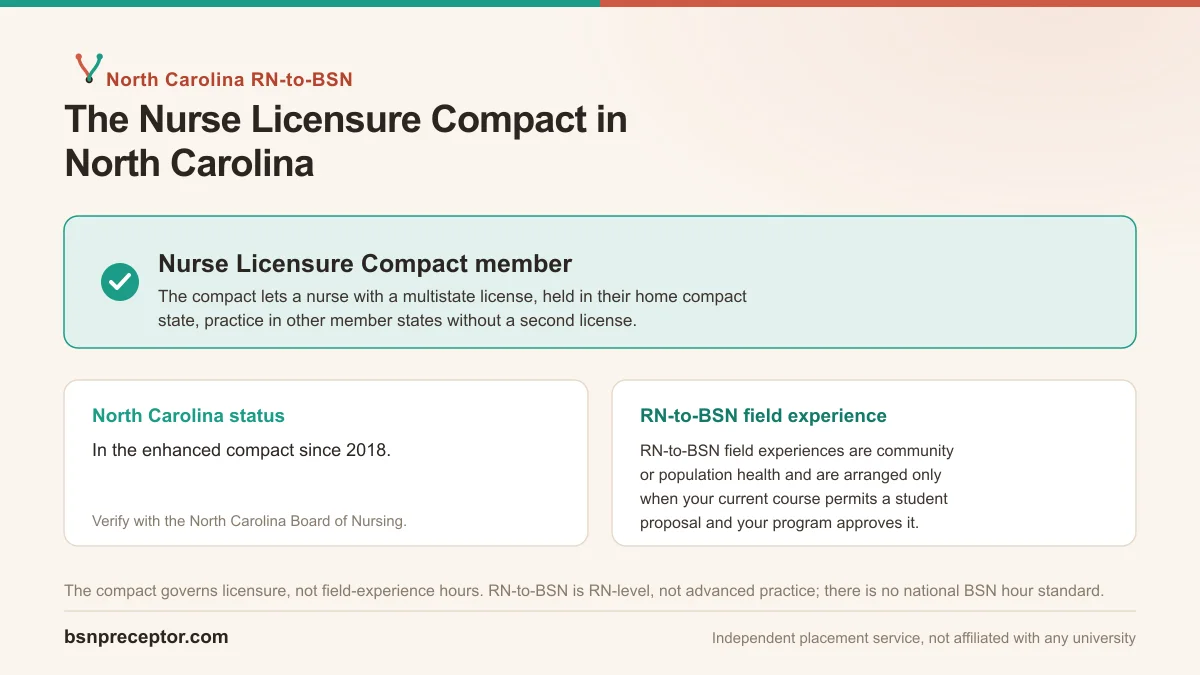
Because RN-to-BSN students are usually working nurses, licensure comes first. North Carolina has been part of the enhanced Nurse Licensure Compact since 2018, so a nurse who holds a multistate license as a resident of another compact state can generally practice here without a second license. If North Carolina is your primary residence, your license is issued through the North Carolina Board of Nursing. Compact rules change over time, so confirm your own status with the board.
For a community or population health field experience the preceptor is generally an experienced registered nurse or another qualified professional in the setting. Public health nurses, school nurses, and community-program supervisors routinely qualify. A bachelor's experience does not require a nurse practitioner, and your program decides who it will approve and what sign-off it needs.
We keep it honest. If your program places you, we will tell you. If not, we look for an approvable community or public health site and preceptor near you, make the introduction, and hand your program clean paperwork. We are independent, we work with students at any university, and final approval always rests with your school.
Yes. North Carolina takes part in the Nurse Licensure Compact, so a multistate license held by a resident of another compact state generally covers practice here. If North Carolina is your primary residence, you are licensed through the North Carolina Board of Nursing. Confirm current rules with the board.
Usually your school does. Traditional prelicensure BSN programs coordinate hospital rotations for their students. We focus on RN-to-BSN community field experiences and the smaller number of accelerated or online prelicensure students who must self-source a site.
There is no state or national BSN number. Each program sets its own total, often in the range of about 30 to 120 hours for the RN-to-BSN community experience. Check the exact figure with your program and see our BSN clinical hours page.
Yes. County health departments, community and migrant health centers, home health, and school health operate across eastern and western North Carolina. Rural searches take a little longer, so reach out early with your county and program.
Typically an experienced registered nurse or a qualified public health professional at your site. A nurse practitioner is not required for a bachelor's community experience. Your program approves the final choice.
Outside sourcing applies only when the current program explicitly permits or requires a student-proposed preceptor, mentor, or site. An advisor reviews the course instructions before candidate sourcing begins.
We do not guarantee placement. Final approval rests with your program.
