In North Dakota, BSN placement help is mostly for RN-to-BSN students, working nurses finishing the bachelor's, who arrange a community or population health field experience with their own preceptor. A smaller group of accelerated and online prelicensure students also self-sources a site, while traditional prelicensure programs arrange their own clinical rotations. This page maps where those experiences happen in a large, rural state and how licensure works here.
Last updated July 2026
A BSN is a bachelor's degree, not an advanced-practice program, so the RN-to-BSN experience is built around community and population health. North Dakota is spread thin across a lot of land, which shapes the search, but the state runs a real public health network of 28 local public health units organized as single-county and multi-county districts. Those units are often the most reachable field sites.
Around the local public health units sit community health centers, home health and hospice agencies, tribal health programs, and school health, giving RN-to-BSN students a workable set of population-health settings even far from the cities.
The eastern cities hold the most options. Fargo and neighboring West Fargo, Grand Forks, and the capital, Bismarck, have the largest share of clinics, agencies, and hospital population-health teams. Minot adds a northern hub, and the western oil-patch communities around Williston bring occupational and community health tied to a fast-changing population.
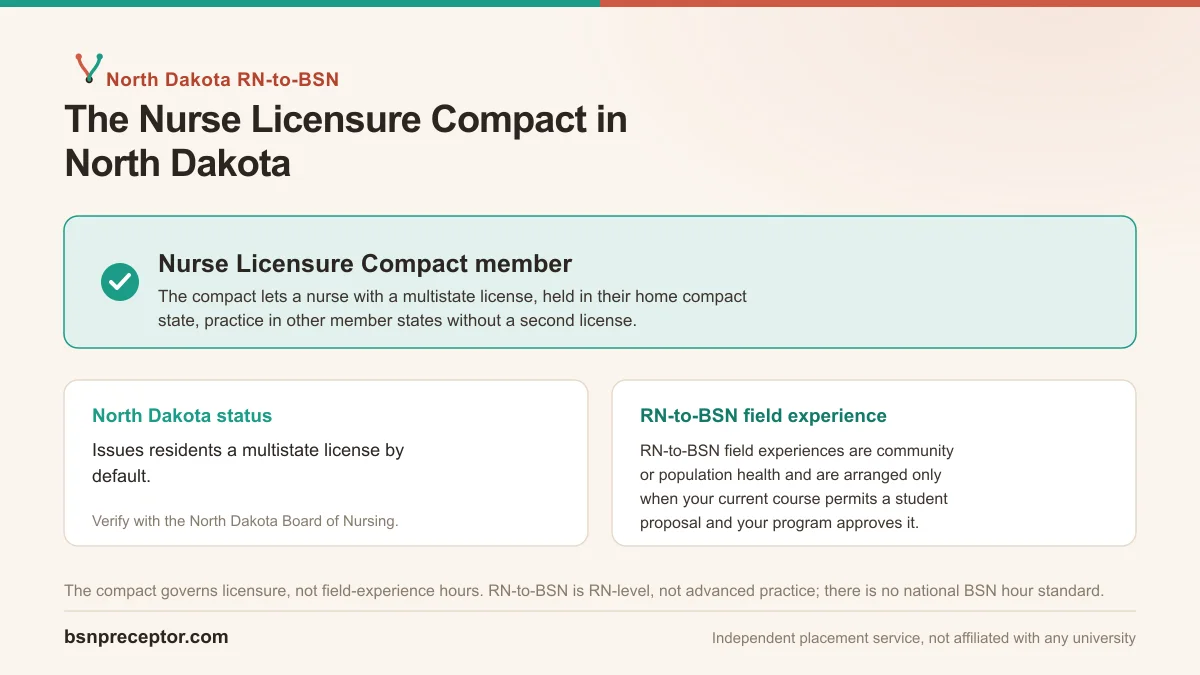
North Dakota is a member of the Nurse Licensure Compact, and for nurses whose primary residence is North Dakota the state issues a multistate license by default. A nurse who holds a multistate license from another compact state can generally practice here without a second license. Licensure runs through the North Dakota Board of Nursing, and because compact details change, confirm your own status with the board.
For a community or population health field experience the preceptor is generally an experienced registered nurse or another qualified professional at the site. Public health nurses, school nurses, and community-program supervisors routinely qualify. A bachelor's experience does not require a nurse practitioner, and your program sets the final rules on credentials and paperwork.
We keep the promise honest. If your program already places you, we will say so. If you are RN-to-BSN or a self-source prelicensure student, we look for an approvable community or public health site and preceptor near you, make the introduction, and give your program clean documentation. We are independent, we work with students at any university, and your school holds final approval.
Yes. North Dakota belongs to the Nurse Licensure Compact, and residents are issued a multistate license by default. A multistate license from another compact state generally covers practice here. Licensure runs through the North Dakota Board of Nursing, so confirm current rules with the board.
Usually your school does. Traditional prelicensure BSN programs coordinate hospital rotations. We focus on RN-to-BSN community field experiences and the smaller number of accelerated or online prelicensure students who must find their own site.
There is no state or national BSN figure. Programs set their own totals, often about 30 to 120 hours for the RN-to-BSN community experience. Confirm the exact number with your program and see our BSN clinical hours page.
Often, yes. Local public health units, community health centers, tribal health programs, home health, and school health operate across rural North Dakota. Sites are spread out, so reach out early with your town and program.
Typically an experienced registered nurse or a qualified public health professional at your site, such as a public health nurse. A nurse practitioner is not required for a bachelor's community experience. Your program approves the final choice.
Outside sourcing applies only when the current program explicitly permits or requires a student-proposed preceptor, mentor, or site. An advisor reviews the course instructions before candidate sourcing begins.
We do not guarantee placement. Final approval rests with your program.
