Most Oklahoma students who come to us are working registered nurses finishing an RN-to-BSN, and the piece they have to arrange themselves is a community or population health field experience with a qualified preceptor. That experience happens in Oklahoma's own health departments, community clinics, schools, and public health programs, not in a hospital specialty rotation. We help you find an approvable site and preceptor; your program sets the exact hours and signs off.
Last updated July 2026
The honest starting point is which path you are on. If you are in a prelicensure BSN program, your school almost always arranges your clinical rotations for you, and most of those students do not need us. If you are an RN-to-BSN student, your program expects you to self-source a community or public health field experience and often a preceptor to sign off. We built this service for that second group, plus the smaller number of accelerated or online prelicensure students whose programs ask them to help find a local site.
There is no national hour count for the BSN. Community field experience totals are set by each program and commonly land somewhere in the rough range of 30 to 120 hours. Treat any number you read online as a starting point and confirm your own requirement in your syllabus. Our BSN clinical hours page explains why the figure moves so much from school to school.
Public health in Oklahoma runs through four kinds of organizations, and any of them can host a community field experience: the Oklahoma State Department of Health with its county health departments, the two large independent city-county agencies, the tribal health systems, and a wide set of community and non-profit programs. The state department supports county health departments across 68 counties, while the Oklahoma City-County Health Department and the Tulsa Health Department run their metros directly.
Oklahoma is two Oklahomas for placement purposes. The Oklahoma City and Tulsa metros, along with Norman, Edmond, Broken Arrow, and Stillwater, hold most of the formal public health infrastructure, so students there usually have several possible sites within a short drive. The Tulsa Health Department alone serves more than 675,000 residents across the county.
Outside the metros, many counties are rural and served by a single county health department office, a critical access hospital, and a home health or hospice agency that covers a wide territory. That does not mean there is no site near you; it means there are fewer of them and the right relationship matters more. If you live in western Oklahoma, the panhandle, or the southeast, tell us early so we can start with the agencies that are realistically within reach.
For a community or population health field experience, your preceptor is generally an experienced registered nurse or another appropriate professional in the setting. That might be a public health nurse at a county health department, a community program supervisor, a school nurse, or a nurse in a care coordination or population health role. It does not have to be an advanced practice nurse or a physician, because you are not doing a prescriber's job. You are learning community and population health practice.
Your program has the final say on who qualifies and what documentation the preceptor must provide, so we screen candidates against your school's written criteria before anyone commits. We assist with the match; we never guarantee that your school will approve a given preceptor or site.
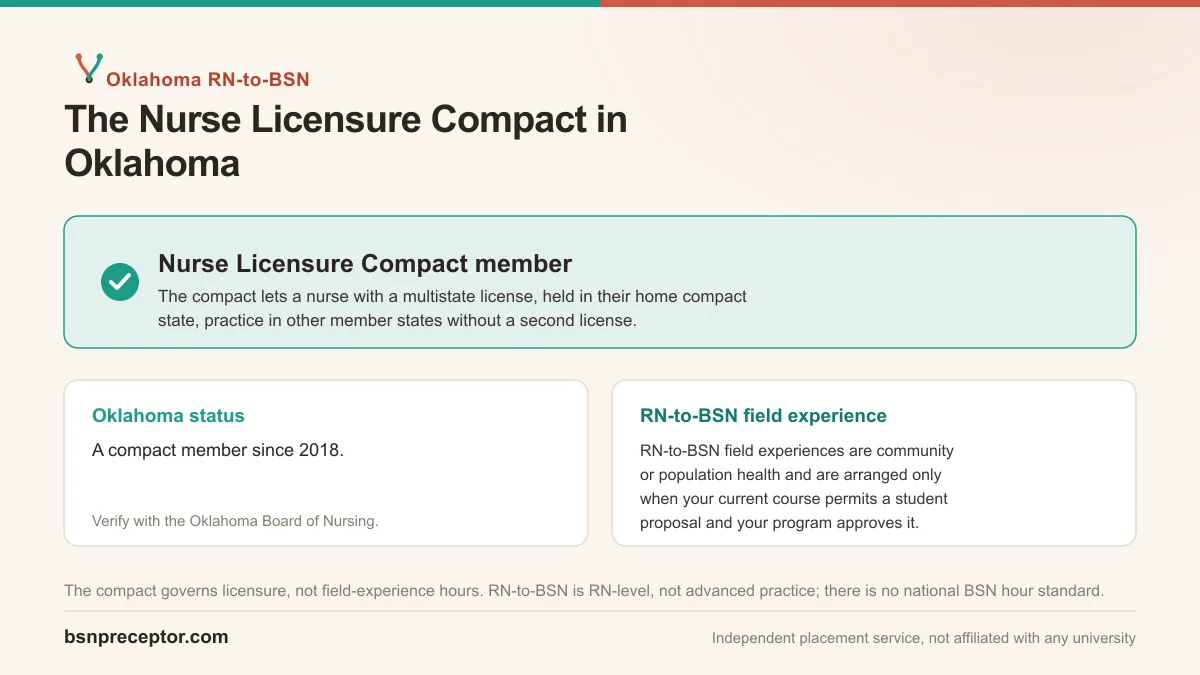
Because RN-to-BSN students are usually already working nurses, licensure sits in the background here rather than being a barrier. Oklahoma is a member of the Nurse Licensure Compact and has been since 2018, so a multistate license issued with Oklahoma as your primary state of residence lets you practice in other compact states, and nurses who live in other compact states can practice in Oklahoma on their multistate license. Many RN-to-BSN programs are online and enroll students across state lines, which is exactly why the compact matters.
The Oklahoma Board of Nursing is the licensing authority, and it is the right place to confirm your own status, renewal dates, and any multistate questions. A field experience site will verify your active license before your first day, so check your renewal the week you register for the course, not the week it starts.
Once we know your city, your program, and your required hours, we identify community and public health sites that fit and approach them on your behalf, then stay with the affiliation paperwork until it is signed. You keep the academic work, because that part has to be yours. Typical field experience totals fall in the rough range of 30 to 120 hours depending on your school, and you can see how we work on the how it works page and what we charge on the cost page.
If you are ready, tell us your details on the contact page or request a match at the top of this page. There is no cost to ask, nothing is billed until a match is confirmed and your program signs off, and we will tell you honestly if your program already places you.
If you are an RN-to-BSN student, usually yes. Most RN-to-BSN programs ask you to self-source a community or population health field experience and a preceptor, and that is the work we help with. Prelicensure BSN students are typically placed by their school. Confirm which model your program uses before you start looking.
There is no national BSN hour standard. Totals are set by each program and commonly fall in the rough range of 30 to 120 hours. Your syllabus is the only authority for your number, so confirm it there and see our BSN clinical hours page for context.
Yes, in most programs. A community or population health field experience is commonly precepted by an experienced registered nurse or an appropriate professional in the setting, such as a public health nurse or a community program supervisor. It does not have to be an advanced practice nurse. Your program sets the exact criteria.
If you hold a multistate license from another Nurse Licensure Compact state, you can generally practice in Oklahoma on it, since Oklahoma is a compact member. If your home state is not in the compact, you may need an Oklahoma license. Confirm your situation with the Oklahoma Board of Nursing.
Often yes, and it is usually the fastest route, because your employer already holds your license and health records. Confirm with your faculty whether your own unit and supervisor qualify, and keep field experience hours clearly separate from paid shifts. Never log the same hour twice.
Outside sourcing applies only when the current program explicitly permits or requires a student-proposed preceptor, mentor, or site. An advisor reviews the course instructions before candidate sourcing begins.
We do not guarantee placement. Final approval rests with your program.
