In Oregon, the BSN students we help are mostly working registered nurses finishing an RN-to-BSN, whose one self-sourced requirement is a community or population health field experience. Oregon has an unusually organized public health system to place that experience in, from county health authorities to coordinated care organizations and school-based health centers. We help you find an approvable site and a qualified preceptor; your program sets the hours and the final approval.
Last updated July 2026
Oregon runs local public health through 33 local public health authorities, made up of 27 county health departments, one health district, and a handful of public-private partnerships. Layered on top are the coordinated care organizations that manage the Oregon Health Plan and pull together clinics, community-based organizations, and population health programs. For a BSN field experience, that gives you more organized entry points than most states offer.
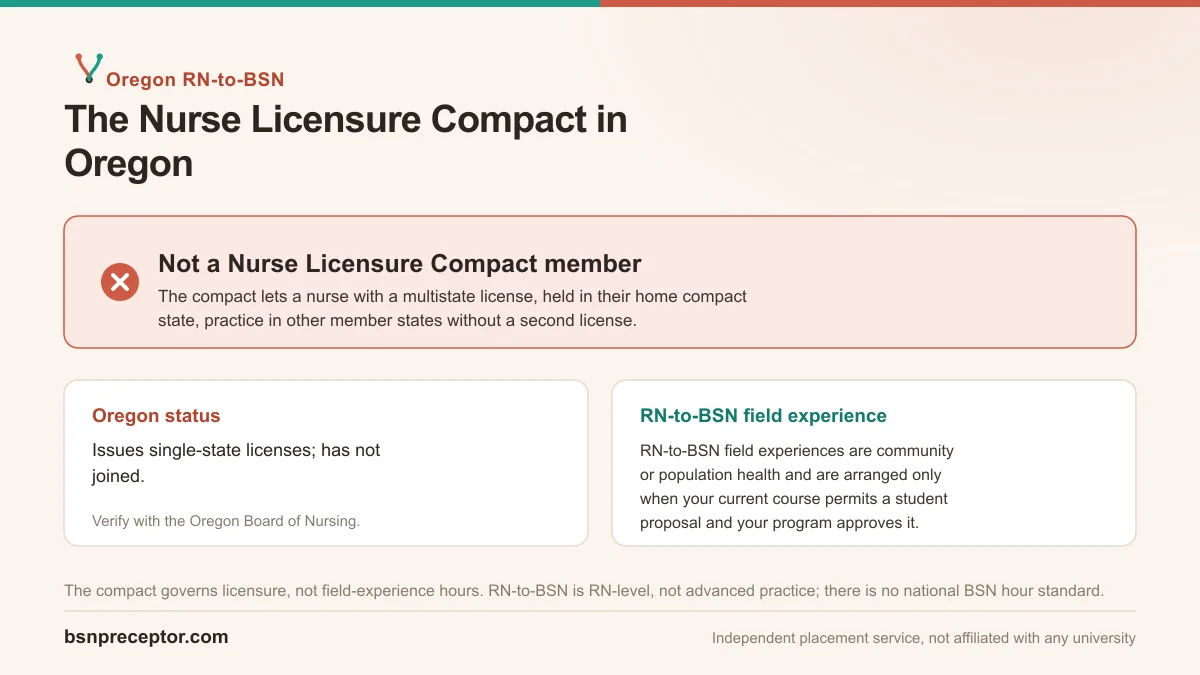
Oregon is one of the states that has not joined the Nurse Licensure Compact, so this is worth reading closely if you are an out-of-state online student. A multistate license from a compact state does not let you practice in Oregon; the state issues single-state licenses, and a nurse practicing here needs an Oregon license obtained by examination or by endorsement. Legislation to join the compact has been introduced but has not passed as of 2026.
For most RN-to-BSN students who already live and work in Oregon, this is simply the license you already hold. If you live in another state and your field experience site is in Oregon, or the reverse, confirm early with the Oregon State Board of Nursing whether you need an Oregon license, because endorsement takes weeks and a site will verify your license before your first day.
Placement is easiest along the Interstate 5 corridor. Portland, Salem, Eugene, and the suburbs of Washington and Clackamas counties hold most of the population and most of the formal public health infrastructure, so a student in the Willamette Valley usually has several possible sites within reach.
East of the Cascades and out on the coast, the picture is rural and in places frontier, where a single county health department and a home health agency may cover an enormous area. Bend and Medford anchor their regions, but if you are in eastern Oregon or a coastal county, tell us your town early so we start with the sites that are genuinely close, and lean on the community health worker and telehealth-friendly programs that rural Oregon has built.
A community or population health field experience is generally precepted by an experienced registered nurse or another appropriate professional in the setting, not a prescriber. In Oregon that is often a public health nurse in a county authority, a nurse in a coordinated care organization, a school-based health center nurse, or a community program lead. Your program decides who qualifies and what the preceptor must sign, so we match candidates against your school's written rules before anyone commits.
Because you are learning community and population health practice rather than doing direct prescriber work, the pool of people who can precept is wider than students expect, which helps a lot in the parts of Oregon where nurses are spread thin.
We are honest about who needs us. Prelicensure BSN students in Oregon are usually placed into their clinical rotations by their school, so most of them do not need a placement service. RN-to-BSN students are the opposite: the community field experience is yours to arrange, and that is our core work, along with the smaller group of accelerated or online prelicensure students whose programs ask them to help find a local site.
There is no national BSN hour requirement. Field experience totals are set by each program and commonly fall in the rough range of 30 to 120 hours, so read your syllabus and confirm your own number. Our RN-to-BSN field experience page walks through what these placements involve.
Tell us your city, your program, and your required hours, and we identify Oregon public health and community sites that fit, approach them for you, and stay with the affiliation agreement until it is signed. You keep the academic project. You can see the steps on the how it works page and our fees on the cost page.
Ready to start? Request a match at the top of this page or send your details through contact. It costs nothing to ask, we bill nothing until a match is confirmed and your program approves it, and we will tell you plainly if your program already arranges placement for you.
No. Oregon has not joined the Nurse Licensure Compact, so a multistate license from another state does not authorize practice here. You need an Oregon license by examination or endorsement. If you live and work in Oregon you likely already hold one; confirm anything unusual with the Oregon State Board of Nursing.
Common sites include county public health authorities, coordinated care organizations, school-based health centers, community and migrant health centers, and home health or hospice agencies. The right fit depends on your program's focus and your location. See RN-to-BSN field experience.
There is no national standard. Each program sets its own total, commonly in the rough range of 30 to 120 hours. Your syllabus is the authority, so confirm your number there and use our BSN clinical hours page for background.
Yes, though there are fewer sites, so early notice helps. We start with the county health department, home health, and school or community programs closest to you, and with the community health worker and telehealth-friendly options Oregon has built for rural areas. Tell us your town when you reach out.
Your program does. We match preceptors and sites against your school's written criteria and help with the paperwork, but final approval always rests with your faculty. We assist; we never guarantee that a given preceptor or site will be approved.
Outside sourcing applies only when the current program explicitly permits or requires a student-proposed preceptor, mentor, or site. An advisor reviews the course instructions before candidate sourcing begins.
We do not guarantee placement. Final approval rests with your program.
