Most Pennsylvania students we work with are licensed registered nurses finishing an RN-to-BSN, and the part they have to arrange themselves is a community or population health field experience with a qualified preceptor. Pennsylvania places that experience in an unusual public health structure, where a few county and municipal health departments cover the cities and state health centers cover much of the rest. We help you find an approvable site and preceptor; your program sets the hours and signs off.
Last updated July 2026
First, the honest split. Prelicensure BSN programs in Pennsylvania arrange clinical rotations for their students, so most of those students do not need us. RN-to-BSN students are asked to self-source a community or public health field experience, and often a preceptor to sign off, which is the work we do. We also help the smaller group of accelerated or online prelicensure students whose programs ask them to identify a local site.
There is no national hour count for the BSN. Community field experience totals are set by each program and commonly fall in the rough range of 30 to 120 hours, so treat any figure online as a starting point and confirm yours in your syllabus. Our BSN clinical hours page explains the variation.
Pennsylvania is dense at the corners and rural in the middle. Philadelphia and its collar counties in the southeast, Pittsburgh and the southwest, and the Lehigh Valley around Allentown and Bethlehem hold the most public health and health system infrastructure, so students there usually have several possible sites nearby. Erie, Harrisburg, Lancaster, Reading, York, Scranton, and Wilkes-Barre anchor their own regions.
The center and northern tier, often called the rural T, is a different problem. Counties there may be an hour or more from the nearest system with a formal student office, and a single home health or hospice agency can cover a large territory. If you live out there, tell us early so we work with sites that are realistically within reach rather than sending you across the state.
Pennsylvania's public health map is worth understanding, because it is not like most states. There are only seven county and four municipal health departments, and together they cover under half the population. Everyone else is served by the Pennsylvania Department of Health through 59 state health centers spread across the counties. Both kinds of office, plus a deep bench of community organizations, can host a field experience.
For a community or population health field experience, your preceptor is generally an experienced registered nurse or another appropriate professional in the setting, not a prescriber. In Pennsylvania that might be a public health nurse at a county health department or state health center, a certified school nurse, a nurse in a care coordination role, or a community program supervisor. Because the work is population health rather than direct prescriber practice, more people qualify than students expect.
Your program decides who counts and what the preceptor must sign, so we screen candidates against your school's written criteria before anyone commits. We assist with the match and the paperwork; we never guarantee that your school will approve a particular preceptor or site.
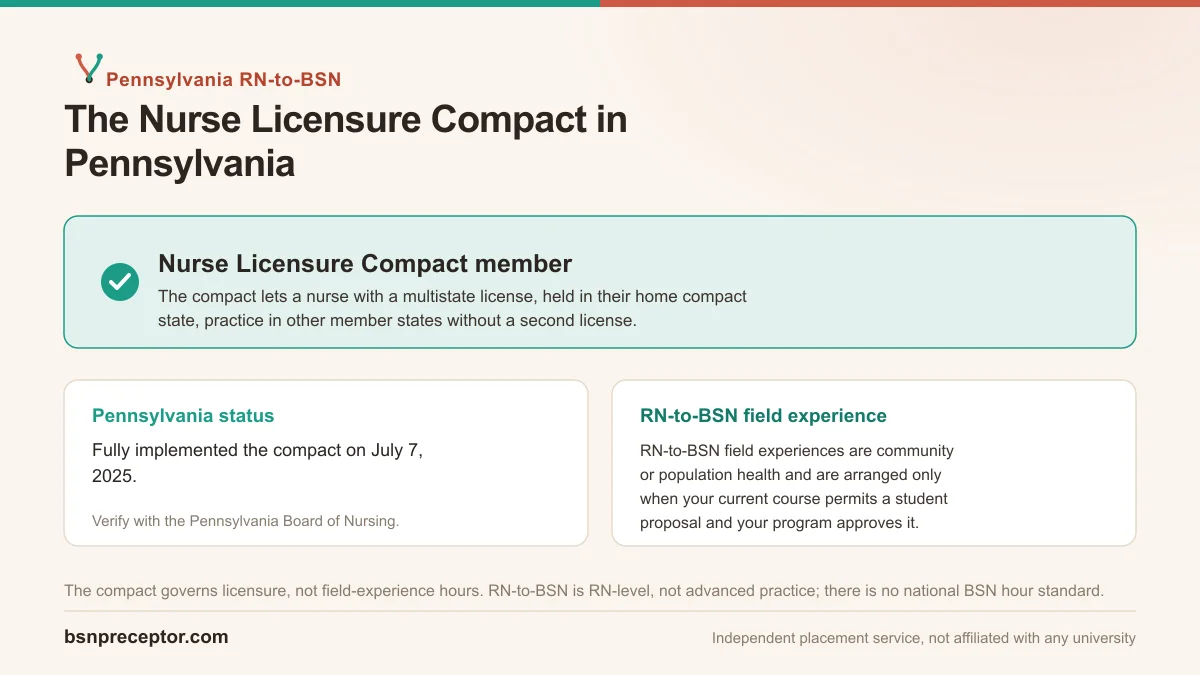
Pennsylvania fully implemented the Nurse Licensure Compact on July 7, 2025, which was a meaningful change for online RN-to-BSN students. A Pennsylvania resident who meets the requirements can now hold a multistate license and practice in other compact states, and nurses from other compact states can practice in Pennsylvania on their multistate license. Applications and renewals run through the state's online licensing system.
The Pennsylvania State Board of Nursing, within the Department of State, is the authority for your license status, renewal, and any multistate questions. Because a field experience site verifies your license before day one, check your renewal the week you register for the course, since a lapsed license is a common reason a start date slips.
Send us your city, your program, and your required hours, and we identify community and public health sites that fit, approach them for you, and stay with the affiliation agreement until it is countersigned. The academic project stays yours. You can see the full sequence on the how it works page and our fees on the cost page.
When you are ready, request a match at the top of this page or send details through contact. There is no cost to ask, nothing is billed until a match is confirmed and your program approves it, and we will tell you honestly if your program already handles placement.
Yes. Pennsylvania fully implemented the Nurse Licensure Compact on July 7, 2025, so nurses from other compact states can practice here on a multistate license, and Pennsylvania residents can apply for one. Confirm your own eligibility with the Pennsylvania State Board of Nursing.
That is common in Pennsylvania, where most counties are served by a state health center rather than a county health department. Those centers, along with home health, hospice, school, and community programs, can host a field experience. Tell us your town so we start with the closest options.
There is no national BSN standard. Each program sets its own total, commonly in the rough range of 30 to 120 hours. Your syllabus is the only authority, so confirm your number there and see our BSN clinical hours page.
In most programs, yes. A community or population health field experience is commonly precepted by an experienced registered nurse or an appropriate professional in the setting, such as a certified school nurse or a public health nurse. It does not have to be an advanced practice nurse. Your program sets the criteria.
Mainly we help RN-to-BSN students, because prelicensure programs usually arrange their own clinical rotations. We do help the smaller group of accelerated or online prelicensure students whose schools ask them to find a local site. See how it works.
Sources · Pennsylvania State Board of Nursing · Pennsylvania State Board of Nursing: Nurse Licensure Compact · NCSBN: Pennsylvania to Fully Implement the NLC July 7, 2025 · Pennsylvania Department of Health: County and Municipal Health Departments · Pennsylvania Department of Health: State Health Centers
Outside sourcing applies only when the current program explicitly permits or requires a student-proposed preceptor, mentor, or site. An advisor reviews the course instructions before candidate sourcing begins.
We do not guarantee placement. Final approval rests with your program.
