In Rhode Island, the BSN students we help are mostly working registered nurses finishing an RN-to-BSN, whose one self-sourced requirement is a community or population health field experience with a qualified preceptor. Because Rhode Island has no county government, that experience runs through a state-level health department and a tight network of community health centers rather than county health offices. We help you find an approvable site and preceptor; your program sets the hours and the final approval.
Last updated July 2026
Rhode Island is different from almost every other state in one way that matters here: it has no county government, so there are no county health departments. Public health is run at the state level by the Rhode Island Department of Health, and day-to-day community care leans heavily on the state's federally qualified health centers, which operate at more than 30 locations. That concentration actually makes sites easier to identify once you know where to look.
Rhode Island is compact enough that travel is rarely the obstacle it is elsewhere, but the communities are distinct. Providence and the urban core, along with Cranston, Warwick, and East Providence, hold most of the population and the densest network of clinics and programs. Pawtucket and Central Falls in the Blackstone Valley are dense and diverse, with strong community health center coverage.
Woonsocket to the north, the South County towns, Newport and Aquidneck Island, and Block Island each have their own smaller systems. Wherever you are, a site is usually a short drive, which is one of the few genuine advantages of doing a field experience in the smallest state. Tell us your city and we will start with the programs closest to you.
A community or population health field experience is generally precepted by an experienced registered nurse or another appropriate professional in the setting, not a prescriber. In Rhode Island that is often a nurse at a community health center, a public health nurse in a state program, a school nurse, or a community program supervisor. Your program decides who qualifies and what the preceptor must sign, so we match candidates against your school's written rules before anyone commits.
Because the work is population health rather than direct prescriber practice, more people can serve as a preceptor than students assume. We assist with the match and the paperwork; we never guarantee that your school will approve a given preceptor or site.
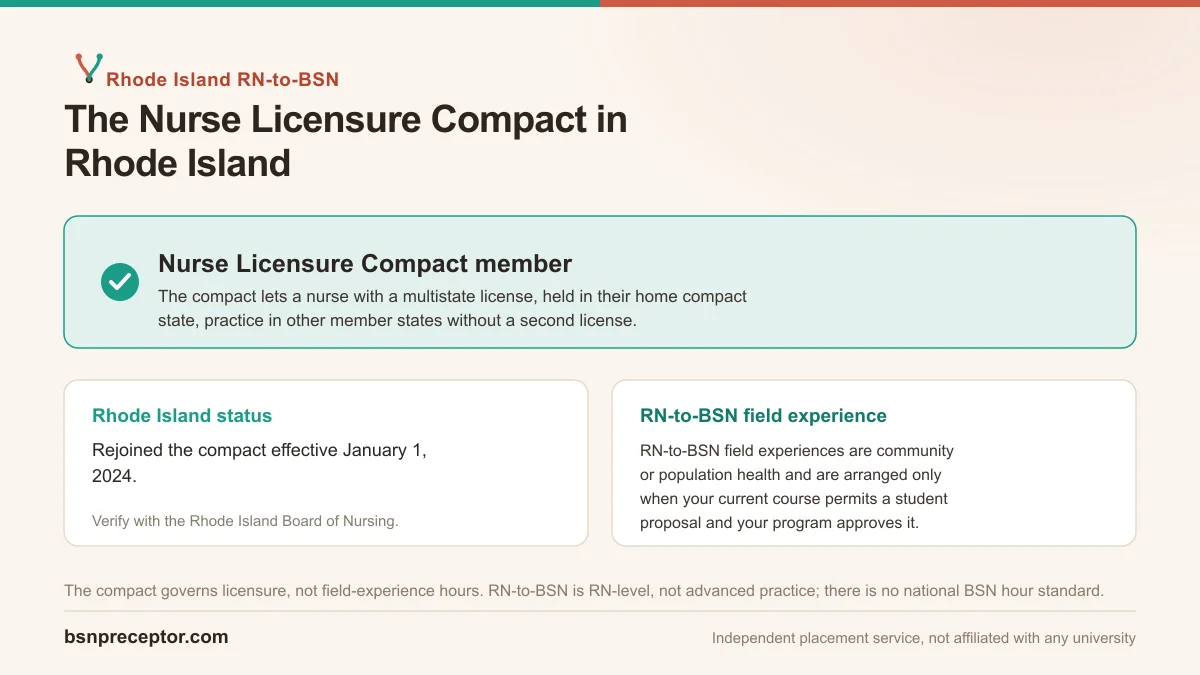
Rhode Island rejoined the Nurse Licensure Compact effective January 1, 2024. That means a Rhode Island resident who meets the requirements can hold a multistate license and practice in other compact states, and nurses from other compact states can practice in Rhode Island on their multistate license. For online RN-to-BSN students who cross state lines for work or school, that removes a common headache.
The Rhode Island Board of Nurse Registration and Nursing Education, which sits within the Department of Health, is the authority for your license status and renewal. A field experience site verifies your license before your first day, so confirm your renewal the week you register for the course rather than the week it starts.
We are honest about who needs a placement service. Prelicensure BSN students in Rhode Island are generally placed into clinical rotations by their school, so most of them do not need us. RN-to-BSN students are the ones who must self-source the community field experience, which is our core work, along with the smaller group of accelerated or online prelicensure students whose programs ask them to find a local site.
There is no national BSN hour requirement. Field experience totals are set by each program and commonly fall in the rough range of 30 to 120 hours, so confirm your own number in your syllabus. Our RN-to-BSN field experience page explains what these placements involve.
Tell us your city, your program, and your required hours, and we identify community and public health sites that fit, approach them for you, and stay with the affiliation agreement until it is signed. The academic work stays yours. You can see the steps on the how it works page and our fees on the cost page.
When you are ready, request a match at the top of this page or send your details through contact. It costs nothing to ask, we bill nothing until a match is confirmed and your program approves it, and we will tell you honestly if your program already places you.
Correct, there are no county health departments here. Public health is run by the state, and community care runs mostly through federally qualified health centers at more than 30 locations, plus home health, hospice, school, and non-profit programs. Any of these can host a field experience.
Yes. Rhode Island rejoined the Nurse Licensure Compact effective January 1, 2024, so nurses from other compact states can practice here on a multistate license, and residents can apply for one. Confirm your eligibility with the Rhode Island Board of Nurse Registration and Nursing Education.
There is no national BSN standard. Each program sets its own total, commonly in the rough range of 30 to 120 hours. Your syllabus is the only authority, so confirm your number there and see our BSN clinical hours page for context.
In most programs, yes. A community or population health field experience is commonly precepted by an experienced registered nurse or an appropriate professional in the setting, such as a community health center nurse or a public health nurse. It does not have to be an advanced practice nurse. Your program sets the criteria.
Often yes, and in a small state it is frequently the fastest route, since your employer already holds your license and health records. Confirm with faculty whether your unit and supervisor qualify, and keep field experience hours separate from paid shifts. Never log the same hour twice.
Outside sourcing applies only when the current program explicitly permits or requires a student-proposed preceptor, mentor, or site. An advisor reviews the course instructions before candidate sourcing begins.
We do not guarantee placement. Final approval rests with your program.
