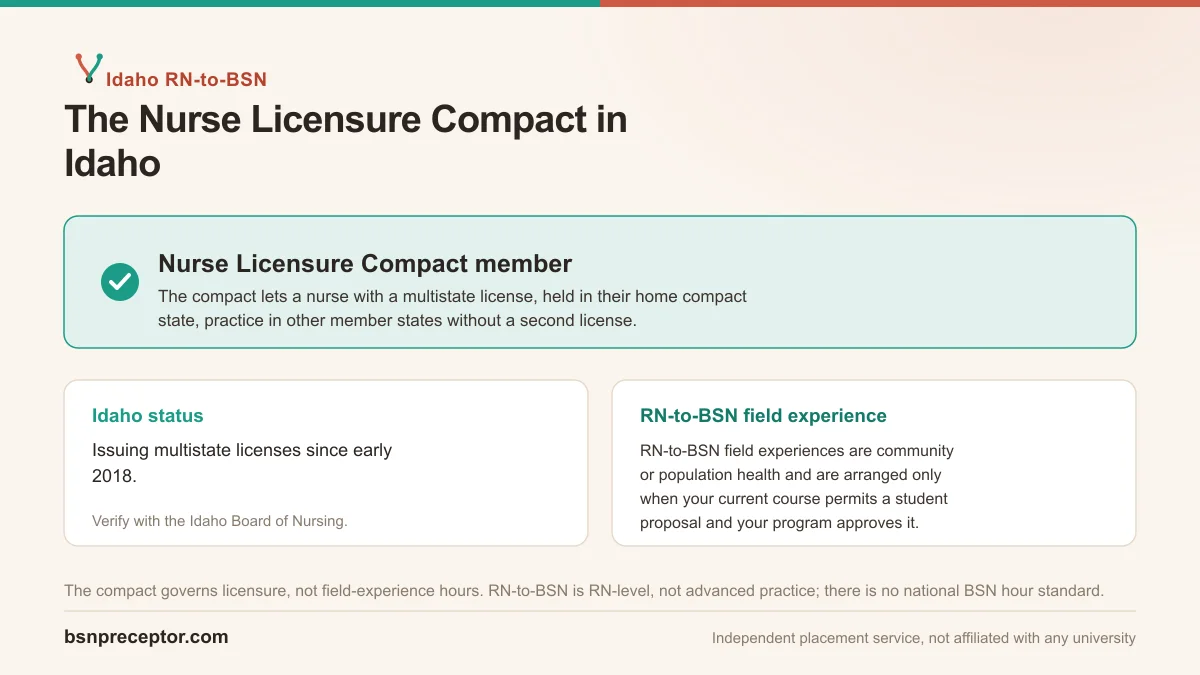
When a student's current baccalaureate nursing course explicitly permits or requires the student to propose a community field-experience site, preceptor, or mentor, we support Brigham Young University-Idaho students with candidate sourcing and documentation. Accreditation establishes the degree, not the course design or placement process.
Last updated July 2026
The compact record deliberately separates an accreditation fact from placement assumptions. Brigham Young University-Idaho is included because of its baccalaureate nursing accreditation evidence, not because the record proves prelicensure, RN-to-BSN, modality, hours, or student sourcing.
The directory basis is CCNE evidence, verified July 21, 2026, for baccalaureate nursing education at Brigham Young University-Idaho. Treat curriculum pathway, field work, hours, affiliation rules, placement responsibility, and candidate eligibility as separate facts that require current school sources.
The student's current program materials should answer the questions the accreditation listing cannot. Gather the catalog year, course instructions, degree audit, objectives, approved locations, mentor or preceptor criteria, site forms, affiliation language, and program contact before defining a search.
Traditional and accelerated prelicensure clinical placements are generally coordinated through the nursing program. If that is the student's pathway, use Brigham Young University-Idaho's clinical office rather than assuming an outside search is needed. Only written current permission to propose a person or site creates a role for independent sourcing.
A confirmed RN-to-BSN or other post-licensure course can use an applied community, population, quality, education, leadership, or care-coordination experience. The objective determines the setting and mentor. Accreditation alone does not show that Brigham Young University-Idaho offers such a pathway or asks students to propose placements.
The candidate screen should connect a real course objective to a suitable professional and organization. Depending on current program rules, that could involve community health, public health, school health, occupational health, home health, hospice, nonprofit work, quality, coordination, or population services. A title alone never establishes mentor or preceptor eligibility.
Do not estimate a student's requirement from the BSN label. There is no universal clinical or field-experience total, and required hours vary across states, programs, pathways, courses, and catalog years. Use Brigham Young University-Idaho's current documents and placement guidance to confirm both the amount and purpose of the experience.
A broad explanation is available in the BSN clinical hours guide, but the student's course documents control. Confirm pathway, experience type, placement ownership, setting, person, state, and forms before outreach.
The directory records Rexburg, Idaho as the institution location. It does not determine the student's eligible placement area or authorize a site. Ask Brigham Young University-Idaho to confirm state and setting boundaries, then evaluate a candidate for relevant work, credentials, availability, paperwork, and site participation.
Our Idaho BSN guide gives a state-level view of possible community and systems settings. The current program still decides whether the student's pathway, location, candidate, site, and documents are acceptable.
Before submission, organize the candidate's professional role, active credentials, relevant experience, site, availability, relationship to the student, and fit with each course objective. Attach current school forms rather than a generic template. The program may still need contracts, compliance materials, authorization checks, or other approvals.
Before a candidate is contacted, verify the pathway, course, applied purpose, required hours, term dates, location authorization, eligible setting, candidate role, credentials, affiliation process, compliance checklist, forms, and school deadline. Confirm explicitly that the student may propose a person or site.
The BSN placement workflow separates requirement review, permission confirmation, candidate sourcing, documentation, and school approval. After the current course permits a proposal, request a match to start an independent search.
BSNPreceptor works independently and works independently of Brigham Young University-Idaho. School names are used descriptively. A sourcing request creates no guarantee of a candidate, placement, approval, graduation, licensure, or another outcome.
It applies only when the student's current baccalaureate nursing course explicitly permits or requires the student to propose a community field-experience site, preceptor, or mentor. Brigham Young University-Idaho makes every approval decision.
No. The accreditation evidence establishes a baccalaureate nursing degree on the verification date. It does not prove prelicensure, accelerated, RN-to-BSN, modality, hours, field requirements, or placement policy.
There is no universal BSN clinical or field-experience total. Required hours vary by state, program, pathway, course, and catalog year. Confirm the current handbook, degree audit, course instructions, and placement office.
Traditional and accelerated prelicensure placements are generally program-coordinated. Use the school's current placement process. Outside sourcing is appropriate only if the program explicitly permits the student to propose a person or site for the current course.
No. BSNPreceptor is an independent service that works separately from Brigham Young University-Idaho. We source and document possible candidates only when program instructions permit it, and we do not guarantee placement or approval.
Sources · CCNE accredited program evidence · AACN The Essentials
Outside sourcing applies only when the current program explicitly permits or requires a student-proposed preceptor, mentor, or site. An advisor reviews the course instructions before candidate sourcing begins.
We do not guarantee placement. Final approval rests with your program.
