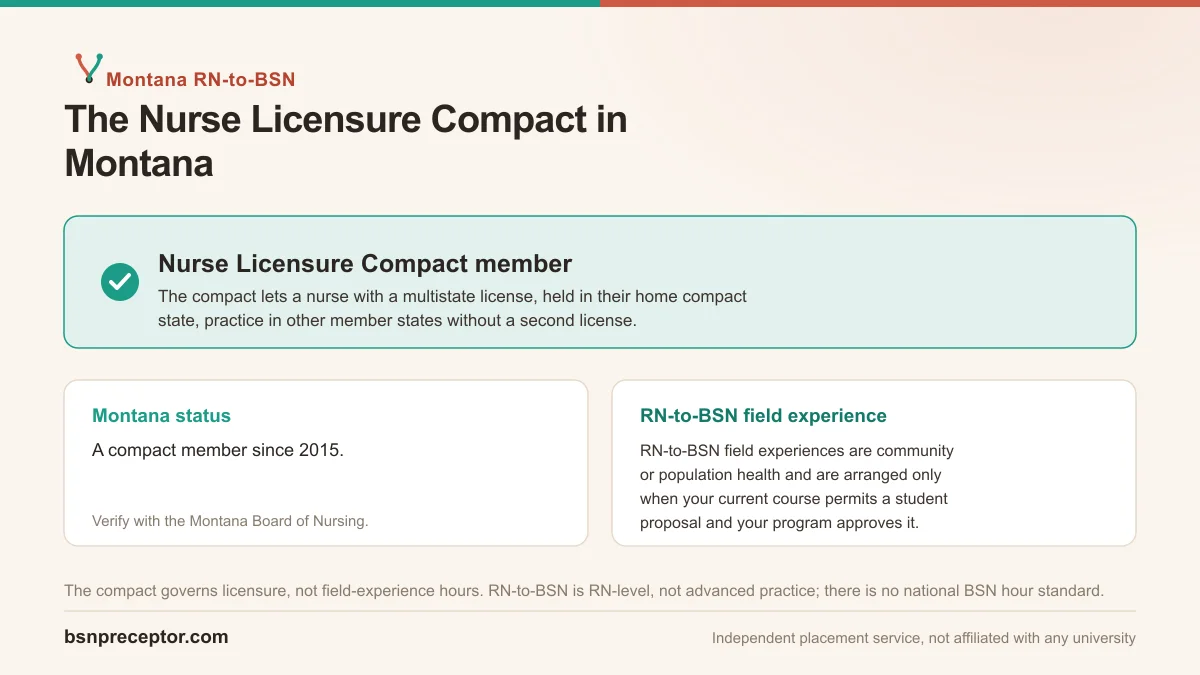
When a student's current baccalaureate nursing course explicitly permits or requires the student to propose a community field-experience site, preceptor, or mentor, Montana State University students may request independent candidate sourcing. Program review stays final, and directory inclusion proves no particular pathway or field requirement.
Last updated July 2026
The record answers one narrow question: why Montana State University belongs in this baccalaureate directory. Pathway, modality, clinical design, field-experience hours, placement ownership, and candidate qualifications require current official program materials.
The directory basis is CCNE evidence, verified July 21, 2026, for baccalaureate nursing education at Montana State University. Treat curriculum pathway, field work, hours, affiliation rules, placement responsibility, and candidate eligibility as separate facts that require current school sources.
Before outreach, identify the student's exact pathway and course, then collect the current catalog page, handbook section, degree audit, course objectives, placement forms, and contact instructions. Ask the program whether it coordinates the experience or explicitly permits the student to propose a person or site.
Prelicensure education typically relies on program-coordinated clinical rotations, affiliation agreements, faculty oversight, and approved sites. A student at Montana State University should follow the current placement instructions first. Independent sourcing should begin only when the program explicitly permits it for that student's course and location.
Post-licensure field work can differ sharply from prelicensure rotations. If the program verifies an RN-to-BSN or similar course and permits the student to propose a site, the experience may involve community, population, education, quality, leadership, or care-coordination objectives. No such offering is inferred here.
Site fit follows the confirmed course objective. Community clinics, public-health services, school or employee health, home health, hospice, nonprofit programs, care coordination, quality, and population-health teams can be considered when allowed. An experienced RN or another relevant professional may fit, but the school must approve the person's role and credentials.
The safe answer to the hours question is program confirmation. Required BSN hours vary by state, pathway, course, school, and catalog year, and the accreditation record provides no total. Have Montana State University identify the controlling handbook, current degree audit, and course instructions before planning any experience.
Read how BSN practice requirements vary, then verify the active course with Montana State University. Planning should begin only after the program confirms the amount, experience type, placement process, location, candidate role, setting, and forms.
Bozeman, Montana is the directory location for Montana State University; it is not a promise that a student can place there. The program must confirm permitted states and location restrictions. Geography is only one screen, alongside pathway, course objectives, setting fit, candidate credentials, site capacity, and affiliation terms.
Our Montana BSN guide gives a state-level view of possible community and systems settings. The current program still decides whether the student's pathway, location, candidate, site, and documents are acceptable.
Before submission, organize the candidate's professional role, active credentials, relevant experience, site, availability, relationship to the student, and fit with each course objective. Attach current school forms rather than a generic template. The program may still need contracts, compliance materials, authorization checks, or other approvals.
The student should be able to show the current course instructions, degree audit, confirmed requirement, objectives, approved state, acceptable setting, candidate criteria, placement process, affiliation information, compliance steps, forms, and deadline. Recheck anything remembered from an older term.
Independent support is most useful after the student turns the current handbook and course instructions into a precise request and verifies permission to propose. See how sourcing works, then use the request form with those details.
BSNPreceptor works independently of Montana State University and does not speak for its nursing program. Candidate sourcing is not school approval. We cannot guarantee availability, placement, affiliation completion, acceptance, course progression, or any other result.
It applies only when the student's current baccalaureate nursing course explicitly permits or requires the student to propose a community field-experience site, preceptor, or mentor. Montana State University makes every approval decision.
No. The accreditation evidence establishes a baccalaureate nursing degree on the verification date. It does not prove prelicensure, accelerated, RN-to-BSN, modality, hours, field requirements, or placement policy.
There is no universal BSN clinical or field-experience total. Required hours vary by state, program, pathway, course, and catalog year. Confirm the current handbook, degree audit, course instructions, and placement office.
Traditional and accelerated prelicensure placements are generally program-coordinated. Use the school's current placement process. Outside sourcing is appropriate only if the program explicitly permits the student to propose a person or site for the current course.
No. BSNPreceptor is an independent service that works separately from Montana State University. We source and document possible candidates only when program instructions permit it, and we do not guarantee placement or approval.
Sources · CCNE accredited program evidence · AACN The Essentials
Outside sourcing applies only when the current program explicitly permits or requires a student-proposed preceptor, mentor, or site. An advisor reviews the course instructions before candidate sourcing begins.
We do not guarantee placement. Final approval rests with your program.
