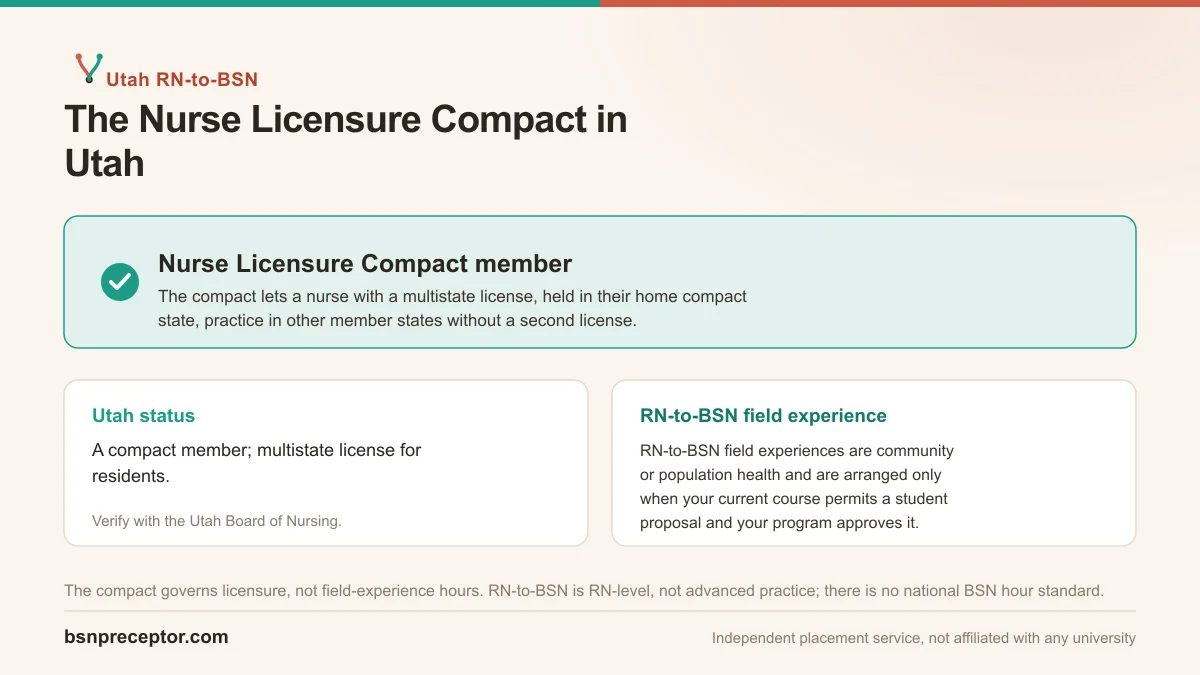
When a student's current baccalaureate nursing course explicitly permits or requires the student to propose a community field-experience site, preceptor, or mentor, we support Utah Tech University students with candidate sourcing and documentation. Accreditation establishes the degree, not the course design or placement process.
Last updated July 2026
Accreditation is the basis for listing Utah Tech University, but accreditation is not a course instruction. A student still needs the current catalog, degree audit, handbook, and placement materials to verify the pathway, field requirement, hours, location, and approval process.
Our July 21, 2026 roster check found Utah Tech University in ACEN accreditation evidence for baccalaureate nursing education. Accreditation supports inclusion here. It does not identify the student's pathway, course objectives, field setting, candidate credentials, location authorization, or sourcing responsibility.
Start with the documents controlling the student's actual term. Confirm pathway, course purpose, dates, approved geography, setting type, candidate credentials, affiliation requirements, compliance items, and submission forms. Older catalogs or another school's process are not reliable substitutes.
Program coordination is generally the rule for prelicensure clinical experiences. That protects course sequencing, site contracts, supervision, and regulatory oversight. Nothing in the accreditation record shows that Utah Tech University allows student proposals, so the student should confirm the current placement process before contacting any professional or organization.
An RN-to-BSN or other post-licensure field experience may apply baccalaureate competencies in a community, population, education, leadership, quality, or coordination setting. Use that framework only after Utah Tech University confirms the pathway, course, student proposal process, and current approval criteria.
Possible community and systems settings include clinics, public-health programs, schools, employee health, home health, hospice, nonprofits, quality teams, care coordination, and population-health services. The proposed person may be an experienced RN or another qualified professional. Current course rules, not this list, determine what is eligible.
Baccalaureate nursing practice requirements cannot be reduced to one reliable number. Hours vary with the state, program, pathway, course, and catalog year. Ask Utah Tech University to confirm the student's current requirement in writing, then use that answer rather than an online comparison or a figure from another school.
The BSN clinical hours guide explains why pathway and state matter without assigning an unsupported total to this institution. Once the program confirms the course requirement and placement ownership, planning can focus on the setting, person, objectives, location, and documents that actually need review.
Use St. George, Utah as directory context only. A student's actual planning area should come from current Utah Tech University guidance about authorized states, course location, site eligibility, and affiliation. Even inside an approved area, a willing person or organization is not automatically eligible.
The Utah BSN field-experience guide describes the wider planning landscape. Use it to understand possible settings, not to bypass the program's pathway, authorization, affiliation, credential, or approval requirements.
Before submission, organize the candidate's professional role, active credentials, relevant experience, site, availability, relationship to the student, and fit with each course objective. Attach current school forms rather than a generic template. The program may still need contracts, compliance materials, authorization checks, or other approvals.
Confirm these items before outreach: the exact baccalaureate pathway and course; whether the program coordinates placement or permits a student proposal; the approved requirement and dates; eligible state and setting; candidate credentials; course objectives; conflicts; affiliation and compliance process; school and site forms; and submission deadline.
If the confirmed course allows a student-proposed person or setting, send the pathway, objectives, dates, geography, role criteria, site criteria, and forms through the matching request. Our process guide explains how screening supports, but never replaces, program review.
BSNPreceptor works independently and works independently of Utah Tech University. School names are used descriptively. A sourcing request creates no guarantee of a candidate, placement, approval, graduation, licensure, or another outcome.
It applies only when the student's current baccalaureate nursing course explicitly permits or requires the student to propose a community field-experience site, preceptor, or mentor. Utah Tech University makes every approval decision.
No. The accreditation evidence establishes a baccalaureate nursing degree on the verification date. It does not prove prelicensure, accelerated, RN-to-BSN, modality, hours, field requirements, or placement policy.
There is no universal BSN clinical or field-experience total. Required hours vary by state, program, pathway, course, and catalog year. Confirm the current handbook, degree audit, course instructions, and placement office.
Traditional and accelerated prelicensure placements are generally program-coordinated. Use the school's current placement process. Outside sourcing is appropriate only if the program explicitly permits the student to propose a person or site for the current course.
No. BSNPreceptor is an independent service that works separately from Utah Tech University. We source and document possible candidates only when program instructions permit it, and we do not guarantee placement or approval.
Sources · ACEN accredited program evidence · AACN The Essentials
Outside sourcing applies only when the current program explicitly permits or requires a student-proposed preceptor, mentor, or site. An advisor reviews the course instructions before candidate sourcing begins.
We do not guarantee placement. Final approval rests with your program.
