In Vermont, the BSN community field experience usually happens in a health-district office, a community health center, a school, or a visiting-nurse home health and hospice agency, not on a hospital floor. We help already-licensed RN-to-BSN students, plus the smaller group of prelicensure students who must self-source, find a population-health site and an approvable preceptor. We are independent and never guarantee a placement or a school's approval of a site.
Last updated July 2026
The reflex when you hear preceptor is to picture a prescriber signing off on hospital rotations, and for the BSN that picture is usually wrong. Most prelicensure BSN students in Vermont have their clinical rotations arranged by their nursing school, so if your program assigns your sites, you are already covered.
We are built for the self-source path. That mainly means RN-to-BSN students, already-licensed nurses finishing the bachelor's, whose program asks them to arrange a community or population-health field experience and find a preceptor for it. It also includes the minority of prelicensure or accelerated students asked to help locate a local site. If your practicum or capstone course tells you to find your own placement, the rest of this page is for you.
An RN-to-BSN field experience is population-focused, so its home is community and public health, not a hospital unit. For a small state, Vermont has a well-developed community-health safety net to draw on.
The preceptor for this work is generally an experienced BSN-prepared RN or an appropriate professional in the setting, such as a public-health nurse or a community-program supervisor, not a prescriber. Your program sets the exact qualification bar, so confirm it before you reach out.
Vermont is one of the least populous states, and outside a few centers it is deeply rural. The Burlington area, including South Burlington, Winooski, and Essex, is the largest population center and holds the widest choice of sites. Rutland, the capital of Montpelier, Barre, Brattleboro, Bennington, and St. Albans anchor smaller regional hubs.
Because the population is small and spread out, a given community may have only one health-district office, one community health center, or one visiting nurse agency, so slots can be limited and several students may seek the same host. The upside is that Vermont's Blueprint for Health and its visiting nurse tradition mean community-health infrastructure reaches even small towns. Start early, be open about which district you can travel to, and a rural placement is very achievable.
For a BSN community field experience, the preceptor does not have to be a nurse practitioner or any kind of prescriber. Because the work is population-health and community focused, many programs accept an experienced RN, often BSN-prepared, a public-health nurse, or an appropriate professional who supervises the setting.
Programs usually ask for an active, unencumbered license where it applies, some years of relevant experience, and no family or direct-supervisory conflict with the student. Your school sets and enforces those rules, and it has final say over whether a preceptor is approved, so confirm the criteria before you approach anyone.
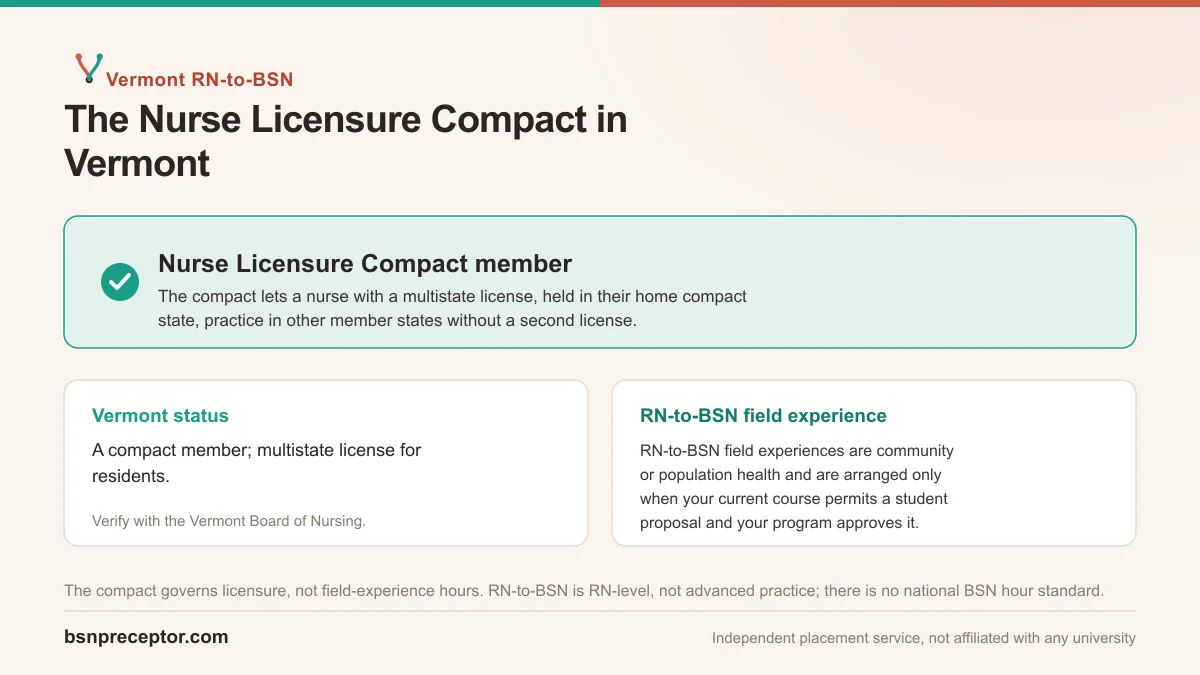
Vermont is a member of the Nurse Licensure Compact (NLC). If Vermont is your primary state of residence, you can hold a multistate RN license that lets you practice in Vermont and the other compact states without a separate license, which helps RN-to-BSN students who are working nurses enrolled in online programs based in another state.
In Vermont the Board of Nursing sits within the Secretary of State's Office of Professional Regulation, which issues and verifies your license. A field experience is an academic activity supervised through your program and does not change your license, but keep your RN license active and in good standing throughout. Compact and residency rules change over time, so confirm your own status with the board.
There is no national clinical-hour number for the BSN. The 2021 AACN Essentials are competency-based and set no required hour count for entry-level education, and accreditors ask for sufficient practice experiences without naming a figure. For RN-to-BSN community field experiences the requirement is usually modest and project-based, commonly somewhere in the range of about 30 to 120 hours, with some programs separating total hours from direct-contact hours. Confirm your own figure in your course catalog; see BSN clinical hours and RN-to-BSN field experience for how it is structured.
Our role is the finding-and-matching step: locating a community or public-health site and an approvable preceptor near you, then handing your program what it needs to review them. Final approval always rests with your school, and we never promise acceptance. There is no cost to ask, nothing is billed until a match is confirmed and your program approves it, and if we cannot find a fit you owe nothing. Start at #match or through contact, and see how it works.
It depends on your path. Prelicensure BSN students in Vermont usually have their clinical rotations arranged by their nursing school, so most do not self-source. RN-to-BSN students generally arrange their own community or population-health field experience and preceptor, then submit them for the program's approval. We help with that self-source step.
In community and public-health settings. Common hosts include the Department of Health district offices, federally qualified community health centers, Blueprint for Health community health teams, visiting nurse home health and hospice agencies, school health programs, and aging services. The Burlington area has the most options; rural districts take more lead time but are very workable.
Yes. Vermont is a member of the Nurse Licensure Compact, so an RN whose primary state of residence is Vermont can hold a multistate license and practice in other compact states. The Vermont Board of Nursing, within the Secretary of State's Office of Professional Regulation, issues and verifies licenses. Confirm current compact and residency rules with the board.
No. For a BSN community field experience the preceptor is commonly an experienced RN, often BSN-prepared, a public-health nurse, or an appropriate professional in the setting, not a prescriber. Requirements vary by program, so confirm the qualifications your school will accept before you approach a potential preceptor. Your program has final say.
There is no national BSN hour standard. RN-to-BSN community field experiences are set by each program and commonly fall somewhere around 30 to 120 hours, sometimes split between total and direct-contact hours. Confirm the exact figure in your own course catalog before you plan rather than relying on a single number you find online.
Outside sourcing applies only when the current program explicitly permits or requires a student-proposed preceptor, mentor, or site. An advisor reviews the course instructions before candidate sourcing begins.
We do not guarantee placement. Final approval rests with your program.
