For an RN-to-BSN in Washington, the bachelor's capstone is usually a community or population-health field experience you arrange on your own, not another shift on a hospital floor. Washington runs a strong public-health system on both sides of the Cascades, so approvable sites exist whether you live in the Puget Sound cities or the farm towns of the east. We help you find a site and a preceptor and get your program to sign off.
Last updated July 2026
In Washington, prelicensure nursing students almost always have their clinical rotations arranged by their school, so most of them do not need a placement service. The students we help are RN-to-BSN nurses, already licensed and working, whose program asks them to locate a community or population-health field experience and a preceptor to sign the hours.
We also help the smaller number of accelerated or online-hybrid prelicensure students who are told to find their own local sites. Either way the goal is the same, an approvable site and a preceptor your school will accept. See what the field experience involves.
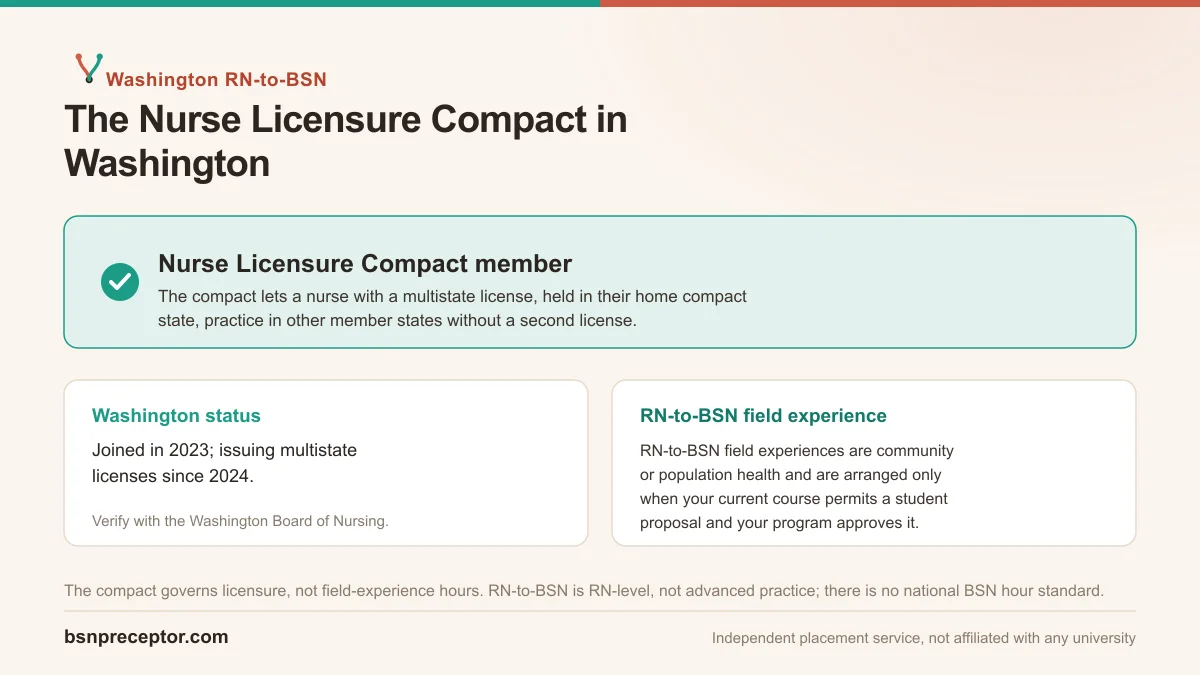
This is newer in Washington than in most states. Washington joined the Nurse Licensure Compact in 2023, and the state began issuing multistate registered-nurse licenses in early 2024. If Washington is your primary residence, you can now hold a multistate license that lets you practice here and in the other compact states without a separate license in each.
That change matters for RN-to-BSN students, who are usually working nurses and are often enrolled in online programs based elsewhere. Licensing is handled by the Washington State Board of Nursing, the agency formerly known as the Nursing Care Quality Assurance Commission. Compact and residency rules can change, so confirm your status with the board.
Washington delivers public health through about 35 local health jurisdictions, a mix of county health departments, multi-county health districts, and two city-county agencies, serving all 39 counties and working alongside tribal governments. Those jurisdictions run the kind of population-health programs a capstone can attach to.
Geography splits the state. West of the Cascades, the Puget Sound corridor from Seattle and Bellevue through Tacoma and Everett is dense with health systems, community clinics, and public agencies, and is usually the easiest place to secure a formal site. East of the mountains, Spokane anchors the northeast while the Yakima Valley and the Tri-Cities carry large agricultural communities, migrant and seasonal farmworker health needs, and community health centers that lean heavily on public-health nursing. Vancouver in the southwest sits inside the Portland metro. Rural and tribal communities across the state add school health, home health, and hospice settings.
Your preceptor for a community or population-health experience is generally an experienced BSN-prepared registered nurse or an appropriate professional in the setting, such as a public-health nurse, a clinic supervisor, or a nurse in a care-coordination role. It does not have to be an advanced-practice nurse, since the work centers on population health, prevention, and coordination.
Programs differ on the exact credentials and forms they require, so a preceptor has to satisfy both the site and your school. We check that alignment before we make an introduction, which saves you from lining up a preceptor your program will not approve.
The BSN has no national clinical-hour requirement. National nursing competencies are written around skills rather than a set number of hours, so your community field-experience total is set by your own program and commonly falls in the range of roughly 30 to 120 hours.
Treat any general figure with caution and rely on your syllabus. Read how BSN clinical hours work, then confirm your exact requirement with your program.
Give us your program, your city, and the setting you have in mind, and we look for an approvable site and a preceptor who will sign your hours, on either side of the Cascades. Asking costs nothing, we do not bill until a match is confirmed and your school signs off, and we will say so honestly if your program already arranges your placement.
Look over how it works and our cost, then start through the match form or the contact page. We help with placement and never guarantee it, and your program always has the final say.
Yes. Washington joined the Nurse Licensure Compact in 2023 and began issuing multistate registered-nurse licenses in early 2024. If Washington is your primary residence you may qualify for a multistate license. Confirm your status with the Washington State Board of Nursing.
In most programs, yes. RN-to-BSN students usually self-source a community or population-health experience and a preceptor. Prelicensure students are the exception, since their schools generally arrange rotations for them.
Common sites east of the Cascades include county health departments, community and migrant health centers in the Yakima Valley and Tri-Cities, tribal health programs, and home health or hospice agencies. Spokane adds larger health systems and clinics.
Usually an experienced registered nurse or a public-health professional, such as a public-health nurse or a community-program supervisor. It does not have to be an advanced-practice nurse, but the person must still meet your program's rules.
There is no national or statewide number. Programs set their own totals, commonly in the range of roughly 30 to 120 hours. Confirm the exact figure with your school.
Outside sourcing applies only when the current program explicitly permits or requires a student-proposed preceptor, mentor, or site. An advisor reviews the course instructions before candidate sourcing begins.
We do not guarantee placement. Final approval rests with your program.
