If you are finishing an RN-to-BSN in West Virginia, the capstone is usually a community or population-health field experience you arrange yourself, not another hospital rotation. West Virginia is one of the most rural states in the country, and its public-health and community-clinic network reaches into nearly every county, which is exactly where these placements live. We help you find an approvable site and a preceptor and get your program to sign off.
Last updated July 2026
West Virginia BSN requirements split by path. Prelicensure students, working toward a first license, generally have their rotations arranged by the school. The students we serve are RN-to-BSN nurses finishing the bachelor's, whose program asks them to self-source a community or population-health field experience and a preceptor to sign the hours.
We also help the smaller group of accelerated or online-hybrid prelicensure students who are asked to identify their own sites. You can read how the field experience works before you start.
West Virginia is the only state that sits entirely within Appalachia, and more than half of its residents live in rural areas. Public health runs through county health departments in all 55 counties, coordinated by the state Bureau for Public Health, and that county network is often the natural home for a population-health project.
Community health centers are unusually important here. The state carries a dense network of federally qualified and community health centers, hundreds of clinic sites in total, including a large number of school-based health centers that bring care straight into schools. Charleston in the Kanawha Valley, Huntington on the Ohio River, and the university town of Morgantown are the larger hubs. Wheeling and the northern panhandle, Martinsburg and the eastern panhandle, Parkersburg, Beckley, and Clarksburg round out the map. Across the coalfield and mountain counties, home health and hospice agencies do much of the front-line work for an aging, spread-out population.
For a community or population-health experience, your preceptor is generally an experienced BSN-prepared registered nurse or another appropriate professional in the setting, such as a public-health nurse, a clinic or program supervisor, or a nurse in a care-coordination role. It does not have to be an advanced-practice nurse.
Because your program sets its own rules on preceptor credentials and paperwork, the person who signs your hours has to satisfy both the site and your school. We screen for that fit before we make an introduction, so you are not left with a preceptor your program will not accept.
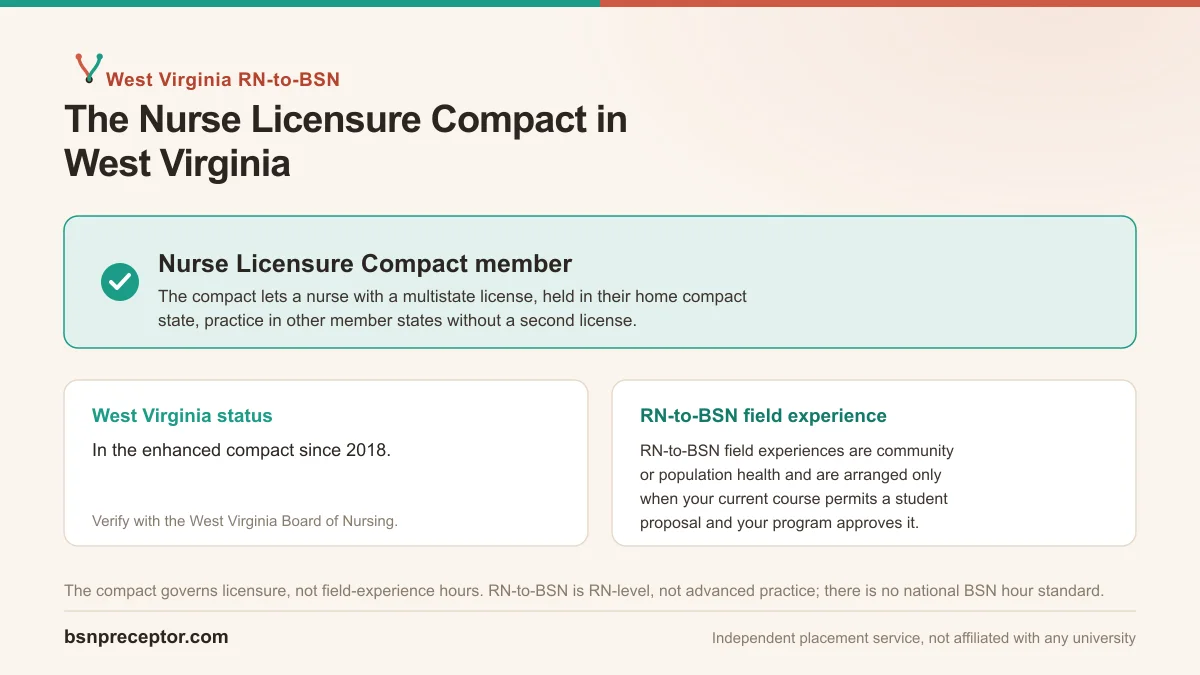
West Virginia is a member of the Nurse Licensure Compact and has taken part in the enhanced compact since 2018. If West Virginia is your primary residence, you can hold a multistate registered-nurse license that lets you practice here and across the other compact states. That is a practical help for working RNs enrolled in out-of-state online programs, which describes many RN-to-BSN students.
Licensing sits with the state RN board, known today as the West Virginia RN Board after a recent renaming. Compact and residency rules can change, so confirm your own standing with the board before you build a placement around it.
There is no national clinical-hour count for the BSN. The current national competencies are built around skills rather than a fixed number of hours, so your community field-experience total is set by your program, usually somewhere in the range of roughly 30 to 120 hours.
Because that range is wide, the only number that matters is the one in your syllabus. See how BSN clinical hours work, then confirm the exact figure with your program.
Send us your program, your county, and the kind of setting you are after, and we go find an approvable site and a preceptor who will sign your hours, whether you are near Charleston or out in the coalfields. There is no charge to ask, we do not bill until a match is confirmed and your school signs off, and we will tell you honestly if your program already arranges placement.
Review how it works and our cost, then reach us through the match form or the contact page. We assist with placement and never guarantee it, and your program holds final approval.
Usually yes. RN-to-BSN programs typically ask you to self-source a community or population-health experience and a preceptor, then submit the site for approval. Prelicensure students generally have rotations arranged by their school.
County health departments reach all 55 counties, and West Virginia has a dense network of community and school-based health centers. Home health and hospice agencies are common placement sites across the coalfield and mountain counties.
Yes. West Virginia belongs to the enhanced Nurse Licensure Compact, so a resident can hold a multistate registered-nurse license. Confirm your eligibility with the West Virginia RN Board.
Usually an experienced registered nurse or a public-health professional, such as a public-health nurse or a program supervisor. It does not have to be an advanced-practice nurse, though the person must still meet your program's rules.
There is no national or statewide standard. Programs set their own totals, commonly in the range of roughly 30 to 120 hours. Confirm the exact number with your school before planning your site.
Outside sourcing applies only when the current program explicitly permits or requires a student-proposed preceptor, mentor, or site. An advisor reviews the course instructions before candidate sourcing begins.
We do not guarantee placement. Final approval rests with your program.
