For an RN-to-BSN in Wisconsin, the bachelor's capstone is usually a community or population-health field experience you set up yourself, not another hospital rotation. Wisconsin runs one of the most locally controlled public-health systems in the country, with dozens of city, county, and tribal health departments, which gives you a lot of doors to knock on. We help you find an approvable site and a preceptor and get your program to sign off.
Last updated July 2026
Wisconsin BSN requirements depend on your path. Prelicensure students usually have their rotations arranged by the school and rarely need outside help. Our work is with RN-to-BSN students, already-licensed nurses finishing the degree, whose program asks them to self-source a community or population-health field experience and a preceptor to sign the hours.
We also help the smaller number of accelerated or online-hybrid prelicensure students asked to find their own sites. Start with how the field experience works to see what typically counts.
Wisconsin runs a decentralized public-health system, with something like 84 local health departments plus a dozen tribal health departments, most of them agencies of a county but some serving a single city, village, or town. The state Department of Health Services supports them through regional offices in Green Bay, Rhinelander, Milwaukee, Madison, and Eau Claire. For you, that patchwork means many possible homes for a population-health project.
The geography runs from the dense southeast to the rural north and west. Milwaukee is the largest city and carries its own city health department alongside heavy community-clinic activity. Madison anchors the south-central region, Green Bay and the Fox Valley cities of Appleton and Oshkosh anchor the northeast, and Kenosha and Racine sit along the southern lakefront. The Driftless Area in the southwest, the dairy country of the central and northern counties, and the ports of La Crosse and Superior are more rural, where community health centers, migrant health programs, and home health agencies do much of the work.
For a community or population-health experience, your preceptor is generally an experienced BSN-prepared registered nurse or an appropriate professional in the setting, such as a public-health nurse, a health-department supervisor, or a nurse in a care-coordination role. It does not have to be an advanced-practice nurse, because the focus is population health and prevention rather than diagnosis and treatment.
Each program keeps its own rules on preceptor credentials and forms, so the person signing your hours has to satisfy the site and your school at once. We check for that before we make an introduction, so you are not building around a preceptor your program will later reject.
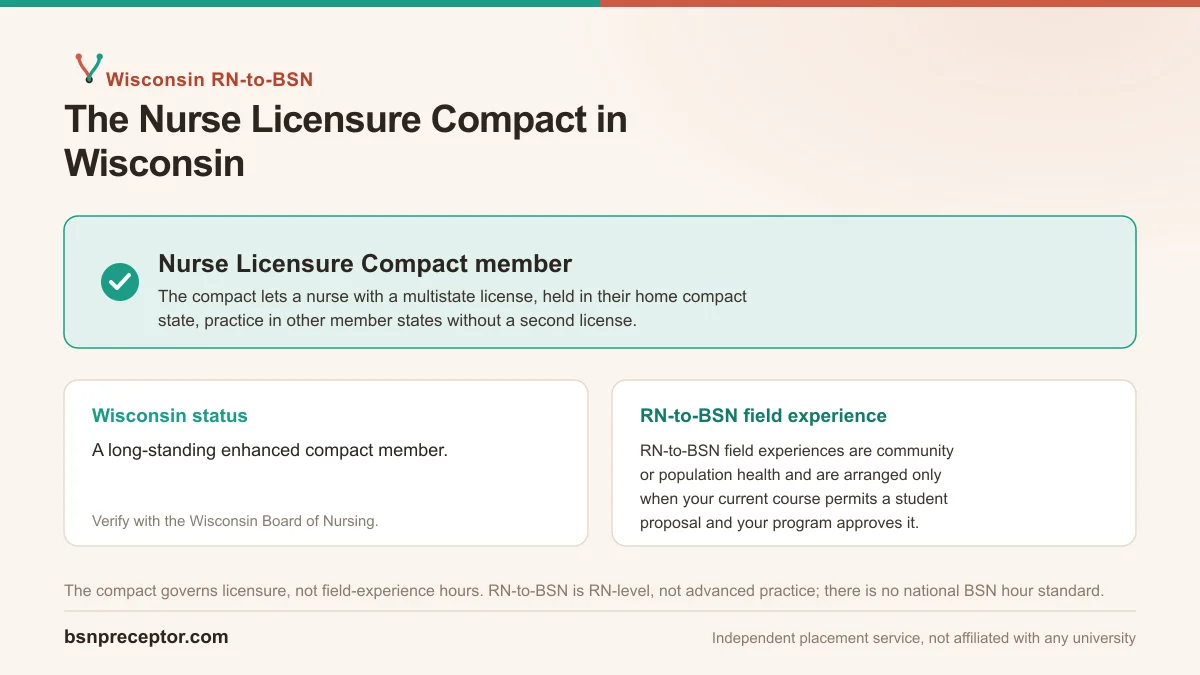
Wisconsin is a long-standing member of the Nurse Licensure Compact and took part in the enhanced compact when it took effect. If Wisconsin is your primary residence, you can hold a multistate registered-nurse license good in Wisconsin and the other compact states. That helps the many RN-to-BSN students who work as nurses while enrolled in programs based in another state.
Licensing is handled by the Wisconsin Board of Nursing, which operates within the state Department of Safety and Professional Services. Compact and residency rules can change, so confirm your own status with the board before you rely on it for a placement.
The BSN has no national clinical-hour requirement. National competencies describe skills rather than a set number of hours, so your community field-experience total is set by your program and usually falls in the range of roughly 30 to 120 hours.
Since the range is broad, trust your syllabus over any general figure. Read how BSN clinical hours work, then confirm the exact requirement with your program.
Tell us your program, your city or county, and the setting you want, and we look for an approvable site and a preceptor who will sign your hours, from Milwaukee to the northern counties. It costs nothing to ask, we do not bill until a match is confirmed and your school signs off, and we will be straight with you if your program already handles placement.
See how it works and our cost, then start through the match form or the contact page. We help with placement and never guarantee it, and final approval rests with your program.
Usually yes. RN-to-BSN programs typically ask you to self-source a community or population-health experience and a preceptor, then submit the site for approval. Prelicensure students generally have rotations arranged by their school.
Wisconsin runs a decentralized system with dozens of city, county, and tribal health departments, plus community health centers, school health, and home health agencies. That range gives students many possible homes for a population-health project.
Yes. Wisconsin is a member of the enhanced Nurse Licensure Compact, so a resident can hold a multistate registered-nurse license. Confirm your eligibility with the Wisconsin Board of Nursing.
Usually an experienced registered nurse or a public-health professional, such as a public-health nurse or a health-department supervisor. It does not have to be an advanced-practice nurse, but the person must meet your program's rules.
There is no national or statewide standard. Programs set their own totals, commonly in the range of roughly 30 to 120 hours. Confirm the exact figure with your school.
Outside sourcing applies only when the current program explicitly permits or requires a student-proposed preceptor, mentor, or site. An advisor reviews the course instructions before candidate sourcing begins.
We do not guarantee placement. Final approval rests with your program.
