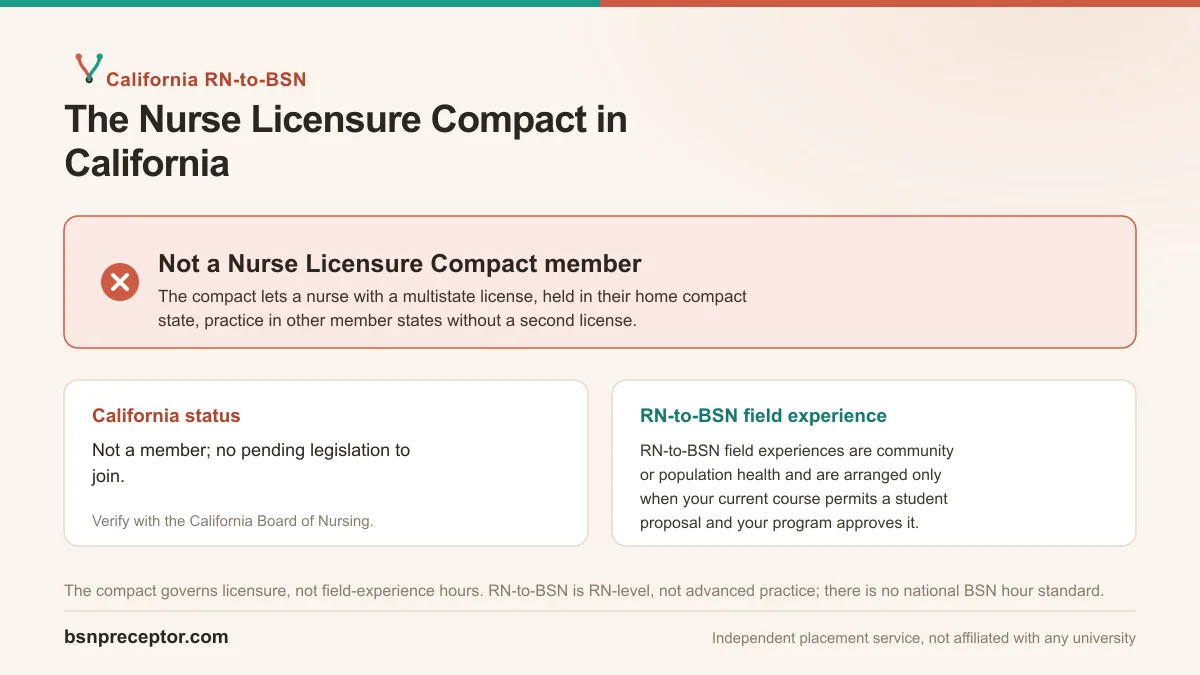
When a student's current baccalaureate nursing course explicitly permits or requires the student to propose a community field-experience site, preceptor, or mentor, we can help students at San Francisco State University prepare an approval-ready proposal. The program remains the authority and no school policy is inferred from accreditation.
Last updated July 2026
The record answers one narrow question: why San Francisco State University belongs in this baccalaureate directory. Pathway, modality, clinical design, field-experience hours, placement ownership, and candidate qualifications require current official program materials.
The accreditation fact for San Francisco State University comes from CCNE and was verified on July 21, 2026. Its scope is degree accreditation. The source does not prove a particular pathway, course format, field requirement, student proposal process, review timeline, or candidate standard.
Before outreach, identify the student's exact pathway and course, then collect the current catalog page, handbook section, degree audit, course objectives, placement forms, and contact instructions. Ask the program whether it coordinates the experience or explicitly permits the student to propose a person or site.
Prelicensure education typically relies on program-coordinated clinical rotations, affiliation agreements, faculty oversight, and approved sites. A student at San Francisco State University should follow the current placement instructions first. Independent sourcing should begin only when the program explicitly permits it for that student's course and location.
Post-licensure field work can differ sharply from prelicensure rotations. If the program verifies an RN-to-BSN or similar course and permits the student to propose a site, the experience may involve community, population, education, quality, leadership, or care-coordination objectives. No such offering is inferred here.
Site fit follows the confirmed course objective. Community clinics, public-health services, school or employee health, home health, hospice, nonprofit programs, care coordination, quality, and population-health teams can be considered when allowed. An experienced RN or another relevant professional may fit, but the school must approve the person's role and credentials.
There is no universal BSN clinical or field-experience total across schools and pathways. Required hours vary by state, program, pathway, course, and catalog year. Do not use a number from another institution, an older handbook, or a different pathway as San Francisco State University's requirement. Confirm the current handbook, degree audit, course instructions, and placement office.
The BSN hours guide can help a student ask better questions about pathway and course structure. It cannot calculate a San Francisco State University requirement or establish that a student proposal is allowed. Those answers belong to the current program.
Use San Francisco, California as directory context only. A student's actual planning area should come from current San Francisco State University guidance about authorized states, course location, site eligibility, and affiliation. Even inside an approved area, a willing person or organization is not automatically eligible.
The California BSN field-experience guide describes the wider planning landscape. Use it to understand possible settings, not to bypass the program's pathway, authorization, affiliation, credential, or approval requirements.
Candidate willingness is only the beginning. An approval packet should explain the role, credentials, setting, relevant work, supervision, availability, course alignment, and paperwork status. The program can then apply its current site, affiliation, compliance, conflict, and candidate rules.
A complete planning brief names the student's actual pathway and course and records the approved experience, requirement, dates, location, setting, person, credentials, objectives, proposal permission, forms, conflicts, affiliation steps, compliance items, and submission sequence.
The BSN placement workflow separates requirement review, permission confirmation, candidate sourcing, documentation, and school approval. After the current course permits a proposal, request a match to start an independent search.
This is independent support, not a service operated, approved, or endorsed by San Francisco State University. We have no authority to accept a person or site and cannot promise that a suitable candidate will be available or that a proposal will pass program and site review.
It applies only when the student's current baccalaureate nursing course explicitly permits or requires the student to propose a community field-experience site, preceptor, or mentor. San Francisco State University makes every approval decision.
No. The accreditation evidence establishes a baccalaureate nursing degree on the verification date. It does not prove prelicensure, accelerated, RN-to-BSN, modality, hours, field requirements, or placement policy.
There is no universal BSN clinical or field-experience total. Required hours vary by state, program, pathway, course, and catalog year. Confirm the current handbook, degree audit, course instructions, and placement office.
Traditional and accelerated prelicensure placements are generally program-coordinated. Use the school's current placement process. Outside sourcing is appropriate only if the program explicitly permits the student to propose a person or site for the current course.
No. BSNPreceptor is an independent service that works separately from San Francisco State University. We source and document possible candidates only when program instructions permit it, and we do not guarantee placement or approval.
Sources · CCNE accredited program evidence · AACN The Essentials
Outside sourcing applies only when the current program explicitly permits or requires a student-proposed preceptor, mentor, or site. An advisor reviews the course instructions before candidate sourcing begins.
We do not guarantee placement. Final approval rests with your program.
