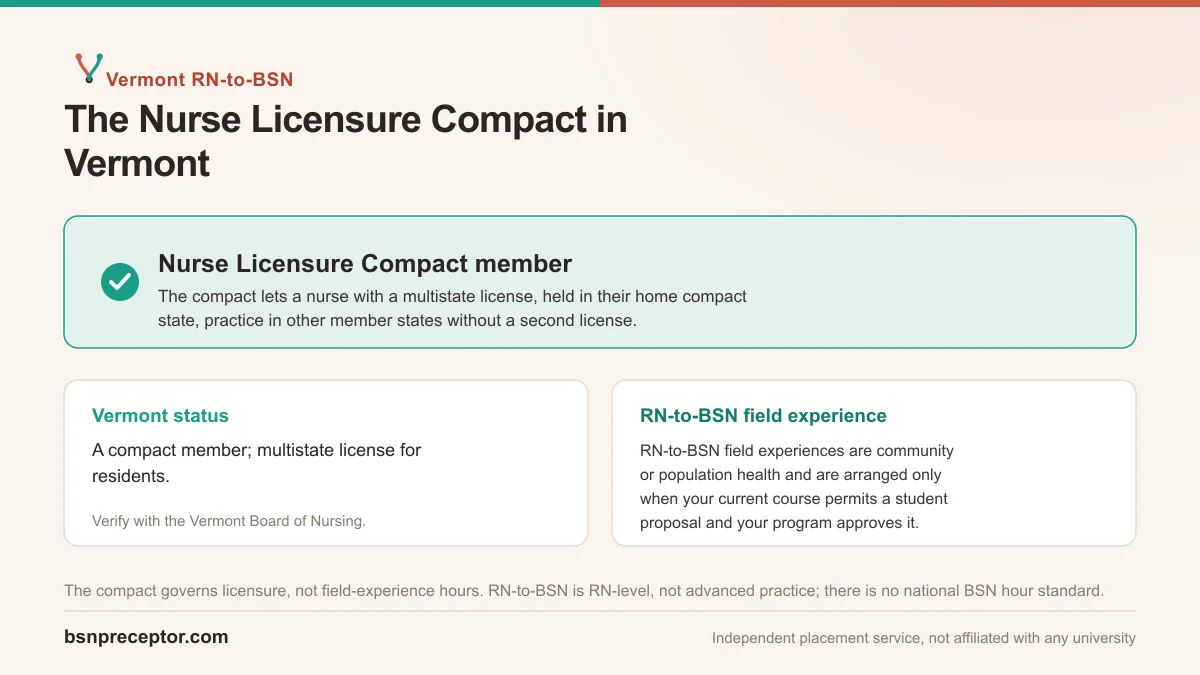
When a student's current baccalaureate nursing course explicitly permits or requires the student to propose a community field-experience site, preceptor, or mentor, we support Vermont State University (formerly Vermont Technical College) students with candidate sourcing and documentation. Accreditation establishes the degree, not the course design or placement process.
Last updated July 2026
The record answers one narrow question: why Vermont State University (formerly Vermont Technical College) belongs in this baccalaureate directory. Pathway, modality, clinical design, field-experience hours, placement ownership, and candidate qualifications require current official program materials.
As of the July 21, 2026 review, NLN CNEA records supported an accredited baccalaureate nursing degree at Vermont State University (formerly Vermont Technical College). That is useful but limited evidence. It cannot be used to infer prelicensure, RN-to-BSN, modality, clinical hours, placement assistance, or approval criteria.
A useful request begins with a current requirement packet. Confirm the pathway, course objective, placement ownership, eligible setting, location, candidate qualifications, compliance steps, affiliation process, and approval deadline. If the program has not authorized a student proposal, outside sourcing should not begin.
For a confirmed prelicensure pathway, the normal starting point is the program's coordinated clinical-placement process. Students should not bypass assigned rotations or contact sites independently unless Vermont State University (formerly Vermont Technical College) expressly authorizes a student proposal for the current course. The baccalaureate accreditation listing proves no exception to that general practice.
If the current program confirms a post-licensure or RN-to-BSN pathway and a student-proposed field experience, the work may focus on community health, population health, education, leadership, quality, care coordination, or another applied objective. This conditional example does not claim that Vermont State University (formerly Vermont Technical College) offers that pathway or requires outside placement.
Site fit follows the confirmed course objective. Community clinics, public-health services, school or employee health, home health, hospice, nonprofit programs, care coordination, quality, and population-health teams can be considered when allowed. An experienced RN or another relevant professional may fit, but the school must approve the person's role and credentials.
The safe answer to the hours question is program confirmation. Required BSN hours vary by state, pathway, course, school, and catalog year, and the accreditation record provides no total. Have Vermont State University (formerly Vermont Technical College) identify the controlling handbook, current degree audit, and course instructions before planning any experience.
A broad explanation is available in the BSN clinical hours guide, but the student's course documents control. Confirm pathway, experience type, placement ownership, setting, person, state, and forms before outreach.
Use Inge Smith Luce, MSN/ED, RN-C, Paramedic, CEN, Vermont as directory context only. A student's actual planning area should come from current Vermont State University (formerly Vermont Technical College) guidance about authorized states, course location, site eligibility, and affiliation. Even inside an approved area, a willing person or organization is not automatically eligible.
For broader setting context, review the BSN field-experience guide for Vermont. It can help identify community and systems setting categories, while the student's current program remains the authority on whether a proposal is allowed and what is eligible.
Before submission, organize the candidate's professional role, active credentials, relevant experience, site, availability, relationship to the student, and fit with each course objective. Attach current school forms rather than a generic template. The program may still need contracts, compliance materials, authorization checks, or other approvals.
A practical readiness checklist includes the active catalog year, degree audit, course number, pathway, objective, confirmed requirement, dates, approved geography, setting category, candidate qualifications, placement ownership, affiliation needs, compliance items, required forms, and review deadline. Mark every unresolved item for program confirmation.
Independent support is most useful after the student turns the current handbook and course instructions into a precise request and verifies permission to propose. See how sourcing works, then use the request form with those details.
BSNPreceptor works independently of Vermont State University (formerly Vermont Technical College) and does not speak for its nursing program. Candidate sourcing is not school approval. We cannot guarantee availability, placement, affiliation completion, acceptance, course progression, or any other result.
It applies only when the student's current baccalaureate nursing course explicitly permits or requires the student to propose a community field-experience site, preceptor, or mentor. Vermont State University (formerly Vermont Technical College) makes every approval decision.
No. The accreditation evidence establishes a baccalaureate nursing degree on the verification date. It does not prove prelicensure, accelerated, RN-to-BSN, modality, hours, field requirements, or placement policy.
There is no universal BSN clinical or field-experience total. Required hours vary by state, program, pathway, course, and catalog year. Confirm the current handbook, degree audit, course instructions, and placement office.
Traditional and accelerated prelicensure placements are generally program-coordinated. Use the school's current placement process. Outside sourcing is appropriate only if the program explicitly permits the student to propose a person or site for the current course.
No. BSNPreceptor is an independent service that works separately from Vermont State University (formerly Vermont Technical College). We source and document possible candidates only when program instructions permit it, and we do not guarantee placement or approval.
Outside sourcing applies only when the current program explicitly permits or requires a student-proposed preceptor, mentor, or site. An advisor reviews the course instructions before candidate sourcing begins.
We do not guarantee placement. Final approval rests with your program.
