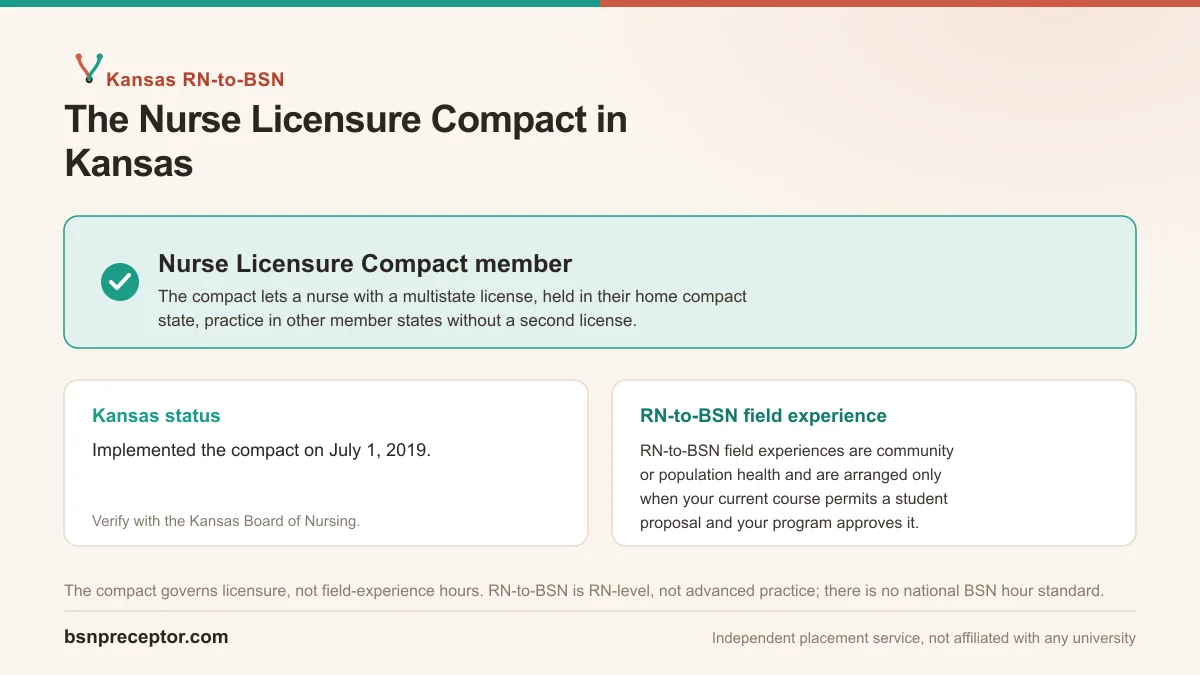
When a student's current baccalaureate nursing course explicitly permits or requires the student to propose a community field-experience site, preceptor, or mentor, our role is to source and document a possible match for Washburn University review. The accreditation record does not identify pathway, modality, hours, or placement responsibility.
Last updated July 2026
Use this snapshot as an identity and evidence check, not as a handbook. The accreditor record supports a baccalaureate nursing degree at Washburn University; it cannot answer which pathways are active, how courses are delivered, whether field work applies, or who coordinates placement.
As of the July 21, 2026 review, CCNE records supported an accredited baccalaureate nursing degree at Washburn University. That is useful but limited evidence. It cannot be used to infer prelicensure, RN-to-BSN, modality, clinical hours, placement assistance, or approval criteria.
The student's current program materials should answer the questions the accreditation listing cannot. Gather the catalog year, course instructions, degree audit, objectives, approved locations, mentor or preceptor criteria, site forms, affiliation language, and program contact before defining a search.
If the student's confirmed pathway leads to initial RN licensure, the program generally coordinates clinical experiences. Begin with Washburn University's assigned-placement process. An external search is suitable only when the current course documents explicitly allow the student to propose a site or preceptor for program review.
An RN-to-BSN or other post-licensure field experience may apply baccalaureate competencies in a community, population, education, leadership, quality, or coordination setting. Use that framework only after Washburn University confirms the pathway, course, student proposal process, and current approval criteria.
The candidate screen should connect a real course objective to a suitable professional and organization. Depending on current program rules, that could involve community health, public health, school health, occupational health, home health, hospice, nonprofit work, quality, coordination, or population services. A title alone never establishes mentor or preceptor eligibility.
Do not estimate a student's requirement from the BSN label. There is no universal clinical or field-experience total, and required hours vary across states, programs, pathways, courses, and catalog years. Use Washburn University's current documents and placement guidance to confirm both the amount and purpose of the experience.
A broad explanation is available in the BSN clinical hours guide, but the student's course documents control. Confirm pathway, experience type, placement ownership, setting, person, state, and forms before outreach.
A school location and a field-experience location are separate facts. Although Washburn University is listed in Topeka, Kansas, the student should verify state authorization, course geography, licensure considerations, and affiliation requirements before outreach. The person and organization must also support the confirmed objectives.
For broader setting context, review the BSN field-experience guide for Kansas. It can help identify community and systems setting categories, while the student's current program remains the authority on whether a proposal is allowed and what is eligible.
A complete proposal connects the current course to a specific person and setting. Document credentials, role, experience, site, availability, supervision, and willingness to complete school paperwork. This preparation helps Washburn University review the request but cannot replace its affiliation, compliance, authorization, or approval process.
The student should be able to show the current course instructions, degree audit, confirmed requirement, objectives, approved state, acceptable setting, candidate criteria, placement process, affiliation information, compliance steps, forms, and deadline. Recheck anything remembered from an older term.
Once the current requirements and permission to propose are clear, our placement process uses them to identify and screen a possible person or site. We share candidate information for program review rather than presenting a match as approved. A request can begin at the matching form.
BSNPreceptor works independently and works independently of Washburn University. School names are used descriptively. A sourcing request creates no guarantee of a candidate, placement, approval, graduation, licensure, or another outcome.
It applies only when the student's current baccalaureate nursing course explicitly permits or requires the student to propose a community field-experience site, preceptor, or mentor. Washburn University makes every approval decision.
No. The accreditation evidence establishes a baccalaureate nursing degree on the verification date. It does not prove prelicensure, accelerated, RN-to-BSN, modality, hours, field requirements, or placement policy.
There is no universal BSN clinical or field-experience total. Required hours vary by state, program, pathway, course, and catalog year. Confirm the current handbook, degree audit, course instructions, and placement office.
Traditional and accelerated prelicensure placements are generally program-coordinated. Use the school's current placement process. Outside sourcing is appropriate only if the program explicitly permits the student to propose a person or site for the current course.
No. BSNPreceptor is an independent service that works separately from Washburn University. We source and document possible candidates only when program instructions permit it, and we do not guarantee placement or approval.
Sources · CCNE accredited program evidence · AACN The Essentials
Outside sourcing applies only when the current program explicitly permits or requires a student-proposed preceptor, mentor, or site. An advisor reviews the course instructions before candidate sourcing begins.
We do not guarantee placement. Final approval rests with your program.
